


Most expats assume that getting a mortgage approved in Germany comes down to one thing: how much they earn. It feels logical. You have a good job, a stable income, maybe even savings sitting in the bank, so why wouldn't a lender say yes?
The problem is that German banks don't just look at the borrower. They also look very closely at the property itself, because the property is the collateral behind the loan. This is where loan to value Germany becomes one of the most important numbers in the entire application, and it's a number that many buyers only hear about after they've already made an offer.
The German term for this is "Beleihungsauslauf", and once you understand it, a lot of confusing mortgage decisions start to make sense. Banks in Germany don't automatically use the purchase price you agreed with the seller. Instead, they calculate their own internal value for the property, and your loan is measured against that number, not only against what you're actually paying.
That difference matters more than most buyers expect. A higher "Beleihungsauslauf" can mean you need a bigger down payment, your mortgage approval becomes harder to secure, your interest rate can shift, full financing becomes riskier for the bank to accept, and in some cases a low internal valuation opens up a financing gap that has to be closed before the deal can move forward.
This article walks through what loan to value really means for a mortgage in Germany, how banks calculate it, why their number often doesn't match the purchase price, and what you can do about it. The same principles matter whether you're comparing a home loan Germany option or preparing a wider German mortgage application.
You can also read more about how mortgage approval works in Germany.
Finance for Expats - Quick Answer
How does loan to value work in Germany?
In Germany, loan to value is closely linked to the "Beleihungsauslauf". It compares the mortgage loan amount with the value the bank accepts for the property. A lower "Beleihungsauslauf" usually means lower risk for the lender, while a higher "Beleihungsauslauf" can require more down payment, stronger income or higher mortgage rates.
Table of contents
- What does loan to value mean in Germany?
- What is "Beleihungsauslauf"?
- How to calculate "Beleihungsauslauf" and loan to value
- What is "Beleihungswert"?
- "Beleihungswert", "Verkehrswert" and "Kaufpreis"
- How loan to value affects mortgage approval
- How loan to value affects mortgage rates
- Why high loan to value can make full financing harder
- How much down payment do expats need?
- What if the bank valuation is lower than expected?
- Owner occupied homes vs investment property
- How to improve your loan to value
- Loan to value checklist before making an offer
- FAQs about loan to value and "Beleihungsauslauf"
What does loan to value mean in Germany?
Loan to value is a simple idea with a fairly big impact. It compares how much you're borrowing against how much the property is actually worth, at least in the eyes of the lender. This loan to value ratio is usually shortened to LTV, which is how you'll often see it referenced in financing conversations.
In a German context, the number that lenders actually work with is the "Beleihungsauslauf". It's the German financing world's version of LTV, and it plays the same role: telling the bank how exposed it would be if things went wrong.
This is the part that surprises a lot of first-time buyers. A German mortgage isn't approved purely on the strength of "can this person pay it back?" The bank is also asking a quieter second question: if this loan ever had to be recovered through the property, is the property good enough security for that?
That question is where loan to value Germany comes in, and it runs through the entire mortgage in Germany process from the first valuation to the final offer.
What is "Beleihungsauslauf"?
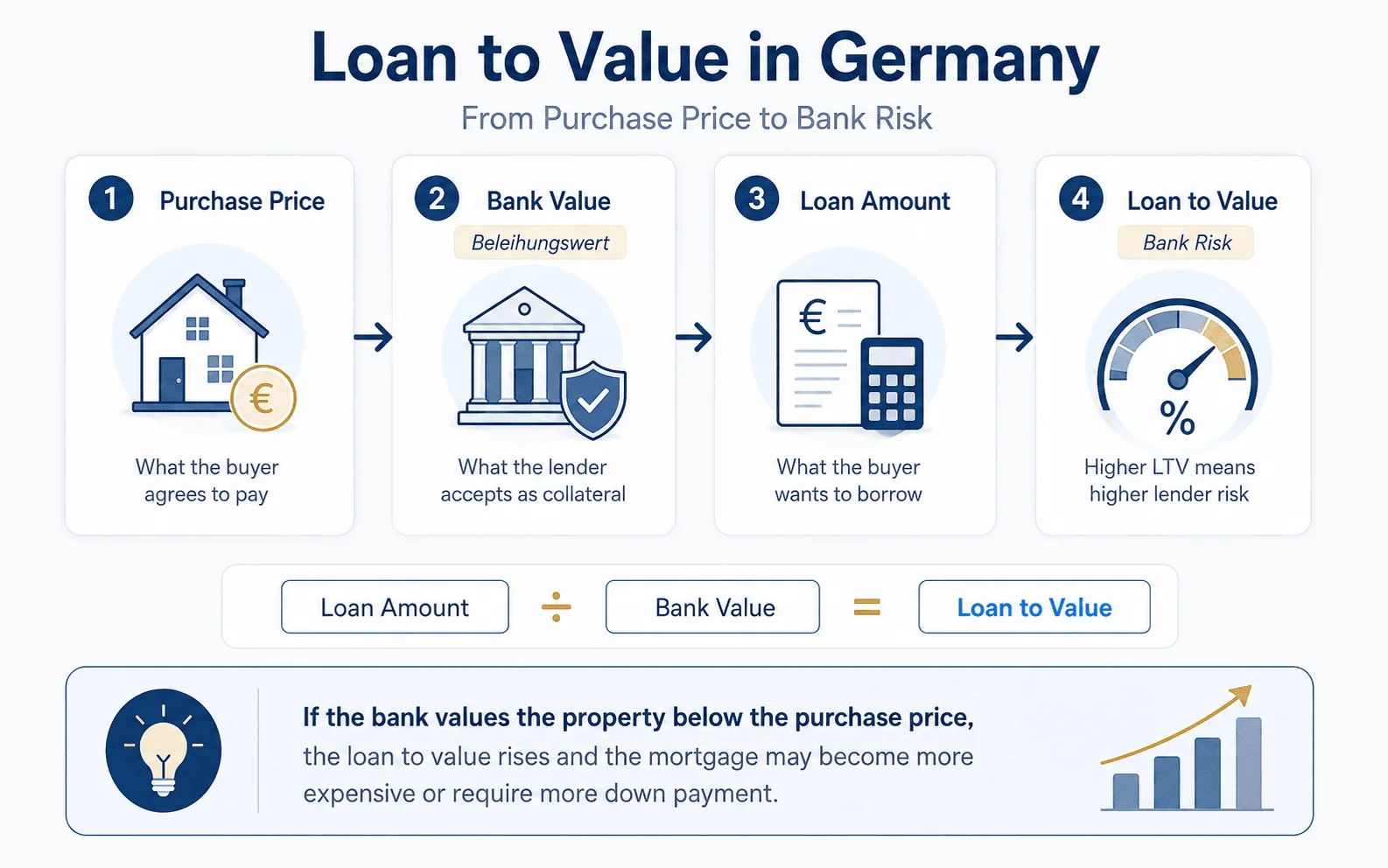
"Beleihungsauslauf" is the ratio between your "Darlehenssumme" (the loan amount) and the value the lender is willing to accept for the property. It's essentially a risk metric, a way for the bank to measure exposure before it commits to lending you money.
This is worth understanding before you make an offer on a property, not after. Two buyers with identical salaries and nearly identical financial profiles can walk away with very different mortgage approval outcomes and different financing conditions simply because their loan to value ratios aren't the same.
The amount of "Eigenkapital" or "Eigenmittel" you contribute also matters because more own funds usually reduce the "Darlehenssumme" and therefore the "Beleihungsauslauf".
"Beleihungsauslauf" tends to matter most in a handful of situations:
- when the buyer doesn't have much "Eigenkapital" or "Eigenmittel"
- when the agreed price sits above what the bank is willing to value the property at
- when the buyer is aiming for 90 percent, 100 percent or even 110 percent financing
- when mortgage rates are already elevated
- when the condition of the property itself is uncertain or hard to assess
If any of these apply to your situation, it's worth getting familiar with how to "Beleihungsauslauf berechnen" before you're locked into a purchase agreement. The same principle can materially affect a home loan Germany application even when the borrower side of the case looks strong.
How to calculate "Beleihungsauslauf" and loan to value
The formula behind this is refreshingly simple, at least on paper. The LTV formula is:
Loan amount / accepted property value x 100 = loan to value
The same logic is used for an LTV calculation or when trying to "Beleihungsauslauf berechnen".
The tricky part is what counts as the "accepted property value." In German financing, that's not automatically the purchase price. It's usually the "Beleihungswert", or another internal figure the bank lands on after its own assessment.
This is why trying to "Beleihungswert berechnen" yourself can only ever provide an estimate: the final lender assessment can still differ.
Here's a quick example to make this concrete:
- Purchase price: EUR 500,000
- Bank value: EUR 480,000
- Loan amount: EUR 400,000
If you calculate loan to value based on the purchase price, you get 80 percent:
EUR 400,000 / EUR 500,000 x 100 = 80%
But if you calculate it based on the bank's own value, you land closer to 83 percent:
EUR 400,000 / EUR 480,000 x 100 = 83.3%
It doesn't sound like a huge gap on paper, but that gap can be the difference between a smooth approval and a lender asking for more documentation, more down payment or a different financing structure altogether.
This is exactly why buyers sometimes walk into a mortgage conversation feeling confident, thinking their financing looks safe, when the bank sees something a little more cautious.
Finance for Expats Tool
Calculate Your Mortgage and Repayment Scenario
Before you get too far into negotiations, a mortgage calculator Germany tool can help you test different loan amounts, interest rates and repayment assumptions. Our German mortgage calculator can show how changes to the financing structure affect the monthly payment.
- Test different loan amounts
- Compare interest-rate assumptions
- Change the repayment rate
- See the effect on your monthly mortgage payment
Calculate your mortgage scenario
The calculator provides orientation only and does not replace an individual mortgage assessment.
What is "Beleihungswert" and why is it not always the purchase price?
"Beleihungswert" is the value the bank uses specifically for lending security. You can think of it as the lender's security-focused or lending value for the property. It's a conservative figure, and it's often lower than what you'd see quoted as the market price, and sometimes lower than the purchase price you and the seller agreed on.
There are several reasons this happens. Banks tend to value properties cautiously by design, and that caution gets compounded by factors like the physical condition of the property, risks tied to the specific location, buyers overpaying in a competitive market, an asking price that was never realistic to begin with, upcoming renovation needs, or the property simply being a type that's harder to resell quickly if the bank ever had to.
The "Beleihungswertermittlung" is therefore not the same thing as simply looking at the advertised price. The bank's property valuation and bank valuation focus on how much security the property can realistically provide over time.
This also explains why a "Beleihungswert Immobilie" figure can be lower than the purchase price. Depending on the bank and the financing structure, the resulting value can also interact with an internal "Beleihungsgrenze", meaning the lender may only be willing to treat part of the assessed property value as comfortably financeable security.
At its core, the bank isn't asking what you're willing to pay for the property. It's asking what the property could realistically support as collateral if things went sideways. That's a fundamentally different question, and it's one worth sitting with before you commit to a price.
If you want the fuller picture on this topic, there's a separate breakdown on why bank value can differ from the purchase price.
"Beleihungswert", "Verkehrswert" and "Kaufpreis": what is the difference?
These three terms all sound like variations of "property value," which is exactly why so many expats mix them up.
"Kaufpreis" is simply the price you and the seller agreed on. It's the number on the contract.
"Verkehrswert", sometimes called "Marktwert", is the estimated market value of the property, closer to what an independent appraiser might say the property is genuinely worth on the open market.
"Beleihungswert" is different from both of those. It's the conservative, security-focused value the lender uses internally, and it's usually the most cautious of the three numbers.
The distinction between "Beleihungswert" and "Verkehrswert" matters because one is primarily lender-focused and the other is closer to a market-value concept. The bank's own valuation can therefore matter more for your mortgage approval than your own emotional read on the place, or even the seller's asking price.
It's worth keeping "Kaufpreis", "Marktwert", "Verkehrswert" and "Beleihungswert" straight, because a lot of confusion during financing comes from buyers assuming they're all roughly interchangeable.
How does loan to value affect mortgage approval in Germany?
German banks tend to assess a mortgage application from two separate angles: the borrower and the property.
On the borrower side, they're looking at:
- income
- employment situation
- residence permit status
- general affordability
- credit history
On the property side, they're looking at:
- property value
- condition
- location
- how usable the property is as collateral
- the "Beleihungsauslauf"
In a typical German mortgage, the property acts as security for the financing, usually supported legally through a "Grundschuld". That makes the property valuation an important part of the overall mortgage approval decision.
Here's the part that catches people off guard: even a genuinely strong income doesn't automatically solve a weak loan to value position. If the property's accepted value is too low, or the loan amount is too high relative to that value, income alone doesn't fully offset the risk from the bank's perspective.
Generally speaking, a lower LTV makes a mortgage in Germany application look safer on paper. A higher LTV tends to invite more questions, more documentation requests and stricter conditions from the lender. The same applies when comparing a home loan Germany case across different banks.
If you want to know exactly what banks are checking on the borrower side, there's a detailed guide on what documents banks check for mortgage approval.
How does loan to value affect mortgage rates Germany?
Loan to value doesn't just affect whether you get approved. It can also influence how your loan gets priced.
The general principle across mortgage rates Germany is straightforward: a lower LTV usually represents less risk for the bank, while a higher LTV can come with a higher interest rate or more restrictive terms attached to it.
The same basic logic applies across German mortgage rates and wider mortgage interest rates Germany comparisons. A low LTV can make the financing case look more secure, while a high LTV can increase the lender's risk assessment.
It's worth being cautious here though, because lenders price risk differently, and there's no single fixed LTV interest rate or threshold that applies across every bank. The home loan interest rate in Germany is influenced by several factors, including the borrower profile, property, fixed rate period and overall financing structure.
A few things tend to hold true regardless of lender. More own funds in the deal generally improves your financing conditions. A loan that's large relative to the property's accepted value increases risk from the lender's side. And when interest rates are already high, affordability becomes more sensitive to every other variable in the equation.
Because of all this, it's worth comparing offers based on the full financing structure rather than fixating on the headline mortgage rate Germany alone.
For a broader look at where rates currently stand, see this breakdown of current mortgage rates Germany.
Why high loan to value can make full financing harder
It helps to separate three different financing scenarios that often get lumped together: financing part of the purchase price, financing the entire purchase price, and financing the purchase price plus the "Kaufnebenkosten" (the additional buying costs).
"100 Prozent Finanzierung" typically refers to financing the full purchase price itself. "110 Prozent Finanzierung" usually goes a step further and implies covering the purchase price plus the acquisition costs on top.
This type of "Vollfinanzierung" naturally increases the lender's exposure, especially when the buyer contributes very little "Eigenkapital". The result is a high loan to value, which generally leaves less room for a weaker property valuation or other risks in the case.
Expats in particular may face closer examination if their residence situation is temporary, if their income comes from abroad or fluctuates, if their down payment is on the lower side, or if the property itself is priced aggressively.
None of this means full financing is off the table. Mortgage approval Germany cases with high financing ratios can still be possible. It genuinely depends on the strength of the borrower, the specific lender's criteria and how the property valuation lands.
But it's fair to say the margin for error shrinks as loan to value climbs.
For a broader look at how loan to value, own funds and the overall financing structure affect approval, see our guide to mortgage approval and financing options for expats.
How much down payment do expats need to reduce "Beleihungsauslauf"?
Putting more money down does two things at once: it lowers your loan amount and, by extension, it lowers your loan to value ratio. That's the direct mechanical relationship, and it's the main lever most buyers have control over.
In practical terms, more "Eigenkapital" or "Eigenmittel" can reduce the "Beleihungsauslauf". That's why the question of down payment Germany requirements is closely tied to loan to value rather than being a completely separate mortgage topic.
It's important to remember that your down payment isn't just measured against the purchase price. You also need to account for the "Kaufnebenkosten", the additional costs layered on top of the property price itself.
These typically include:
- real estate transfer tax
- notary fees
- land register costs
- broker fee where applicable
That said, pouring every last euro of savings into the down payment can create its own kind of risk, especially if it leaves you with no liquidity afterward. The goal isn't necessarily the maximum possible down payment. It's a financing structure that's actually balanced.
Expats especially should try to hold back a cash reserve for things like moving costs, renovation surprises, ongoing maintenance, family needs, or the kind of job or visa uncertainty that can come with living abroad.
Down payment strategy is closely tied to the overall cost of a mortgage in Germany, and it's worth reading through the full buying costs and property purchase process before locking in a number.
What if the bank valuation is lower than expected?
This scenario plays out more often than buyers expect. You agree on a purchase price with the seller, the bank then runs its own bank valuation, and that valuation comes in lower than the price you agreed to.
Suddenly your loan to value ratio jumps, because the "Beleihungswert" or other accepted bank value is lower than expected, and a financing gap appears where there wasn't one before.
This can directly affect mortgage approval, particularly if the requested loan amount was already relatively high compared with the purchase price.
The good news is that this isn't automatically a dead end. There are several practical paths forward:
- increase your down payment to cover the gap
- renegotiate the purchase price with the seller
- approach a different lender who may assess the property differently
- strengthen the property documentation
- reduce the loan amount
- reconsider whether the property is really the right fit
- work with a mortgage broker who has visibility across multiple lenders
A low property valuation isn't automatically the end of the purchase, but it absolutely needs to be addressed before you sign anything binding. A home loan Germany structure that works at one property value can look very different if the lender comes in lower.
If your current lender's number doesn't sit right with you, it's worth looking at how to compare alternative lender assessments rather than assuming one bank's valuation is the final word.
Loan to value for owner occupied homes vs investment property
The underlying loan to value mechanics stay the same whether you're buying a home to live in or an investment property, but the financial reasoning behind the decision changes quite a bit.
For an owner occupied property, what matters most is long-term affordability and stability. A stronger down payment can ease monthly pressure and reduce risk, and it's worth being careful not to let emotional attachment push you into overpaying.
The same property valuation principles still apply: if the bank thinks the property is worth less than the purchase price, the mortgage in Germany structure may require more own funds.
For an investment property, the calculation gets more layered. Rental income, yield and cash flow all become part of the picture alongside loan to value. Higher leverage can actually improve your return on equity, but it also raises your exposure to risk.
Vacancy periods, maintenance costs and future refinancing all need to be factored in, and a lower than expected bank valuation can genuinely change whether the investment still makes sense on paper.
If you're weighing a property as an investment, it's worth running the numbers through the Property Investment Calculator to test whether the property still works once the actual home loan Germany amount is factored in.
How to improve your loan to value before applying for a German mortgage
There are practical steps you can take before you ever submit an application. If your goal is to "Beleihungsauslauf senken" or "Beleihungsauslauf verbessern", the biggest levers are usually the loan amount, your own funds and the relationship between the purchase price and the bank's likely property valuation.
- Increase your own funds where realistically possible.
- Avoid draining all your liquidity into the down payment.
- Target properties where the bank's likely valuation supports the purchase price.
- Negotiate the price down if the valuation looks like a stretch.
- Get property documentation ready early rather than scrambling later.
- Build realistic renovation costs into your planning from the start.
- Compare multiple lenders, since risk assessment genuinely varies between banks.
- Run the numbers through a mortgage calculator Germany tool before you apply.
- Talk to a mortgage advisor before making a binding offer.
A German mortgage calculator can help test the repayment side of the case, but the property choice itself matters just as much. A home loan Germany application becomes easier to structure when the purchase price is realistic relative to the likely bank value.
If you're still comparing properties, it's worth using the Real Estate Search Engine to search and compare German properties before committing to a purchase price. It's a natural step to take before you're locked into the mortgage process, especially since the property you choose has a direct effect on your loan to value outcome.

Loan to value checklist before making an offer
This is a quick, scannable checklist to help you avoid overpaying or underestimating your financing risk. Before moving ahead with a home loan Germany application, it helps to have a rough view of your loan to value Germany position, expected "Beleihungsauslauf", possible "Beleihungswert" and available down payment.
- Do you know the purchase price and the estimated acquisition costs?
- Do you know how much down payment you actually have available?
- Have you estimated the risk that the bank valuation could come in lower?
- Have you compared the purchase price against the market value?
- Have you checked the property's condition thoroughly?
- Have you factored in likely renovation costs?
- Have you calculated your expected loan amount?
- Have you worked out your approximate loan to value?
- Have you tested different mortgage rate scenarios?
- Will you still have a cash reserve after the down payment?
- Would the property purchase still work if the bank value comes in lower?
- Would a lower valuation require significantly more own funds?
- Have you discussed the case with a mortgage advisor before signing anything?
Working through these questions before making an offer can reduce the risk of discovering a mortgage approval problem only after you've already committed to the property.
FAQs about loan to value and "Beleihungsauslauf" in Germany
What is loan to value in Germany?
Loan to value in Germany compares your mortgage loan amount with the property value the lender is willing to accept. It is therefore not always calculated using the purchase price alone. In German mortgage conversations, this concept is usually closely linked to the "Beleihungsauslauf". A lower loan to value ratio generally means that the bank has more property value supporting the loan, while a higher ratio can make the financing case more sensitive to down payment, income and property valuation.
What is "Beleihungsauslauf"?
"Beleihungsauslauf" is the ratio between the "Darlehenssumme" and the property value the bank accepts for lending purposes. It matters because the ratio helps the lender assess how much risk it is taking with the mortgage. Two borrowers with similar incomes can therefore receive different mortgage approval outcomes if one requires a much larger loan relative to the bank's accepted property value. More "Eigenkapital" or "Eigenmittel" usually lowers the ratio and can make the overall financing structure look safer.
What is "Beleihungswert"?
"Beleihungswert" is the value a bank uses when assessing the property as lending security. It is usually more conservative than simply taking the agreed "Kaufpreis" at face value and can also differ from the property's "Marktwert" or "Verkehrswert". The bank is trying to determine how much value the property can reliably provide as collateral rather than what a specific buyer is willing to pay today. This is why the "Beleihungswert" can materially affect both the loan to value ratio and mortgage approval.
How do you calculate "Beleihungsauslauf"?
You calculate "Beleihungsauslauf" by dividing the loan amount by the value accepted by the bank and multiplying the result by 100. For example, a EUR 400,000 loan against an accepted property value of EUR 480,000 produces a ratio of about 83.3 percent. The important point is that the bank value can differ from the purchase price. That means a buyer may initially estimate an 80 percent LTV while the lender assesses the same financing at a higher ratio.
Does a lower loan to value improve mortgage rates?
A lower loan to value can improve financing conditions because it generally reduces the lender's risk. However, there is no single LTV threshold or guaranteed interest rate that applies across all German banks. Mortgage pricing also depends on factors such as borrower income, property quality, fixed rate period and the lender's own criteria. In practice, contributing more own funds can improve the financing structure, but buyers should compare the entire mortgage offer rather than looking only at the advertised interest rate.
Can expats get a mortgage with high loan to value?
Yes, a high loan to value mortgage can be possible for expats, but approval depends on the overall case. Banks may look closely at income strength, employment stability, residence status, the amount of available down payment and the quality of the property itself. A temporary residence situation, foreign or variable income and a low level of own funds can lead to additional scrutiny. High LTV financing is therefore not automatically impossible, but lender criteria and property valuation become particularly important.
What happens if the bank values the property below the purchase price?
If the bank values the property below the purchase price, your loan to value ratio increases. The bank is effectively measuring the requested mortgage against a smaller accepted property value, which can create a financing gap. You may need to contribute more own funds, reduce the loan amount, renegotiate the purchase price or compare another lender's assessment. A lower bank valuation is not automatically the end of the purchase, but it should be addressed before entering into binding commitments.
Is "Beleihungswert" the same as "Verkehrswert"?
No, "Beleihungswert" and "Verkehrswert" are related but not identical. "Verkehrswert" is closer to an estimated market value of the property, while "Beleihungswert" is a lender-focused value used for security purposes. The "Beleihungswert" is generally intended to be more conservative because the bank is considering the property's ability to support the loan over time. This distinction matters for expats because a property can have a purchase price or market value that is higher than the figure the lender accepts for mortgage calculations.
Loan to value is not just a bank formula. It shapes your whole mortgage strategy
Loan to value is one of the key numbers sitting behind every German mortgage decision. The lower your "Beleihungsauslauf", the safer your case is likely to look to the lender. The higher it climbs, the more weight falls on your income strength, the quality of the property and how much you're able to put down.
As an expat, it's worth taking the time to understand the real difference between "Kaufpreis", "Beleihungswert" and the bank's own valuation before you make an offer, not after.
A solid mortgage plan is built around both what you can afford monthly and what the property is genuinely worth in the bank's eyes.
The best next step is to run your numbers early and compare what different lenders are likely to expect before you're committed to anything binding.
Before committing to a purchase price, check how the bank may view the property value, your loan amount and your down payment. This can help avoid surprises during mortgage approval.