

Table of Contents
- Introduction
- How the German Property Market Works for Buyers
- Mortgage Basics When Buying Property in Germany
- Affordability and Risk Assessment by German Banks
- Required Documents When Buying Property in Germany
- Mortgage Approval Timeline
- Common Challenges for Expats
- Property Search with Financing in Mind
- Cost Structure Beyond the Purchase Price
- Investment vs Owner Occupied Property
- Tools That Support Better Decisions
- Frequently Asked Questions
- Final Thoughts
Introduction
What Buying Property in Germany Really Involves for Expats
Buying property in Germany is often described as a "national pastime" that involves a staggering amount of paperwork and a very specific cultural mindset. For many expats, the process is a culture shock. In markets like the US or the UK, the focus is often on the property itself the "curb appeal." In Germany, the process is driven by the Finanzierung (financing). This is why understanding the system is essential when buying property in Germany or buying a house in Germany as an international buyer.
Why does it work differently? Because the German system is built on stability and long-term risk mitigation rather than speculative growth. While headline prices might catch your eye, the financing rules matter more. A bank doesn't just care if the house is worth €500,000, they care if you are the kind of person who can reliably pay for it for the next 30 years.
Common misconceptions include the idea that a high salary automatically guarantees a loan, or that you can "buy now and figure out the mortgage later." In reality, without a pre-approval or a solid "Finanzierungsbestätigung" (financing certificate), most sellers won't even let you view a high-demand apartment in Berlin or Munich. This guide will walk you through the logic of the German market, the mechanics of mortgages, and how to navigate the approval timeline as a non-German resident seeking an expat mortgage solution.
In practical terms, this guide helps you understand how German banks think about home financing, how mortgage affordability is assessed, which documents reduce friction, and what typically delays approval for expats buying a house in Germany.
This is especially relevant for a first time home buyer who is learning the German system from scratch and needs to understand not just property listings, but how a German mortgage is actually approved.
How the German Property Market Works for Buyers
Buyer First, Property Second Logic
In many countries, you find a house, fall in love, and then go to the bank. In Germany, this is a recipe for heartbreak. German banks evaluate the borrower before the property. This "Buyer First" logic means your creditworthiness, residency status, and equity are vetted before the bank even looks at the blueprints of the flat you want to buy. This is a core principle of real estate financing Germany and explains why mortgage Germany approvals always start with the borrower rather than the property.
Financing readiness shapes the entire process. Because the market is competitive, especially in "A-cities" like Hamburg, Frankfurt, or Stuttgart, real estate agents (Maklers) act as gatekeepers. They will ask for proof of financing early. If you haven't spoken to a broker or a bank to establish your budget, you are effectively invisible to the market.
Why Mortgage Approval Shapes Your Budget
Your budget isn't what you think you can afford it is what a bank is willing to stress test when evaluating mortgage affordability. Searching for a home without a clear mortgage approval leads to emotional overreach falling for a penthouse when the bank will only fund a two-bedroom flat.
Furthermore, failed financing can have legal consequences. Once you sign a reservation agreement or move toward a notary appointment, a failure to secure funds can lead to lost reservation fees or, in extreme cases, damages owed to the seller.
That clarity also strengthens your position in negotiations because sellers and agents tend to prefer buyers who can move toward the notary stage without major financing uncertainty.
Mortgage Basics When Buying Property in Germany
Mortgage Types Commonly Used in Germany
The German mortgage market is famous for its fixed rate mortgages (Annuitätendarlehen). Unlike the US, where a 30 year fixed mortgage is common, Germans typically fix mortgage interest rates for 10, 15, or 20 years.
- Fixed rate mortgage: You pay a fixed interest rate for a specific time period which creates stability for long term planning and provides "Planungssicherheit" (planning security).
- Variable rate mortgage: Less common and typically used for short term bridge financing or by investors. These loans often track EURIBOR and can become riskier if rates spike.
One reason long term fixed rates dominate the German home loan market is planning security. Most buyers prefer predictable monthly payments and long term stability over short term rate speculation.
At the end of the fixed period, the remaining loan balance is refinanced at the mortgage rates available at that time. Variable structures can be useful in specific cases, but they also expose buyers more directly to changing short term mortgage rates.
Loan to Value and Equity Expectations
The loan to value ratio describes how much of the property price the bank is financing.
- Residents usually need around 10 to 20 percent equity plus additional funds for purchase costs, which effectively means providing a sufficient down payment Germany banks expect for mortgage approval.
- Expats or non residents may need 30 to 40 percent equity.
The more equity you bring, the lower the perceived risk for the bank which usually leads to better mortgage interest rates and a lower loan to value ratio overall.
It is also important to remember that banks often expect buyers to cover the Kaufnebenkosten (closing costs) from their own funds. In practice, equity is needed not only for the purchase price, but also for one time acquisition costs that sit on top of it.
Higher equity does not just improve approval chances. It can also improve the "Sollzins" (nominal interest rate) because the bank sees a lower risk profile.
Affordability and Risk Assessment by German Banks
Debt to Income Ratio and Monthly Burden
German banks tend to be conservative when calculating mortgage affordability. In many cases they expect the total monthly debt obligations to remain below roughly 35 to 40 percent of the household net income.
Banks calculate a household surplus by subtracting estimated living expenses, insurance, and existing loan obligations from the household income.
You can estimate affordability scenarios using the Property Investment Calculator.
Used early, it works as a practical mortgage calculator for comparing repayment rates, interest changes, and long term affordability before you start attending viewings.
Existing car leases, student loans, credit card balances, and even personal guarantees can materially reduce borrowing capacity because lenders assess the full monthly burden rather than salary in isolation. This is why the effective debt to income ratio often feels tighter than many expats expect.
If the math is tight, the bank may still decline the loan even if you believe you could live more frugally. German lenders usually underwrite stability, not optimism.
Interest Rate Risk and Stress Testing
Even if current mortgage interest rates are relatively low, banks simulate higher interest environments to check whether borrowers would still be able to afford the loan if interest rates increase in the future. This helps lenders assess the interest rate risk of the borrower and determine whether the financing remains sustainable if mortgage rates rise significantly over time.
For buyers, the practical lesson is simple: test worst case scenarios early. Scenario planning is far more useful before an offer is made than after a specific property has already become emotionally important.
Required Documents When Buying Property in Germany
Salaried Employees with German Contracts
- Last three months of payslips (Lohnabrechnungen)
- Annual tax statement (Lohnsteuerbescheinigung)
- Bank statements showing savings or equity
- Identification and residence permit
These are standard mortgage documents in Germany banks require when applying for a home loan in Germany lenders can approve for property buyers.
If you have a permanent German contract (unbefristet), you are generally the bank's preferred type of applicant.
Consistency often matters more than a single very strong salary month. If you are still in your probation period, many lenders prefer to wait until the Probezeit has ended before issuing final approval.
Cross Border Income and Remote Work
If income is generated outside Germany or in a different currency, banks may apply conservative adjustments when calculating income to compensate for exchange rate risks.
In some cases, banks may "haircut" your income, meaning they count only part of it to create a buffer against currency fluctuations.
Certified translations of foreign employment contracts, tax returns, and proof of tax residency can reduce friction and make it easier for the lender to assess the stability of the income source.
Self Employed and Freelancers
Self employed buyers usually need several years of tax assessments and financial statements. Higher equity levels are often required.
In practice, lenders often want to see at least two to three full years of tax assessments and will usually work with an average view of profit rather than the strongest recent month.
Because freelance income is considered more volatile, stronger documentation and more equity usually help offset that risk.
Mortgage Approval Timeline when Buying Property in Germany
Typical Mortgage Approval Timeline
- Initial consultation with a mortgage broker or bank
- Financing pre approval
- Property selection
- Bank review of borrower and property
- Loan contract offer
- Notary appointment
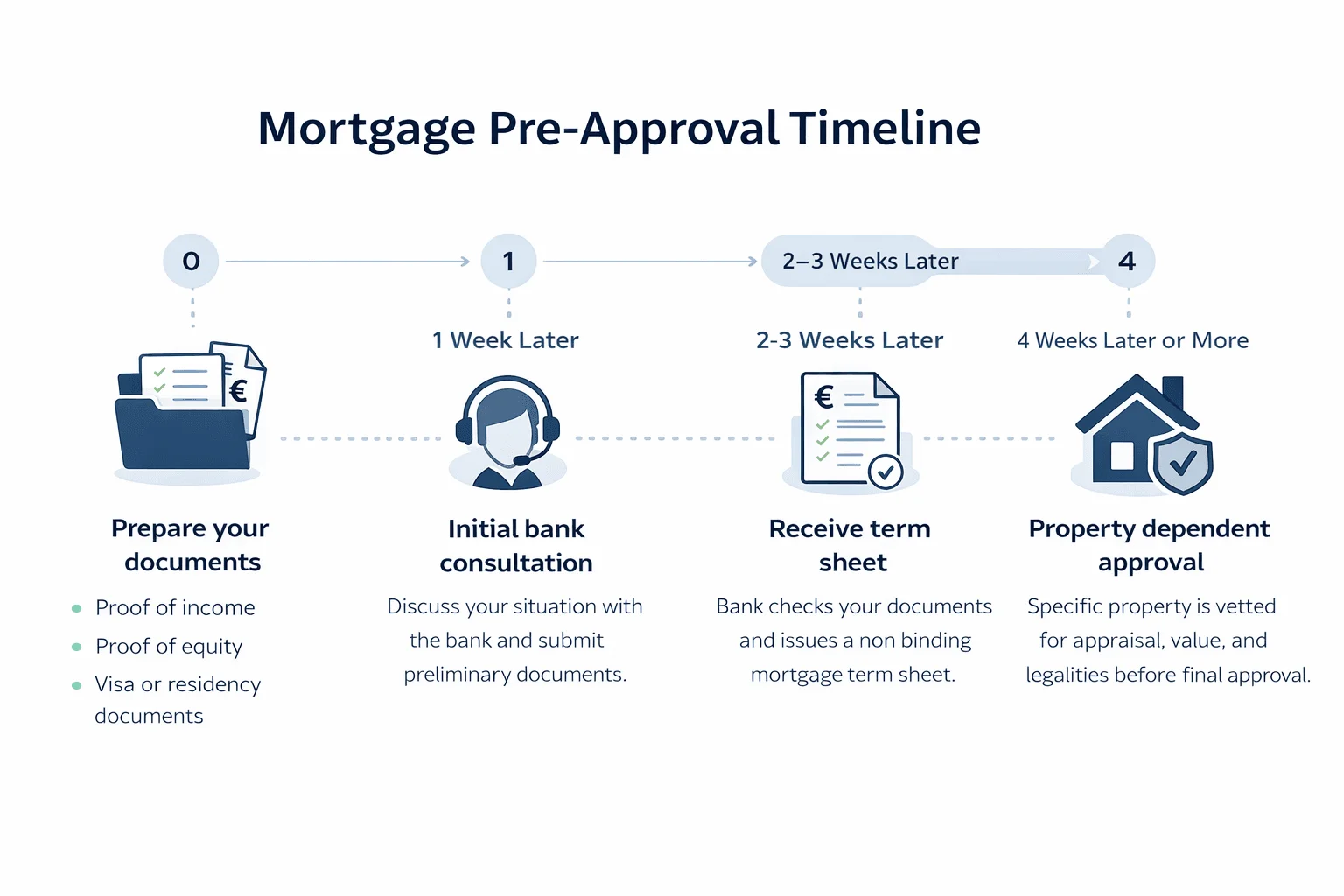
This visual overview explains the mortgage process Germany buyers typically go through when purchasing property. For expats and international buyers, understanding the buying property timeline Germany banks follow is essential before starting the property search.
The process usually begins with preparing your financial documents, including proof of income, available equity, and residency status. Once the documents are ready, buyers typically have an initial consultation with a bank or mortgage broker to discuss financing options and determine their borrowing capacity.
After the preliminary review of documents, the bank may issue a non-binding mortgage term sheet that outlines potential loan conditions. The final approval usually happens once a specific property has been selected and the bank completes its appraisal, legal checks, and risk assessment.
This step-by-step structure reflects the typical mortgage process Germany lenders follow and explains why financing preparation plays such a central role in the buying property timeline Germany.
Once a property has been selected, the lender normally also needs the relevant property file, such as floor plans, an exposé, and often documents from the land register (Grundbuchauszug), before moving from general borrower approval to a binding offer.
As a rule of thumb, the first budget discussion can happen quickly, a financing confirmation may follow within a few business days, and the detailed review often takes the longest once all borrower and property documents have been submitted in full.
Common Challenges for Expats Buying Property
Variable Income Bonus and Commission
Banks usually average bonuses over several years and may only count part of that income when assessing affordability.
In many cases, lenders look at a multi year average of variable income and may still discount part of that amount if the bonus or commission is not contractually guaranteed.
If 40 percent of your compensation comes from bonus or commission, do not expect the bank to treat all of it as stable income.
Stock Options and Equity Compensation
Unvested stock options or RSUs are often not considered as stable income by banks.
For tech professionals, this often means that vested and already sold equity can strengthen the equity position, while unvested awards usually carry little to no weight in the affordability calculation.
German lenders tend to care far more about cash in hand than potential future earnings.
Residence Status and Long Term Stay
Permanent residency often improves financing conditions while temporary visas can lead to stricter lending requirements.
Residence stability usually matters more to a bank than nationality alone.
- A Niederlassungserlaubnis (Permanent Residency) usually creates the strongest financing profile.
- Blue Card holders and borrowers on other temporary work permits can still be financed, but often with more conservative terms or more required equity.
- Very recent arrivals or short remaining permit duration can make approval much harder.
Property Search with Financing in Mind
Searching Only Within Approved Ranges
Searching for properties within a realistic price range based on your financing approval helps avoid disappointment and wasted time.
A common mistake is to search at the absolute upper limit of the budget. If a bank indicates that €600,000 may be possible, many buyers are still better off searching lower so that taxes, fees, and valuation gaps do not derail the transaction later.
It also helps to think in terms of total acquisition cost rather than purchase price alone. A property can look affordable in the listing and become unaffordable once the Kaufnebenkosten are added.
You can explore available properties using the Real Estate Search Engine.
Cost Structure Beyond the Purchase Price
One Time Purchase Costs
- Property transfer tax (Grunderwerbsteuer)
- Notary and land registry fees
- Estate agent commission (Maklerprovision) where applicable
These items are often grouped under the German term Kaufnebenkosten and are usually expected to be paid from your own funds rather than being fully financed.
This is why a €500,000 purchase can easily end up closer to €560,000 in total cost.
Ongoing Costs and Risk Buffers
Homeowners should also consider maintenance costs, association fees, and potential vacancy risks for investment properties.
For apartments, this often includes Hausgeld and the maintenance reserve of the building. For investment properties, buyers should also factor in vacancy risk and local rent regulation such as the Mietpreisbremse when comparing long term returns.
Investment vs Owner Occupied Property
Different Goals Different Financing Logic
The financing logic differs depending on whether the property is intended for personal use or as an investment. Owner occupied properties focus on affordability and stability while investment properties focus on cash flow and tax considerations.
For owner occupied homes, the lender focuses heavily on stable monthly affordability and long term payment discipline. For investment properties, the discussion shifts more toward expected rent, vacancy buffers, overall cash flow, and strategic use of equity.
The tax treatment can also differ. Interest on an investment property may be treated differently for tax purposes than interest on an owner occupied home, which is why many buyers compare structures carefully before deciding how much equity to deploy.
Tools That Support Better Decisions
Using Calculators and Strategy Reviews
Before starting the buying process, it is helpful to model different scenarios and interest rate changes. The Property Investment Calculator can help estimate monthly payments and long term affordability.
A mortgage comparison becomes much more useful once you test repayment speed, fixed rate length, and long term flexibility side by side instead of looking only at the headline interest rate.
Good preparation also means testing different repayment speeds, interest rate changes, vacancy assumptions for rental property, and the consequences of moving abroad again within a few years.
Buyers who expect career or country changes should also review whether the financing allows Sondertilgungen (unscheduled repayments) or later rental use without undermining the original financing strategy.
If you would like professional guidance, you can also contact the team directly via the contact page.
Frequently Asked Questions
Do I need mortgage approval before making an offer
While not legally required, most sellers expect proof of financing before accepting an offer.
How long does mortgage approval take in Germany
The process typically takes between two and four weeks depending on documentation and bank processing time.
Can expats buy property in Germany
Yes. There are no legal restrictions preventing foreigners from purchasing real estate in Germany.
Does mortgage approval affect Schufa
A formal credit request can slightly impact the credit score, but preliminary financing inquiries are usually neutral. During the comparison phase, buyers usually want a Konditionsanfrage (request for terms) rather than a full Kreditanfrage whenever possible.
Can I apply with multiple banks
Yes. Many buyers compare several lenders directly or through a broker, and a structured mortgage comparison can improve pricing as long as the inquiries are coordinated carefully.
Final Thoughts
Buying Property in Germany with Clarity
The German real estate market rewards preparation. Buyers who understand financing rules, maintain strong documentation, and evaluate affordability carefully often navigate the process far more smoothly.
Having a clear financing strategy often makes the difference between missing opportunities and successfully buying property in Germany.
Understanding mortgage Germany requirements, loan to value ratios, and mortgage affordability calculations helps expats navigate the buying property timeline Germany banks expect.
Structure beats speed. Buyers who keep their documents organised, their equity clearly traceable, and their financing readiness realistic usually move with more confidence and far fewer expensive surprises.
In other words, financing defines opportunity. A good mortgage comparison and a clear funding strategy often matter more than the first property that catches your eye.