


Property Valuation in Germany: Why Banks May Value Your Home Below the Purchase Price
Table of Contents
- What is a property valuation in Germany?
- Purchase price, market value and mortgage lending value explained
- Estimate the value of a property in Germany
- Why may a bank value a property below the purchase price?
- How do German banks determine property value?
- Which property valuation method is used?
- Which factors have the greatest effect on property value?
- How does property valuation affect a mortgage in Germany?
- What are Beleihungsauslauf and Beleihungsgrenze?
- Example: The purchase price is €500,000 but the bank value is €450,000
- What can you do if the bank valuation is too low?
- Bank valuation vs independent appraisal
- Which documents does the bank need for property valuation?
- How can expats reduce the risk of a low bank valuation?
- Property valuation checklist before buying
- FAQs about property valuation in Germany
- The purchase price is not the value your bank must finance
You've agreed a price with the seller, and then your bank comes back with a number that's lower than what you agreed to pay. This happens more often than most buyers expect.
German banks normally carry out their own property valuation before finalising a mortgage, and the purchase price you negotiated is not automatically the figure they use. The property functions as "Kreditsicherheit", the collateral behind your loan, and the bank may apply a more conservative property value for lending purposes. If that accepted value comes in lower than the purchase price, you may need more equity, a smaller mortgage, or a rethink of the purchase price itself.
A German bank does not automatically base a mortgage on the price agreed with the seller. It completes its own property valuation and may use a more conservative value for lending purposes. If the accepted value is lower than the purchase price, the buyer may need more equity, a smaller mortgage or a lower purchase price.
This article walks through the different values involved, how German banks actually assess a property, which valuation methods you'll come across, and what your options are if the numbers don't line up. If you're still early in the process, our guide to buying property in Germany covers the complete purchase journey, costs and documents in more depth. If you are starting from zero and want to understand the wider property, financing and tax context first, the Finance for Expats Knowledge Hub is a useful starting point.
What is a property valuation in Germany?
A property valuation, or "Immobilienbewertung", is essentially an estimate of the economic value of a house, apartment or investment property. But "value" isn't a single fixed number, and it depends on who's asking and why.
A seller wants to know the achievable selling price. A buyer wants to know whether the asking price is fair. A bank wants to know something slightly different: whether the property provides sufficient security for the home loan being requested. That last question matters most once you're deep into real estate financing, because it's the bank's own assessment, not the market chatter or the asking price, that ultimately shapes your mortgage terms.
Purchase price, market value and mortgage lending value explained
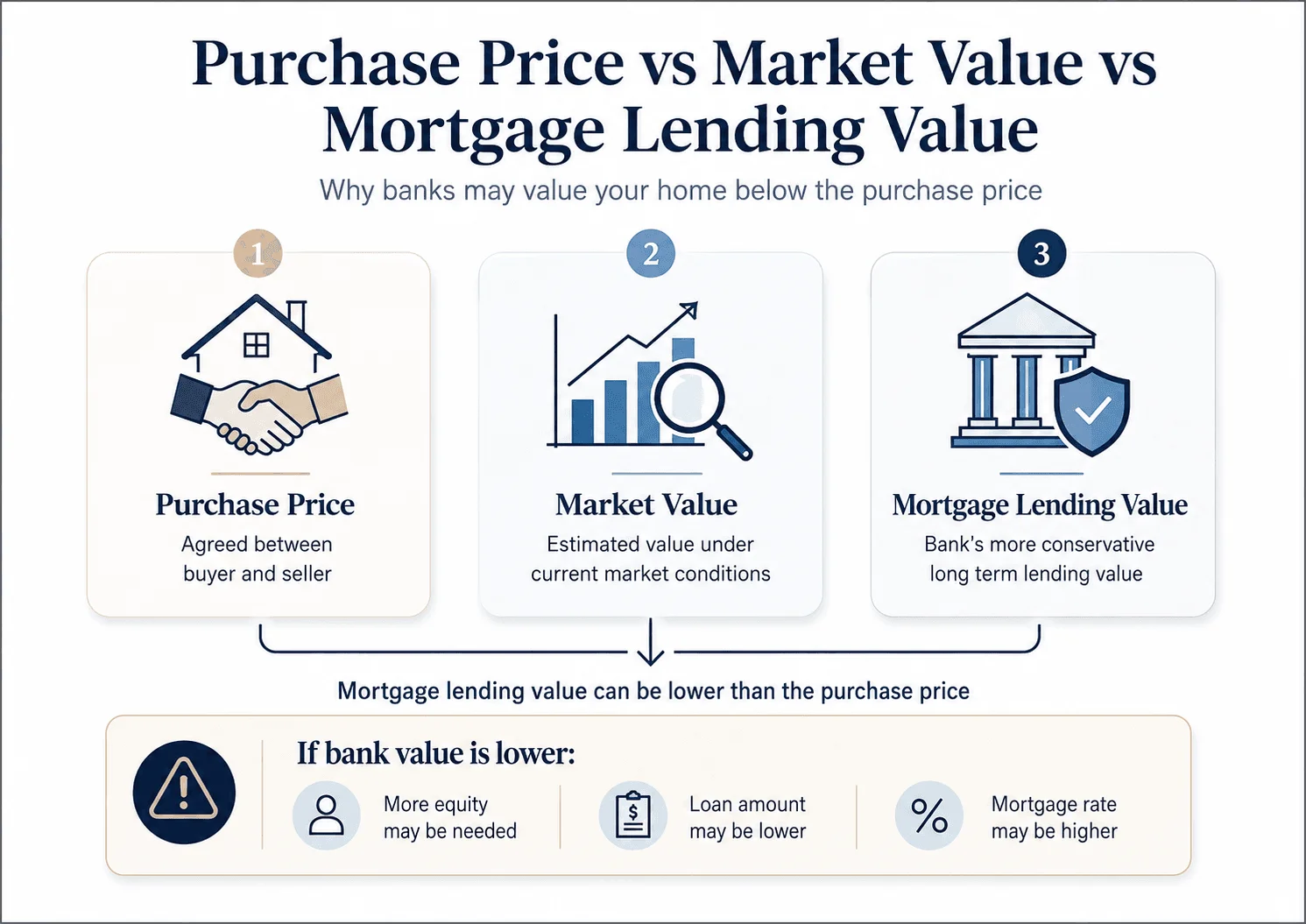
International buyers are often surprised to learn there isn't just one "value" attached to a German property. There are at least four important terms, and mixing them up is where a lot of confusion starts.
Purchase price or Kaufpreis
The "Kaufpreis" is simply the price you and the seller agree on. It's shaped by demand, competing offers, negotiation skill, and sometimes plain urgency. It reflects what you're willing to pay, not necessarily what a bank considers the property value to be. Buying costs like transfer tax, notary fees and agent commission sit separately from this pure property value.
Market value or Marktwert
"Marktwert" is the price a property could reasonably achieve under normal market conditions. Location, property type, condition, size and comparable sales all feed into it. Current supply and demand can affect the result, and it can still land higher than the more cautious figure a lender ends up using.
Verkehrswert
"Verkehrswert" is the formal German term generally associated with market value, based on the legal and physical characteristics of the property under normal market conditions, not on how motivated the buyer or seller happens to be. A "Wertgutachten", or formal valuation report, can be used to document it.
Mortgage lending value or Beleihungswert
The "Beleihungswert" is the cautious value banks use for lending and collateral purposes. Rather than chasing short-term market peaks, it focuses on sustainable, long-term characteristics of the property, which is exactly why it can end up below both the purchase price and the current market value.
The German "Beleihungswertermittlungsverordnung" defines the lending value as one intended to stay independent of temporary market fluctuations. It's also worth knowing that not every lender applies precisely the same model, so two banks can land on two different figures for the same property.
Estimate the value of a property in Germany
Use the Finance for Expats Real Estate Valuation Tool for an initial indication of a property's value before discussing the final mortgage valuation with a lender.
- The tool provides initial orientation only.
- It does not replace the valuation performed or accepted by the financing bank.
- It is not a legally binding "Wertgutachten".
- The final mortgage value depends on the lender, property documents and individual property assessment.
Why may a bank value a property below the purchase price?
This is usually the question buyers actually want answered. A few common reasons show up again and again:
- The agreed price sits above what comparable properties support.
- Competing offers pushed the price up during a bidding situation.
- The asking price reflects seller expectations rather than solid market evidence.
- The property needs substantial renovation, or key components are outdated.
- The layout or property type limits future resale demand.
- The building has a short "Restnutzungsdauer", or remaining useful life, or weak energy performance.
- Sustainable rental income doesn't support the price, for investment properties.
- Legal restrictions or land register entries limit usability.
- The location has weaker long-term prospects.
- The bank simply applies conservative assumptions or safety margins as standard practice.
It's worth emphasising: a lower bank valuation doesn't automatically mean the property is a bad buy. It means the lender sees more risk in the relationship between the loan you're requesting and the collateral backing it than you may have expected.
How do German banks determine property value?
Banks typically look at a broad set of factors: property type, address and micro-location, plot and living area, construction year, building condition, modernisation history, energy certificate, rental status and sustainable rental income, floor plan and usability, comparable transactions, legal documents and restrictions, and long-term resale potential.
The valuation itself might involve an automated or desktop assessment, an internal bank model, an external appraiser, or a full physical inspection. Not every property requires a site visit. German lending-value rules allow simplified procedures in certain circumstances, but higher-value or unusual properties tend to get closer scrutiny.
Which property valuation method is used?
German valuation practice recognises three main methods, the "Vergleichswertverfahren", "Ertragswertverfahren" and "Sachwertverfahren", sometimes used in combination depending on the property.
Vergleichswertverfahren
This comparison-based method relies mainly on comparable property transactions, and it's often the go-to approach for standard apartments and typical residential properties. Reliable local market data is essential, and asking prices are not the same thing as completed transaction prices.
You can compare properties and local asking prices using the Finance for Expats Real Estate Search Engine as a starting point, though this does not substitute for the bank's own valuation.
Ertragswertverfahren
The income approach is commonly used for rented and investment properties, centring on sustainable rental income and the property's income-producing ability. If the rental income is weak, a high purchase price may not be supported, and optimistic rent assumptions shouldn't be treated as guaranteed.
You can calculate the property's rental return and cash flow with our Property Investment Calculator, and our guide on rental yield and real returns in Germany explains the investment side in more depth.
Sachwertverfahren
The cost approach considers the land value, or "Grundstückswert", plus the value of the building itself, and tends to come into play where comparable sales or rental data are limited. Construction type, age, condition and depreciation all affect the outcome, and the preliminary result is usually adjusted to reflect actual market conditions. It isn't simply construction cost minus age.
Which factors have the greatest effect on property value?
Several factors can materially influence a property's valuation, especially when a lender is looking at long-term collateral quality rather than only the current asking price.

Location and comparable properties
City, district, micro-location, transport links, schools, noise, environmental risk, local services, local demand and comparable properties all feed into long-term development prospects.
Building condition and modernisation
Roof, windows, heating, insulation, wiring, plumbing, structural defects, modernisation quality and renovation backlog all feed directly into expected future repair costs.
Building age and Restnutzungsdauer
Beyond the original construction year, banks consider the effective age after modernisation and the likely need for future capital expenditure. "Restnutzungsdauer" refers to the property's remaining useful life: how many more years the building is expected to function well before major structural renewal is needed.
Energy efficiency
The energy certificate, "Energieeffizienzklasse", heating type and insulation standard can influence future operating costs and resale demand. There's no fixed rule that one energy class automatically knocks off a set percentage of value, but poor efficiency does raise questions.
Legal and usage restrictions
Land register entries, rights of way, "Erbbaurecht", existing tenants, unapproved construction work, residential or commercial use and the declaration of division for apartments can all restrict resale or use.
How does property valuation affect a mortgage in Germany?
The property serves as "Kreditsicherheit", or collateral, for your loan, and the bank's valuation directly affects the maximum "Darlehenssumme" it's willing to offer. If the accepted value comes in lower than expected, your financing ratio effectively rises, which can make the mortgage more expensive or harder to approve.
You may need more "Eigenkapital", or the bank may simply reduce the loan amount. Strong income alone doesn't compensate for insufficient property collateral, and approval depends on both sides of the equation.
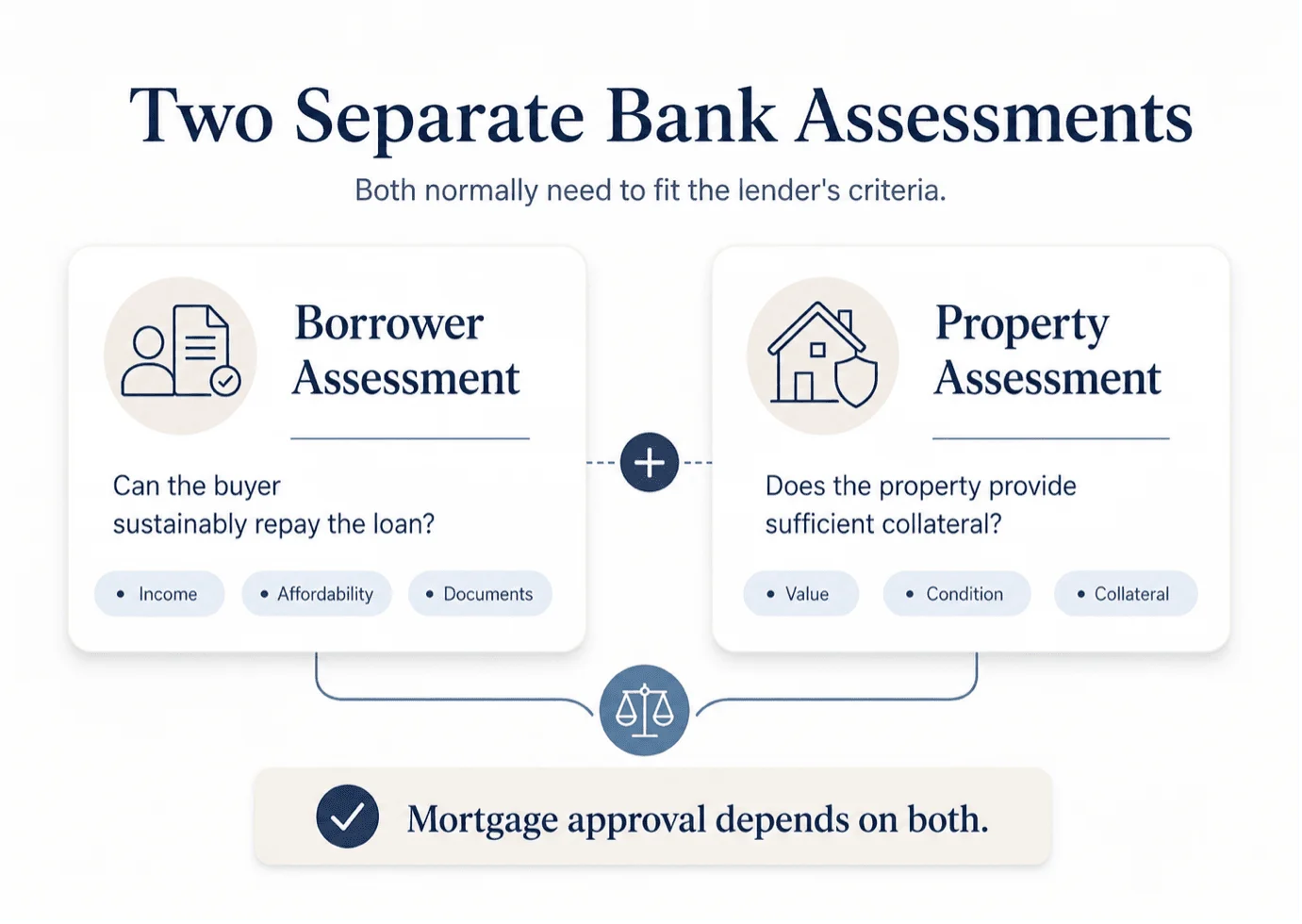
The bank performs two separate assessments:
- Borrower assessment: Can the buyer sustainably repay the loan?
- Property assessment: Does the property provide sufficient collateral for the requested loan?
Both generally need to satisfy the lender's criteria. For more on how banks assess the borrower side, see our guide to getting a mortgage in Germany as an expat.
What are Beleihungsauslauf and Beleihungsgrenze?
"Beleihungsauslauf" describes the relationship between the loan amount and the value accepted for lending purposes. The higher this ratio, the more risk the lender is taking on, which can affect pricing, available lenders and how much gets approved.
"Beleihungsgrenze" describes the portion of the accepted value considered available as loan security in a particular lending context. Different banks apply different internal policies here, so there's no single universal percentage that applies across the board.
Example: The purchase price is €500,000 but the bank value is €450,000
Numbers make this much easier to picture. Say you've agreed to buy a property for €500,000, and you'd like to borrow €450,000 toward it.
- Purchase price: €500,000 from the buyer's view, but not automatically accepted by the bank.
- Accepted property value: Not relevant from the buyer's negotiation view, but €450,000 from the bank's lending view.
- Requested mortgage: €450,000, which equals 90% of the purchase price from the buyer's perspective.
- Bank's perspective: The same €450,000 mortgage equals 100% of the accepted property value.
- Initial equity toward price: €50,000 from the buyer's view, but potentially insufficient from the bank's risk view.
From your perspective, the €450,000 mortgage represents 90% of the purchase price, a fairly standard financing level. From the bank's perspective, it represents 100% of the value it's actually willing to recognise, shifting the loan into a higher-risk category. That can mean a less attractive rate, a smaller approved amount, or a request for more equity. Renegotiating the purchase price may also become part of the conversation.
This example excludes acquisition costs, which sit on top of the figures above.
Calculate the total cost of buying the property
A valuation gap is only one part of the required budget. Buyers also need to calculate taxes, notary fees, agent commission and ongoing ownership costs separately. The Total Cost of Ownership Calculator helps keep these figures distinct: the purchase price, the bank-accepted value, the equity required to bridge any gap, and additional acquisition costs.
Before deciding whether you can cover a possible valuation gap, it's also worth using the Affordability Calculator to estimate the loan amount your monthly payment budget can realistically support. This calculator translates a monthly payment budget into an indicative maximum loan. It doesn't value the individual property, doesn't represent mortgage approval, and doesn't tell you what value the bank will accept. It's an indicative planning figure, not a bank decision.
What can you do if the bank valuation is too low?
If the numbers come back lower than hoped, you generally have several options:
- Provide additional "Eigenkapital", or reduce the requested mortgage.
- Negotiate a lower purchase price with the seller.
- Ask the lender to review missing or incorrect property information.
- Submit evidence of completed modernisation or professional renovation cost estimates.
- Commission an independent appraisal where appropriate.
- Compare offers from another lender.
- Withdraw from the purchase before becoming legally bound.
One thing worth avoiding: sending the same file to a long list of banks without any analysis of why the first valuation came in low. It rarely helps and can slow things down further.
Can another bank value the property differently?
Yes, different banks use different data sources, valuation models and risk policies, so a second lender may reach a different figure. A higher valuation doesn't automatically mean the overall mortgage offer is better. It's worth comparing interest rate, repayment structure, flexibility, required equity and total cost together, not just the headline value.
Unusual properties may also be treated more favourably by specialist lenders. Our guide to mortgage brokers in Germany explains how lenders differ in their experience with international borrower profiles and how the property itself can influence the approval assessment.
Bank valuation vs independent appraisal
A bank valuation is prepared specifically for lending and risk assessment, performed or commissioned by the lender, and may lean conservative. The complete internal report isn't always shared in full with the buyer.
An independent appraisal, by contrast, is commissioned by the buyer, seller or another party. It can analyse the "Verkehrswert" and property condition in more depth and support negotiation, though it doesn't force the bank to accept the same number.
A "Kurzgutachten" is a shorter, less detailed report than a full "Wertgutachten". It can be useful for initial orientation, but often not enough for disputes, unusual properties, expensive homes or complex legal questions. A full "Immobiliengutachten" or "Wertgutachten" is generally more detailed.
Which documents does the bank need for property valuation?
Depending on the property, banks may ask for:
- Property exposé
- Floor plans
- Living area calculation
- Land register extract
- Site plan
- Energy certificate
- Construction description
- Building plans
- Modernisation records
- Rental agreement, if applicable
- Declaration of division, for apartments
- Annual service-charge statement
- Owners' meeting minutes
- Photos
- Draft purchase agreement
- Renovation quotations
Missing, outdated or inconsistent documents can delay the valuation, trigger additional questions, push the bank toward more cautious assumptions, and ultimately slow down the mortgage decision. For the fuller legal and document checklist, our guide on due diligence in Germany covers what to check before buying in much more detail.
How can expats reduce the risk of a low bank valuation?
Before you're legally committed to a purchase, it's worth taking a few precautions:
- Compare the asking price with similar properties.
- Verify the living area.
- Review the condition and likely renovation costs realistically.
- Request complete property documents up front.
- Check sustainable rental income carefully for investment properties.
- Ask for an early, informal lender assessment.
- Keep additional equity reserves available, rather than relying solely on the asking price.
- Avoid signing the final purchase contract before financing is sufficiently secure.
- Clarify in advance how a lower valuation would affect your ability to proceed.
Property valuation checklist before buying
- Is the purchase price supported by comparable properties?
- Has the bank started or completed its valuation?
- Which property value has the lender accepted?
- Is a "Beleihungswert" being used?
- What is the resulting "Beleihungsauslauf"?
- Could the valuation change the mortgage rate?
- Is additional "Eigenkapital" available?
- Are renovation costs documented?
- Is the living area confirmed?
- Are there land register restrictions?
- Has the "Energieeffizienzklasse" been considered?
- Is the "Restnutzungsdauer" plausible?
- Are all required documents available?
- Is there a reserve for a possible financing gap?
FAQs about property valuation in Germany
Is the bank valuation the same as the purchase price?
No. The purchase price is agreed between buyer and seller, while the bank independently assesses the property as collateral for the home loan. The bank may accept a lower property value for lending purposes, especially if the purchase price is not supported by comparable transactions, condition, rental income or long-term resale expectations.
Why is the bank valuation lower than the purchase price?
Common causes include overpricing relative to comparable properties, poor condition, a weaker location, weak rental income, legal restrictions or conservative assumptions the bank applies as standard practice. A lower valuation does not automatically mean the property is unsuitable, but it does mean the lender sees more risk in the collateral.
What is the Beleihungswert?
The "Beleihungswert" is the cautious value banks use for lending and collateral assessment. It is not simply a repeat of the asking price or the price agreed with the seller. It is intended to reflect a sustainable value that can hold up over the long term, independent of short-term market fluctuations.
What happens if the property appraisal is too low?
If the bank valuation is too low, you may need more equity, a smaller loan, different financing conditions, a renegotiated purchase price or a different lender. In some cases, buyers may decide to withdraw from the purchase before becoming legally bound, especially if the valuation gap makes the financing structure too risky.
Can another bank give the property a higher valuation?
Yes, lender results can differ because banks use different data sources, valuation models and risk policies. However, a higher valuation does not automatically mean the full mortgage offer is better. Buyers should compare interest rate, repayment structure, flexibility, required equity and total cost together.
Should buyers get an independent real estate appraisal?
A "Gutachten" or "Kurzgutachten" can be useful for unusual, expensive or renovation-intensive properties, especially where there is a real gap between the purchase price and the bank's figure. An independent appraisal can support negotiations and decision-making, but it does not force the bank to accept the same value.
The purchase price is not the value your bank must finance
The agreed "Kaufpreis" is only one of several values attached to a property, and it's not the one your bank is obligated to finance. The lender carries out its own property valuation, and the accepted mortgage value may end up lower than what you agreed to pay, affecting your loan amount, required equity and overall mortgage conditions.
The best time to clarify this is before you're legally committed, alongside a review of the property documents, your affordability, and the total acquisition costs. If you'd like an initial read on a property's value, the Property Valuation Tool is a good starting point.
For readers who want to understand the wider context before making a decision, the Finance for Expats Knowledge Hub brings together guides, tools and practical answers around property, financing and long-term planning in Germany.