

Table of Contents
- What is an off plan property in Germany?
- How does buying off plan work in Germany?
- What should buyers check before signing a Bauträgervertrag?
- How does the MaBV construction payment schedule work?
- Calculate your MaBV construction payments
- How do you finance an off plan property?
- How does mortgage disbursement follow construction progress?
- What are Bereitstellungszinsen?
- Can KfW funding support a new build property?
- Which additional costs should new build buyers expect?
- Calculate the total cost of buying the property
- What happens if construction is delayed?
- What happens if the property developer becomes insolvent?
- How does property handover and acceptance work?
- What should buyers check during handover?
- What happens if defects are discovered?
- Advantages and disadvantages of buying off plan
- Off plan property checklist before signing
- FAQs about buying off plan property in Germany
- Buying off plan requires the contract, mortgage and construction plan to work together
Buying an off plan property in Germany means purchasing a house or apartment from a developer before construction is complete. The buyer signs a notarised "Bauträgervertrag", arranges financing in advance, and normally pays the purchase price in stages as defined construction milestones are completed.
In Germany, the buyer usually purchases from a "Bauträger", a property developer responsible for both selling the property and completing the building. The agreement typically combines the transfer of land or ownership rights with the developer's construction obligation. Because the price is paid as work progresses, and because a new build mortgage must be arranged before the building is finished, buying off plan requires more upfront planning than a standard purchase.
This guide covers what an off plan purchase involves, how construction financing is structured, how the MaBV payment system protects buyers, and what can go wrong along the way, from delays to developer insolvency to defects found at handover. For the wider purchase process, buying costs and mortgage preparation, see our hub on buying property in Germany. If you are starting from zero and want to understand the broader property, financing, tax and insurance context first, the Finance for Expats Knowledge Hub is a useful starting point.

What is an off plan property in Germany?
An off plan property is one where the buyer signs before the building exists, or while it's still under construction, often with only architectural plans, a written specification and a projected completion date to go on. In German, this type of new build property is often described as a "Neubauimmobilie".
The purchaser isn't just buying land or an apartment on paper. They're buying the land or apartment share together with the property developer's legal obligation to build and deliver the finished property. This developer is called the "Bauträger", and the purchase is often called a "Bauträgerkauf".
Two paths lead to a new build property in Germany, and it's worth keeping them separate:
- Developer purchase or Bauträgerkauf: The "Bauträger" sells the property and takes full responsibility for completing it according to the agreed plans and "Baubeschreibung".
- Individual construction: The buyer already owns, or separately buys, a plot and commissions contractors independently.
This article covers the first path. If you already own land and plan to build independently, the financing questions differ and aren't the focus here.
How does buying off plan work in Germany?
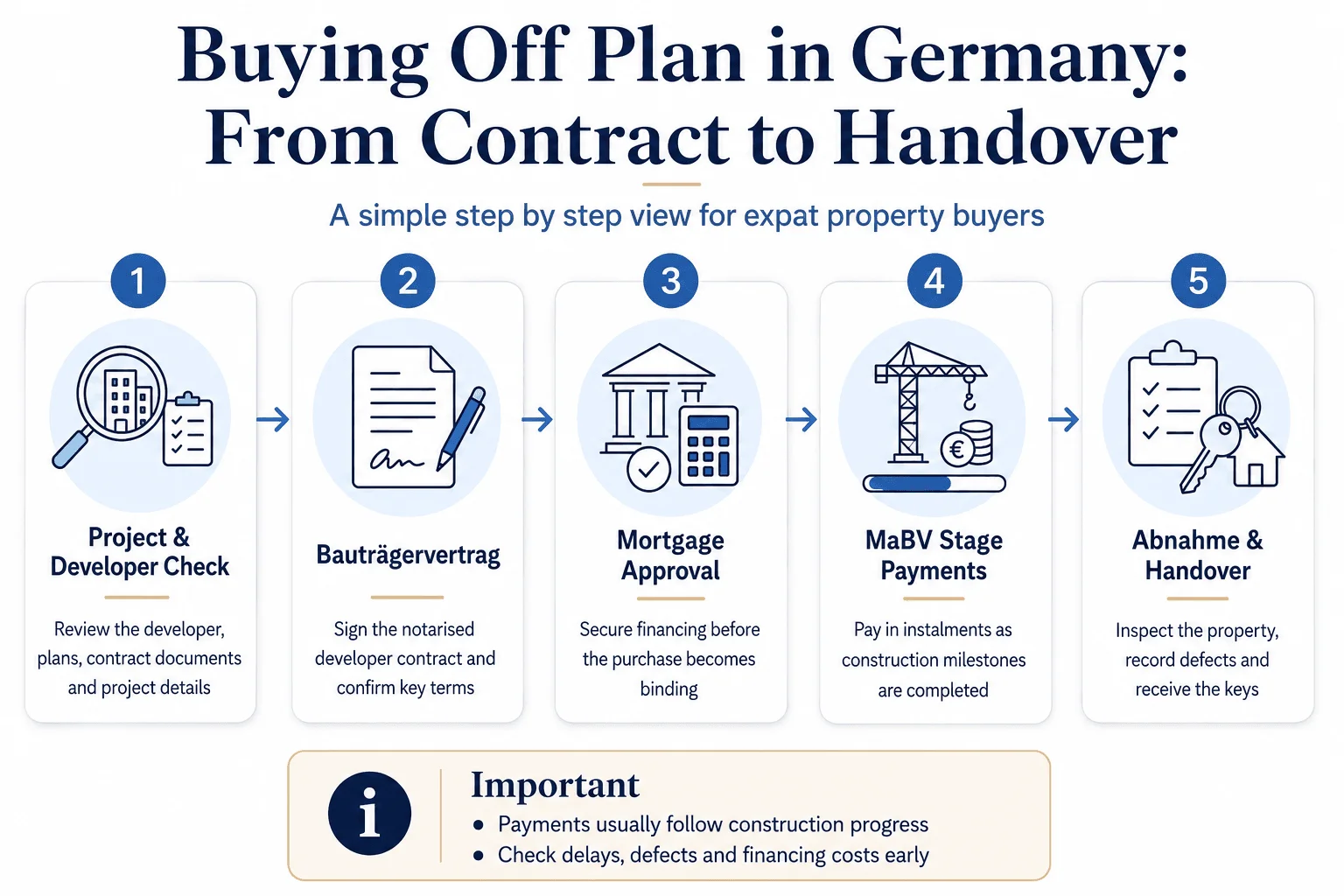
Buying off plan in Germany generally follows five steps:
- Review the project, the real estate developer, and the property documents.
- Secure construction financing or a new build mortgage in principle.
- Sign the notarised "Bauträgervertrag".
- Pay instalments as agreed construction stages are completed.
- Inspect, accept, and take possession of the finished property.
What makes an off plan property purchase more demanding than buying an existing home is that these steps have to line up with each other before signing. A mortgage that assumes a twelve-month build won't help if the developer's realistic timeline is closer to twenty months. Getting financing, contract terms and the construction timetable aligned is really the central task here.
What should buyers check before signing a Bauträgervertrag?
The "Bauträgervertrag" is the most important document in an off plan purchase, covering both the transfer of land or ownership rights and the developer's construction obligation in one agreement. Before signing, work through this checklist:
- The property developer's track record and completed previous projects
- Confirmed ownership of the land
- The "Auflassungsvormerkung", which helps protect the buyer's future ownership claim after notarisation
- The building permit and current project status
- Floor plans and how living area is calculated
- A detailed "Baubeschreibung", sometimes also referred to as "Bauleistungsbeschreibung", describing materials, fittings and standards
- The building's energy standard and technical equipment
- The stated completion date and what happens if it slips
- The MaBV payment schedule attached to the contract
- Provisions for "Sonderwünsche" and how additional costs are handled
- The "Teilungserklärung" for apartment purchases
- How "Sondereigentum" and "Gemeinschaftseigentum" are defined
- The conditions attached to final handover
- The contractual procedure for reporting and fixing defects
Because this contract sits at the intersection of property and construction law, it's worth having it reviewed independently of the developer before signing. Our article on due diligence in Germany covers the broader document-checking process that applies across property purchases.
How does the MaBV construction payment schedule work?
One reason buying off plan property in Germany is relatively safer than in many other countries is the MaBV, short for "Makler- und Bauträgerverordnung". It governs when a developer can collect money from buyers during construction.
The full purchase price is never paid upfront. Payments follow a construction payment schedule tied to defined building milestones, such as completion of the shell, roofing or window installation. This is often described as "Zahlung nach Baufortschritt". The individual instalments are also commonly referred to as "Abschlagszahlungen".
The developer can only request a payment once the legal and contractual conditions for that stage are genuinely met. In practice, the developer or notary issues a "Fälligkeitsmitteilung" confirming a payment is due because the corresponding stage has been reached. Buyers, and their banks, should verify that the invoiced stage has actually been completed on site rather than taking the invoice at face value. Once a stage payment is confirmed, the lender normally releases the matching portion of the mortgage.
Section 3 of the MaBV sets maximum percentages of the contract price payable at each stage, capped at seven instalments drawn from a longer list of building stages. The first instalment, due once groundworks begin, is generally capped at 30 percent where land ownership is transferred, or lower for a leasehold arrangement. A meaningful share, often around 12 percent, isn't due until the living space is ready for occupation.
Exact percentages should always be checked against the current § 3 MaBV, since developers cannot structure payments less favourably to the buyer without additional security such as a bank guarantee. Because MaBV rules and contract structures can be technical, buyers should not rely on a simplified overview alone, but verify the exact payment schedule in the notarised contract.
Typical MaBV payment stages
- Start of groundworks: Often up to 30 percent for freehold or 20 percent for leasehold. Check that the building permit has been issued and that the contract conditions are met before any payment is released.
- Shell and roof structure complete: Additional instalments may become due once the shell and roof stage has genuinely been reached. The site progress should match the invoice.
- Windows and doors installed: The buyer should check whether the materials and installation match the agreed "Baubeschreibung".
- Rough plumbing and electrical work: Progress should be confirmed through documentation, photos or a site visit where possible.
- Interior plastering and screed: This is a stage where independent checks can be helpful, especially if buyers are not technically experienced.
- "Bezugsfertigkeit" or ready for occupation: A larger remaining instalment may become due once the property is genuinely liveable.
- Final completion and external works: The final balance should be checked carefully against handover, "Abnahme" and any defects recorded.
Stages and percentages must be verified against the current § 3 MaBV, and ideally checked against your specific contract with a qualified advisor.
Calculate your MaBV construction payments
Finance for Expats Tool
Construction Payment Calculator
Use the Construction Payment Calculator to estimate milestone-based payments, financing interest and total cost development for a new build project in Germany.
Estimate MaBV milestone payments
Plan construction payment timing
Understand possible interest costs during construction
See how delayed completion may affect financing costs
The tool is especially useful before signing a "Bauträgervertrag", because it helps you understand what may fall due at each construction stage and how this can affect your new build mortgage.
Calculate your construction payments
This calculator provides orientation only. It does not replace the notarised "Bauträgervertrag", the bank's disbursement rules or an individual legal review of the MaBV payment schedule.
How do you finance an off plan property?
Financing an off plan property differs from financing a home you can inspect on day one. Mortgage approval should normally be secured, at least in principle, before signing the "Bauträgervertrag", since the bank needs to assess both you and the project itself.
Because the building doesn't yet exist in finished form, the bank typically values the property based on the planned, completed structure, and will usually ask to see the "Bauträgervertrag", floor plans, "Baubeschreibung" and payment schedule. Developers often want proof of financing capacity before allocating a unit, so it helps to arrange preliminary financing early.
Once approved, the construction loan is rarely paid out as a lump sum. Funds are released in line with contractual instalments as they become due, mirroring the MaBV schedule above. The financing term needs to be long enough for the expected construction period plus a buffer for delays, and expats still need to meet the lender's usual requirements around income, residency and equity.
Our guide to the German mortgage approval process covers borrower eligibility and required documents in more depth.
How does mortgage disbursement follow construction progress?
When a stage payment falls due, the buyer submits the instalment request and supporting documentation, such as the "Fälligkeitsmitteilung", to the lender. The bank checks its "Darlehensauszahlung" conditions before releasing funds from the approved construction loan.
Depending on the mortgage structure, buyers may need to use available equity before or alongside loan funds for certain stages. Delayed paperwork, on either side, can hold up the bank's payment even when the underlying construction stage is genuinely complete, so keeping documentation organised helps avoid friction at each "Baufortschritt" milestone.
What are Bereitstellungszinsen?
One of the less visible costs of a new build mortgage is "Bereitstellungszinsen", or commitment interest. When a bank approves your mortgage, it reserves the full amount, even though only part of it is drawn during early construction.
Most lenders allow a "bereitstellungszinsfreie Zeit", a window during which undrawn funds cost nothing extra. Once that window closes, the bank may charge interest on whatever portion of the loan hasn't been paid out, since it sits reserved and unused. Construction delays are the main driver of this cost, as a longer build means a longer stretch of undrawn loan.
When comparing mortgage offers, check each lender's interest-free period, and test your financing plan against a realistically delayed completion rather than the developer's best case. The Construction Payment Calculator mentioned earlier can help model how a delay affects overall construction financing costs.
Can KfW funding support a new build property?
Some energy-efficient new build properties may qualify for subsidised financing through current KfW programmes, which can reduce overall construction financing costs. Eligibility depends on the specific programme and the building's technical energy standard, so it can't be assumed for every development.
Funding eligibility should be checked before signing, or at least before committing to a construction stage, since some programmes require conditions to be met from the outset. Not every new development qualifies, even when marketed as energy efficient, so verify actual certification rather than relying on sales material.
Where KfW funding applies, it typically needs to be integrated into the overall mortgage structure. Our guide to KfW funding for property buyers covers current programmes and how government-backed financing fits into a purchase.
Which additional costs should new build buyers expect?
A realistic budget for a new build property needs to go beyond the advertised price and headline mortgage figure. Buyers should plan for:
- Property transfer tax
- Notary and land-registry costs
- Agent commission, where applicable
- Mortgage-related costs and fees
- "Bereitstellungszinsen"
- "Sonderwünsche" and upgraded materials or equipment
- Changes to floor plans requested after signing
- Independent construction inspections
- Additional rent during delays
- Moving and furnishing costs
- Initial "Hausgeld" and reserve fund payments for apartments
"Sonderwünsche" deserve particular attention. These special requests, such as upgraded flooring, a different kitchen layout or extra sockets, should always be documented and priced in writing before work begins. A handful of individually small upgrades can add up to substantial "Mehrkosten" by handover, especially if changes are agreed informally rather than through a proper "Nachtrag".
Calculate the total cost of buying the property
Finance for Expats Tool
Total Cost of Ownership Calculator
Once construction-stage payments are accounted for, calculate acquisition-side costs separately with the Total Cost of Ownership Calculator. It estimates the purchase price plus transfer tax, notary fees, land-registry costs and other ancillary expenses.
This calculator does not automatically include every project-specific "Sonderwunsch", construction delay or developer surcharge. Those costs should be added separately to the buyer's own reserve.
What happens if construction is delayed?
Construction delay is one of the most common risks in an off plan purchase. Depending on how long it runs, it can lead to:
- Additional rent or temporary accommodation costs
- Higher "Bereitstellungszinsen" as undrawn loan funds sit reserved for longer
- Delayed rental income for investors
- Postponed moving plans
- Mortgage or funding conditions expiring before completion
- Extra storage or relocation costs
- Disputes over what the completion date actually guaranteed
Before signing, check whether the stated "Fertigstellungstermin" is binding or an estimate, what extensions the contract permits, how delays must be communicated, whether compensation is defined for late completion, and whether your financing remains valid if completion slips.
It isn't accurate to assume every delay automatically entitles a buyer to compensation. Each contract and situation needs individual review, ideally with someone who can read the specific delay clauses.
What happens if the property developer becomes insolvent?
"Bauträgerinsolvenz", or developer insolvency, is one of the more serious off plan risks, even though it's relatively rare. If it happens, construction can stop before completion, and the work actually done on site may not match what's already been paid.
Buyers may need legal advice quickly, and possibly additional funds to complete the project through another party. Completion can become delayed or genuinely uncertain, and the status of the property, land ownership and registered rights becomes critical.
The MaBV structure reduces certain advance-payment risks by tying payments to progress, but it does not eliminate every consequence of an insolvency. This is exactly why checking the property developer's financial history and track record before signing matters, rather than something to worry about only after problems appear.
How does property handover and acceptance work?
Property handover in Germany involves more than receiving keys. The formal "Abnahme", acceptance, is a significant legal milestone and shouldn't be treated as a formality.
The finished property should be inspected before or during "Abnahme". Visible defects need to be recorded in the "Abnahmeprotokoll", ideally with written descriptions and photos. Many buyers bring an independent "Baugutachter" or "Sachverständiger" to spot issues an untrained eye might miss. Essential documents, keys and technical information should be handed over at this stage as well.
It's worth distinguishing between physically receiving keys and legally accepting the property, since German law treats acceptance as a meaningful stage with real consequences for warranty periods and payment obligations.
What should buyers check during handover?
A thorough inspection typically covers:
- Windows and doors
- Floors and surfaces
- Heating and ventilation
- Electrical installations
- Plumbing and water pressure
- Balcony or terrace
- Measurements against the agreed floor plan
- Common areas
- Parking and storage
- Whether agreed "Sonderwünsche" were implemented
- Energy performance and technical documents
What happens if defects are discovered?
If construction defects turn up during or after handover, record each one clearly and report it to the responsible contractual party without delay. Where appropriate, and ideally with professional advice, set reasonable deadlines for repairs, and keep a record of communication and any completed fixes.
Not every issue carries the same weight. A minor cosmetic mark and a serious structural problem don't have the same legal consequences. German law provides a general "Gewährleistung" framework with specific remedies and limitation periods for construction work, but applicable periods and exceptions should always be verified against your specific contract and current statutory rules.
Advantages and disadvantages of buying off plan
Advantages
- Modern construction methods and equipment
- Potentially better energy efficiency
- Lower immediate maintenance needs
- Some ability to choose finishes and layouts
- Clear project documentation, when professionally prepared
- Possible KfW eligibility for energy-efficient builds
- No previous occupant or renovation history
Disadvantages
- The completed property cannot be fully inspected before signing
- Construction delay risk
- Developer insolvency risk, even if reduced by MaBV
- "Bereitstellungszinsen" on undrawn loan funds
- "Sonderwunsch" and upgrade costs that add up
- Potential construction defects at handover
- Uncertainty around exactly how the finished development will look
- Rental income or personal use begins only once construction finishes
Off plan property checklist before signing
- Check the property developer's completed projects
- Review the "Bauträgervertrag" with qualified support
- Read the complete "Baubeschreibung" or "Bauleistungsbeschreibung"
- Confirm the building permit and current project status
- Check the MaBV payment schedule
- Secure your new build mortgage before signing
- Confirm the "bereitstellungszinsfreie Zeit"
- Calculate possible "Bereitstellungszinsen" under a delayed scenario
- Document all "Sonderwünsche" and expected "Mehrkosten" in writing
- Check the contractual "Fertigstellungstermin"
- Review the delay provisions
- Verify the "Teilungserklärung" for an apartment purchase
- Budget for both purchase costs and project-specific extras
- Plan an independent inspection before "Abnahme"
- Keep a financial reserve for delays and defects
FAQs about buying off plan property in Germany
What is an off plan property?
An off plan property is a house or apartment purchased before construction is finished, often while it exists only as plans. In Germany this typically means buying from a "Bauträger", who is contractually responsible for both selling the property and completing its construction according to agreed plans. The purchase price is normally paid in stages as the building progresses.
Can you get a mortgage for an unfinished new build?
Yes. A new build mortgage is generally approved before completion, based on the planned finished building rather than its current state. Funds are usually released in stages matching the contractual construction payments rather than as a lump sum, so the mortgage timeline needs to match the expected build period plus a buffer.
How does the construction payment schedule work?
Under the MaBV, payments are tied to defined construction milestones rather than paid upfront. The developer can only request each instalment once the conditions for that stage are met. Buyers should verify that the relevant stage has actually been completed before authorising payment or asking the lender to release funds.
What are Bereitstellungszinsen?
"Bereitstellungszinsen" are charges a bank applies to the approved but undrawn portion of a construction loan once the interest-free window ends. Since only part of the loan is used during early construction, this cost can add up if the build runs longer than expected or if milestone payments are delayed.
What happens if construction is delayed?
A construction delay can increase financing interest, particularly "Bereitstellungszinsen", and may create additional housing costs while waiting to move in. Whether you have recourse depends on whether the completion date was binding and how the specific contract addresses delays, extensions and possible compensation.
What should buyers check during property handover?
At property handover, arrange an independent inspection if possible, record any issues clearly in the "Abnahmeprotokoll", and confirm that agreed "Sonderwünsche" and specifications were actually delivered. Defects should be documented with photos and descriptions rather than addressed only verbally.
Buying off plan requires the contract, mortgage and construction plan to work together
An off plan property can be a genuinely good way to get a modern, energy-efficient home in Germany, but it asks buyers to commit before they can inspect the finished result. That's the core trade-off running through this whole process.
The "Bauträgervertrag" and "Baubeschreibung" define exactly what the developer must deliver, and the MaBV schedule determines when each construction payment becomes due. Your new build mortgage needs to match those payment stages and a realistic construction timeline, not just the developer's best-case estimate. Delays, "Bereitstellungszinsen", defects and "Sonderwünsche" should all have a place in your financial planning from the start, rather than showing up as surprises partway through the build.
Getting independent support on the contract and construction side, from a lawyer familiar with "Bauträgerrecht" to an independent surveyor at handover, tends to reduce exactly the kinds of avoidable risks covered here. With the right preparation, buying off plan can go smoothly from the first site visit through to the day you get the keys.
If you want to start with numbers, use the Construction Payment Calculator to model stage payments and financing interest, and use the Total Cost of Ownership Calculator to estimate acquisition costs separately.