
Why Real Estate Investment in Germany Attracts Expats
Germany's reputation for stability and for having strong and stable institutions to govern it has led to a steady stream of investors to the Germany real estate market in recent years.
Germany is one of the strongest economies in the world with a very solid institutional framework. German real estate therefore does not usually drop in value in the same way as in Southern and Eastern Europe and therefore does not offer unusually high short term returns. But the returns of the German real estate market are robust and very stable.
Despite the lower return profile mentioned above, Germany offers a large pool of potential tenants, since the percentage of owners is just 46 percent. That is very low in Western Europe. Therefore the number of tenants for high quality real estate in all of Germany's cities is huge.
Many new property investors get Germany property wrong. As noted above, many property investors have expectations for returns from property in Germany similar to Southern and Eastern Europe. This would translate to a rental return of 6 to 8 percent. Germany property investment is however all about low risk and stable returns. Hence returns need to be calculated in a more realistic manner including all costs, tax and inflation. For expats and international investors, this is what real estate investment Germany is really about: stable long term returns rather than unrealistic gross yield expectations.
Germany Real Estate Market: Prices, Demand and Investment Trends
The German property market and prices have been very successful for investors in recent years. Property prices rose strongly from 2010 until 2022. In the big cities, there were even years with double digit growth rates. Only in 2022 and 2023, due to the high interest rates, did property prices fall again. Since 2025, the property market has been in a phase of stabilisation again in most of the successful cities.
Also when it comes to residential real estate on the long term rental market, Germany's supply is often unable to keep pace with demand from potential tenants in the large cities. This is due to a rise in population in individual cities, and particularly a rise in the number of very small households, in other words a large number of very small households of typical renting age. What is more, supply on the new build market is being restricted by a large number of entry barriers to the market for companies. This means that those companies which do enter the market to develop and sell newly built residential real estate are unable to do so successfully in many cases. As a result of these problems on the new build market, supply of newly built residential real estate on the long term rental market is failing to increase in line with demand.
In the meantime, high rental prices and high property prices in cities such as Munich, Berlin, Frankfurt, Hamburg and Stuttgart support the value of property in the long term. However, in terms of returns on property, they are currently being squeezed. If you want to compare actual market opportunities more closely, the Real Estate Search Engine is a useful starting point.
Rental Income in Germany: What Investors Actually Earn
Before looking into the average rental income in Germany, it is interesting to first have a look at the average rent prices in the cities of Germany. As mentioned before, there are big differences in rent prices from city to city, as well as in the different neighborhoods and for different types of houses.
As a broad benchmark:
- Munich commands the highest rents, averaging €18 to €22 per square meter per month in popular districts.
- Other large cities such as Frankfurt, Hamburg and Cologne offer average rental income of around €14 to €18 per square meter per month, and thus sit in the middle in terms of returns on investment.
- The Berlin average rental price per square meter in the most popular rental markets is currently rising quickly. At the moment, the average rental price per square meter in the city is around €12 to €16.
- Leipzig, Dresden, Nuremberg and comparable cities in Germany's newer growth regions have slightly lower rental income with average prices per square meter ranging from €8 to €12.
It has to be noted that the above figures are gross rental income, and after deduction of agent's commission, maintenance, repairs and other operating expenses the net rental income will be lower. As many property investment failures are due to incorrect calculation of the net rental income, it is clear why such modelling is of utmost importance.
What Determines Your Real Return on Investment
A real return on investment is the net rental income a property yields, including all costs of maintaining the property, one time acquisition costs and taxes. Therefore two people can purchase the very same property and achieve an entirely different return on investment.
A model of all expenses for a property investment must be set up before buying a property in Germany. Only this way can the profitability of the investment in the long run be ascertained.
"Rental yield" is the primary metric used by investors to check whether a property is likely to generate sufficient returns to justify its purchase price and related costs.
Rental Yield Explained in a Practical Way
Rental yield in Germany is calculated simply:
Gross Rental Yield = (Annual Rent ÷ Purchase Price) × 100
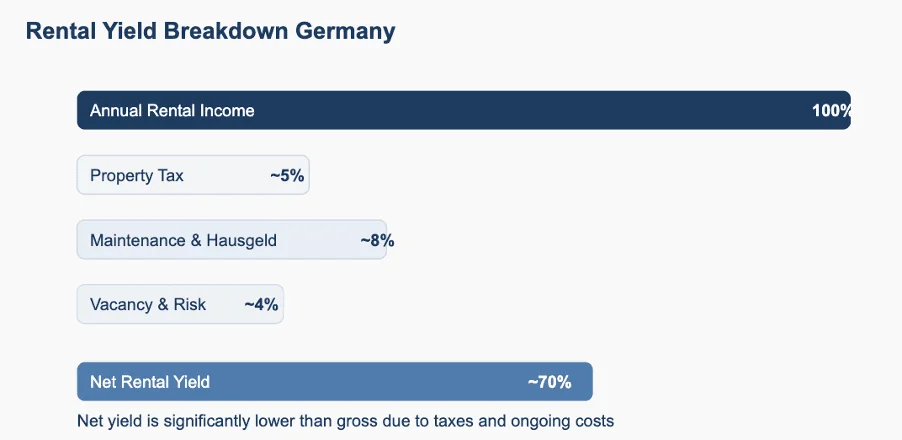
The gross rental yield for the above example would be 4.00 percent. However, other costs, such as property tax, management fees, maintenance, repairs, house insurance and similar items are also factored into the cost of a property and in most cases reduce the gross rental yield by 1 to 2 percent. In the case of the example above, a realistic net rental yield would be between 2.50 percent and 3.00 percent.
The most frequent mistake of new investors is the incorrect consideration of the gross yield as the real return of their investment. In Germany, a rental yield of 4 percent can in fact result in 2 to 2.5 percent net returns. It is not bad, especially in a low risk and very stable market, but it must be considered correctly. If you want to calculate gross and net returns more realistically, the Property Investment Calculator is a useful next step.
Property Tax in Germany and Its Impact on Returns
Property tax in Germany, commonly referred to as "Grundsteuer", is an annual tax that all property owners have to pay. This tax is levied by the municipality and is calculated from the assessed value of a property, multiplied by a local "Hebesatz". The "Hebesätze" can vary greatly from one municipality to another. In small towns they can be far lower than in large urban districts.
The assessment of properties in all German states has been completely overhauled. As part of a large tax reform, new assessment values for properties started to be implemented from January 2025. This replaced old values which had been in place for decades to calculate property tax in Germany.
If you are a property investor you should always remember that property tax in Germany is an annual payment and it cannot simply be ignored. Therefore it has to be included in your calculation as to whether a property will provide you with a good return on your investment or not. The amount of property tax in Germany can vary in different locations. For example, a property in Munich is likely to incur higher property tax than a comparable property in a small town, not necessarily because of a higher "Hebesatz" but because of a higher assessment value.
How Property Tax Affects Your Investment
As previously alluded to, one of the important components of property costs are the taxes levied by local authorities in Germany. "Grundsteuer" is charged annually on the basis of the official valuation of a property and local tax rates, the "Hebesatz". For example, a property bought for €300,000 could have a gross rental return of 4 percent or €12,000 per year. However, after levying an annual property tax charge of €800 this would reduce the gross rental return to just €11,200 per annum, from which all other property costs would still need to be deducted.
Property tax over 20 years can add up to a substantial amount. So, when you buy property, you have to keep in mind the other expenses incurred by property ownership for a long time and check how much return on investment will remain when adding these expenses to the purchase price. The majority of expenses can be reflected in the operating structure of a rental property, often through "Betriebskosten", but the overall effect on your investment returns still has to be calculated carefully.
Total Property Costs Investors Must Understand
Investing in German real estate is associated with many running costs in addition to the initial investment. These in total define the return on investment. So the purchase price of a property alone is not enough for investors to get an idea of their return. Instead, they must familiarize themselves with all the recurring as well as non recurring expenses of a property.
Ongoing Costs
Ongoing costs for already purchased properties include:
- "Grundsteuer": property taxes vary between towns and cities.
- Maintenance and repairs: 1 to 1.5 percent of the purchase price per year for maintenance and repairs is often used as a rule of thumb.
- Property management costs: DIY management can save money, but management companies may be necessary and can materially reduce returns.
- Building insurance and administration: for multi apartment buildings this can become a very relevant cost item and should be included in projections.
One-Time Costs
Other costs will apply upon the purchase of a property in Germany:
- "Grunderwerbsteuer": 3.5 to 6.5 percent of the purchase price depending on the federal state.
- "Notarkosten" and land registry fees: typically 1.5 to 2 percent of the purchase price.
- "Maklerprovision": as from 2020 this is typically capped at a maximum of 3.57 percent per party.
The one off costs incurred when purchasing a property in Germany are huge and can affect the initial return on investment for many years to come. Some of the costs incurred can reach as high as 10 to 12 percent of the purchase price of the property and will take years to recoup in terms of rental income. To see how these one time and ongoing costs influence real returns, use the Property Investment Calculator.
How Property Prices in Germany Affect Rental Yield
The relation between property prices and rental yield in Germany is often inversely proportional. The higher the property prices, the lower the rental yields. For a long time, there has not been a direct correlation between property prices and higher rental income in cities. This is because rental income is often limited by local affordability, market structure and regulation.
As an example, a 60 square meter apartment in a prime Munich location might cost around €600,000 to €800,000. At the same time, the monthly gross rental income may only be around €1,200. The corresponding yield would therefore be relatively low. Munich is one of the few locations where you will not be able to make high rental returns from property in Germany.
Berlin's property prices have more than doubled over the last decade. However, the returns have not increased to the same extent. Nevertheless, there are locations and areas within the city where yields of around 3 to 4 percent can still be achieved. Outside of the main centers, in secondary locations such as Leipzig, there are already locations that offer higher yields of 4 to 5 percent and more. But here the risk of long periods of vacancy and lower liquidity is greater.
Ultimately it is up to the investor to decide whether they want to invest in highly priced and liquid real estate markets, which will most likely offer low yields, or whether they want to look at less expensive markets where higher yields may be offered. Here again, the investor has to make a decision based on his or her investment strategy.
Why Germany Remains Attractive for Long-Term Investors
Germany is no pure yield market. It is also not mainly a short term capital growth market. Germany is first and foremost a long term appreciation and capital preservation market. For this type of investor, Germany is an extremely interesting market for property investment.
Many investors all over the world have to invest their capital somewhere. Investors from more turbulent countries are often interested in a stable market like Germany. The property market is not as sensitive as many other markets. The returns are often low, but the risk is low as well. Therefore returns may be lower, but they are also comparatively safe. This type of investment is interesting for a broad range of investors all over the world.
A further reason for Germany remaining an attractive investment location is the low volatility of the local property market. Legal protection for the owner of a property is strong in Germany. Demand for housing is also structurally supported by urbanization and immigration. All in all, for many investors Germany offers a very low risk investment in European property.
The focus of returns from Germany will therefore in the short term be on capital preservation, and in the long term on capital appreciation. Returns in the form of rental income in the short term are expected to be modest but steady. Moreover, German real estate has historically also benefited from low interest rate periods and from the fact that the buying and selling process is highly organized and well regulated. Consequently, the German property market is first and foremost a long term investment of 15 to 25 years during which there may not be huge gains in the short term, but there is a relatively low risk of volatility and also the possibility of steady capital appreciation over time.
Common Investment Mistakes Expats Make
Investing in Germany real estate is not for the faint of heart. For the inexperienced property investor there are many hidden pitfalls that can result in significant losses of capital. Here are some of the most common mistakes made by expat property investors in Germany.
- Not taking property taxes into account: many expats are surprised to find out only after purchasing a property that they have to pay "Grundsteuer" all year round. They had not included this in their cash flow projections before.
- A lack of understanding regarding rental income: frequently, expats equate gross rental income with net income in their calculations and therefore assume unrealistic yields.
- Overpaying for a property: as a foreigner, and especially when new to a competitive urban market, it is easy to overpay if you rely too heavily on sales pressure or marketing language.
- Not understanding the local market: even if there is a booming property market, in Germany that often results in low yields rather than higher ones.
- Ignoring all purchase costs: many people look only at the purchase price of a property. They do not factor in all the costs incurred during the purchase process. These can add an extra 10 to 12 percent to the purchase price and must be included in the investment calculations in order to get an accurate return on investment.
Frequently Asked Questions
How much rent can you earn in Germany?
Average rent per square meter in Germany's major cities varies strongly by location. Broad benchmark ranges are Munich €18 to €22 per square meter, Berlin €12 to €16 per square meter and Leipzig €8 to €12 per square meter.
What is property tax in Germany?
In Germany, property tax is referred to as "Grundsteuer". As a real estate owner, you are required to pay the annual "Grundsteuer" to the respective municipality of the property. The basis of the tax calculation is the value of the property together with the local "Hebesatz".
How do property taxes affect investment returns?
Property taxes have a big influence on the returns from a rental property because they reduce the real income left after costs. In many cases "Grundsteuer" should be treated as a recurring cost that materially affects net rental yield.
Is Germany good for real estate investment?
Property investments in Germany usually increase at a slower pace than in more speculative markets. But this type of investment is very stable in the long term. German property is therefore very suitable for investors who put their capital at risk over the long term and who value stability and capital preservation.
What is the German real estate market like?
The Germany real estate market is characterized by high property prices for apartments in top locations such as Munich and Berlin, strong and sustained rental demand, and a historically stable environment for property investors. Supply in major cities continues to be constrained and this supports long term values despite occasional short term price corrections.
Understanding Real Returns Before Investing
Investing in German property can be very rewarding for the patient, well prepared and realistic investor. The key is to calculate the real return of a rental property. The gross rent from a tenanted property, less the costs for operating, property tax in Germany and interest for the financing, is the real return from a rental property. These returns are not always high but in markets as stable and robust as Germany they can be worth it.
The returns from property in Germany are low but stable. This has to be taken into consideration before you start your property investment in Germany. So do not go into buying property in Germany with the anticipation of very high returns on your investment. But if you hold your property investment in Germany correctly then it will tend to hold its value in the long term and also return you a modest income from the rental stream it will generate in the meantime.
Our advisors are available to speak with you about the best locations to invest in Germany as well as helping guide you through the whole property buying process. If you want personal support, you can also get in touch through our contact page.