

Table of Contents
- Introduction: Why Capital Gains Tax Germany Matters Before Selling Property
- Selling Property in Germany as an Expat: The Big Financial Picture
- What Is Capital Gains Tax in Germany?
- Spekulationssteuer Germany: The Property Tax Expats Must Understand
- The 10 Year Rule Germany for Property Sales
- Owner Occupied Property and Tax Free Sale in Germany
- How Capital Gains Tax Germany Is Calculated
- Property Sale Net Proceeds: What You Actually Keep After Selling
- Selling Property in Germany: Costs Sellers Must Calculate
- Selling Property With a Mortgage in Germany
- Selling Rental Property, Inherited Property or Investment Property
- Selling Property in Germany as an Expat or Non Resident
- Selling Property in Germany Process Timeline
- Should You Sell Now or Wait?
- Reinvesting After Selling Property in Germany
- How Finance for Expats Can Help Property Sellers
- Frequently Asked Questions About Capital Gains Tax Germany and Selling Property
- Final Thoughts: Calculate the Tax Before You List the Property
Germany has undergone tremendous change in the last years. Therefore, the German real estate market as well as the relevant tax laws are very interesting for potential investors, expats and non resident property owners. In this article we explain the issues that need to be considered prior to putting a property on the German market for sale. In addition, we list and explain the costs which have to be included into the calculation of the proceeds from the sale of a property. We explain in detail the impact of any outstanding mortgage repayment obligations on the sale proceeds. Furthermore, we list and explain the costs which can be deducted from the capital gain in the German tax return. Finally, we present the different options which can be done with the sale proceeds after receipt.
Introduction: Why Capital Gains Tax Germany Matters Before Selling Property
Selling property in Germany also has tax effects besides the capital gain. The net proceeds from the sale of a property, in addition to the not inconsiderable tax to be paid on account of the sale, are eaten into by so called selling costs, and the remaining outstanding mortgage and other deductible expenses are also paid back from the sale proceeds.
As an expat it is of great importance to know beforehand whether the selling of a property in Germany will be tax free or not. This is even more important than the negotiation of the sale price with potential buyers. Many expats ponder the question whether they should sell a property in Germany now or wait a year or two. The answer to this question can be influenced largely by tax issues, mortgage penalties and the expected net proceeds after sale.
Selling Property in Germany as an Expat: The Big Financial Picture
There are many reasons why expats decide to sell their houses in Germany because they move to another part of the world, because of changes in their mortgage, by inheritance, for portfolio reasons or because they liquidate part of their assets. Whatever the reason, before putting the house up for sale, four important questions have to be answered:
- Will capital gains tax apply to this sale?
- What happens to the existing mortgage?
- Which selling expenses reduce the final proceeds?
- Should the proceeds be reinvested, kept as liquidity or used to pay off debts?
This makes selling property in Germany more than a simple real estate transaction. It is a tax decision, a mortgage decision and a liquidity decision at the same time.
What Is Capital Gains Tax in Germany?
The capital gains tax in Germany for private real estate is defined by the period for which the property has been held by the owner as well as by the purpose for which it has been used. Capital gains on real estate are subject to a different set of rules than, for example, the taxation of dividends and of interest payments on stocks and bonds. Any profit which is made by the sale of property within the speculation period is added to the seller's gross income from all sources and taxed accordingly at his or her regular income tax rate. This is referred to by the German term "Spekulationssteuer".
For expats, this distinction is important. Real estate capital gains in Germany are not treated in exactly the same way as dividend tax, stock gains or other investment income. The most important question is therefore not only whether a capital gain exists, but whether the property sale falls within the taxable period.

Spekulationssteuer Germany: The Property Tax Expats Must Understand
"Spekulationssteuer" is the common German term used when a private property sale becomes taxable. It refers to a tax on private gains from real estate sales within the speculation period. The profits from the private sale of real estate within this period are added to the seller's taxable income for the year, and are then taxed at their marginal rate.
It is the individual tax rate and the capital gain in question that determine the amount to be added to personal income subject to tax. Higher income individuals are impacted disproportionately, in that a large portion of any gain could be reclaimed by the tax office in the form of income tax. Those familiar with the rules in other countries might even find themselves negatively surprised by some of the characteristics of the German tax system.
The 10 Year Rule Germany for Property Sales
For privately held rental or investment property, gains are usually tax free if the property is held by a private individual for more than 10 years. Such gains are not subject to "Spekulationssteuer" or any other capital gains tax on the private sale.
The period for assessment of the capital gain is generally the period of time from the date of the notary contract until the date of the sale. In the case where a property owner sells one month prior to the end of the 10 year period, the entire gain could be subject to capital gains tax as if the property had been sold five years earlier.
A simple example: someone buys a rental property in 2015 and in 2024 wants to sell it. After 9 years the gain on sale is subject to tax. However, if he waits just one year until 2025 then the sale of the very same property may be tax free. The difference of one year here could result in a tax saving of tens of thousands of euros. Therefore the 10 year rule is one of the most important aspects to consider before selling a property in Germany.
Owner Occupied Property and Tax Free Sale in Germany
In the case of owner occupied properties the sale can also be tax free before the end of the 10 year period, under the personal use exemption:
- Main residence: May qualify for early tax free sale under personal use exemption
- Rental property: Generally requires 10 years for tax free treatment
- Mixed use property: Rules depend on the type of property and the length of time it was used for personal purposes
Please bear in mind that there are many exceptions to the rule that sales of owner occupied properties are tax free. It is often difficult to establish whether or not a property has been used as the owner's main residence, especially where there has been a change in use at some stage. As with all matters relating to taxation in Germany, it is recommended that expats seek the advice of a suitably qualified tax expert as soon as possible.
How Capital Gains Tax Germany Is Calculated
The capital gains tax Germany is calculated on the taxable gain made on the sale of the property. The taxable gain is not the same as the sale price. It is generally based on the sale proceeds minus the acquisition cost and eligible selling expenses. Certain improvement costs may also be relevant if they are properly documented and qualify for tax purposes.
A simplified formula is:
Sale price - acquisition cost - eligible selling expenses - eligible improvement costs = taxable gain
This formula is only a simplified orientation. The actual calculation can depend on the history of the property, the type of costs, the timing of renovations and the documentation available.
Acquisition Cost and Purchase Price
Acquisition costs for tax purposes are usually the price paid plus the acquisition expenses, i.e. notary and land registry registration costs at the time of purchase. If you purchased a property via a real estate agent, agent's fees may also be considered as acquisition costs. Typically such original purchase documents will have been kept in the files for the property for many years and will form the basis of your cost base for tax purposes.
This is why old purchase documents are so important when selling property in Germany. Expats who bought many years ago and now live abroad should gather these documents early, ideally before the property is listed for sale.
Selling Expenses and Deductible Costs
There are many selling expenses and they can have a very negative impact on your tax liability or even on your net proceeds. It is a good idea to work out your cash expenditure in full and then determine what portion of that is tax deductible.
Typical selling expenses can include real estate agent commission, valuation costs, document costs, legal or advisory costs and marketing costs. However, sellers should separate cash costs from costs that are actually deductible for tax purposes. Not every expense automatically reduces the taxable gain.
Renovation Costs and Value Improvements
Major renovation work on the property can have a significant impact on the gain on sale as well as on the selling price. Major improvements can increase the market value of a property, but the costs may also be relevant for the tax calculation if they qualify and are properly documented. It is worth keeping a record of all major work carried out on the property.
For this reason, expats should not only keep invoices for the purchase itself, but also for renovation works, energy improvements, modernization and other value enhancing measures. The exact tax treatment should be checked individually.
Property Sale Net Proceeds: What You Actually Keep After Selling
The sale price is not the amount that actually arrives in the seller's account after everything has been paid. The estimated net proceeds from the sale are calculated differently from the taxable gain.
A simple net proceeds formula is:
Sale price - outstanding mortgage - selling costs - possible capital gains tax = estimated net proceeds
Many sellers are solely fixated on the sale price. However, it is far more sensible to first calculate your estimated net proceeds and then enter into negotiations. In this way you will quickly see whether you will be making a profit by selling now, whether the proceeds will be sufficient to cover the costs of your next property, and whether it would be better to wait before selling.
This is where a Property Sale Proceeds Calculator Germany is useful. This calculator can help expats estimate the financial result before selling by entering the expected sale price, original purchase price, purchase year, selling year, remaining mortgage, estimated selling expenses and whether the property was owner occupied or rented out. The result should only be used for orientation and does not replace tax advice.
Selling Property in Germany: Costs Sellers Must Calculate
Remember that the sum you receive from the sale of your property could be a lot less than the agreed sale price. Selling property in Germany involves more than finding a buyer and signing the notary contract. Property valuation, agent commission, documents, mortgage repayment, possible prepayment penalty and capital gains tax can all reduce the final result.
Property Valuation Germany Before Selling
Valuation before marketing is crucial for pricing a property at the right level. Overvaluing a property will in the long run reduce its attractiveness on the market. Under valuing a property will result in it being sold too cheaply. For tax planning purposes the estimated sale proceeds are of great importance, as they allow an estimation of tax to be paid on any gain, the remaining mortgage and other sale expenses. A property valuation is the starting point for a well informed decision on the sale.
Real Estate Agent Fees and Maklerprovision
A real estate agent's commission, called "Maklerprovision", can affect the seller's net proceeds. The exact commission and whether it is shared between buyer and seller depends on the agreement, the property type and the structure of the transaction. It is stipulated in the terms and conditions of the agency agreement before signing.
If you are an expat seller living abroad, it is advisable to use a local real estate agent to show your property, handle all the necessary documents and negotiate with potential buyers. Before you engage with an agent, you need to find out what services he is going to provide for the agreed "Maklerprovision".
Notary, Energy Certificate and Sale Documents
German property sales are conducted through notaries. In order to proceed with a sale, the seller will typically need to prepare:
- Land registry extract, called "Grundbuchauszug"
- Energy performance certificate, called "Energieausweis"
- Floor plans
- Building permits and construction documentation
- Rental contracts if the property is currently tenanted
- Proof of ownership
It can take weeks to get hold of some of the documents. Expats living abroad need to have all necessary documents prepared before travelling to Germany for the notary appointment or before granting power of attorney to someone who can act on their behalf.
Selling Property With a Mortgage in Germany
Many sellers are still paying off their home loan in Germany when they decide to sell. This can have significant financial implications. The mortgage is usually not something that can simply be ignored until the notary appointment. The bank should be involved early, especially if the fixed interest period has not yet ended.
What Happens to Your Home Loan in Germany When You Sell
When a property is sold in Germany, the outstanding home loan is usually repaid from the sale proceeds and the land charge, called "Grundschuld", is then released by the bank. There can be a time lag between the time that the buyer pays the purchase price and the time the home loan is repaid. It is therefore wise for the seller to inform his bank as soon as possible that he intends to sell, ideally before he starts advertising the property for sale.
Prepayment Penalty in Germany and Early Repayment Costs
A prepayment penalty in Germany can be incurred with your home loan in Germany if you have a fixed interest rate with your mortgage. The full amount of your home loan is repaid when selling, and if you fixed the interest rate for a certain period you can incur a prepayment penalty.
The prepayment penalties for fixed rate home loans can be huge, sometimes in the thousands, so it is really important to know exactly how much it is going to cost you to repay your home loan early before you accept a buyer's offer. A sale can look profitable at first glance, but much less attractive once the early repayment costs are included.
Selling Rental Property, Inherited Property or Investment Property
Every property is different and the tax implications of the sale of a rental property can be very different from those of an inherited property or an investment property. Rental income and investment income should also be considered separately from the capital gain on sale.
Selling Rental Property Germany
Sellers of rental properties are often particularly affected by the 10 year rule. Some buyers do not want to take on tenants already living in a property. When calculating the value of a rental property, the seller should factor in that its value to potential buyers will be affected by the rental history and the terms of any current leases.
A rented property may therefore have a different buyer pool from an empty or owner occupied property. This can influence the sale price, marketing period and negotiation strategy.
Selling Inherited Property Germany
Inherited property brings another dimension of complexity. Two distinct areas of tax legislation will generally be of relevance: inheritance tax and capital gains tax. There is in no case any automatic connection between the two. This is especially true of the 10 year holding period for capital gains tax, because this period can depend on the time for which the deceased owner held the property. Each case must be looked at individually.
We also have a more detailed article on Inheritance Tax on Property in Germany, which explains the inheritance tax side separately.
Selling Property in Germany as an Expat or Non Resident
As an expat or foreigner you are allowed to sell your property in Germany. Although you live abroad, the German tax laws remain in place because the property is located within Germany. When selling from abroad there are a number of additional steps and intricacies to consider.
Having the correct support in place before you start the process is important, as are sufficient funds for international bank transfers and correctly certified documents for notary appointments. In some cases, power of attorney may be required so that a representative can sign documents or attend appointments in Germany. The earlier this is clarified, the smoother the sale process will be.
Selling Property in Germany Process Timeline
While the individual steps can be standardized in some respects, numerous factors can cause delays. A visual timeline can help expats understand the process before they start.
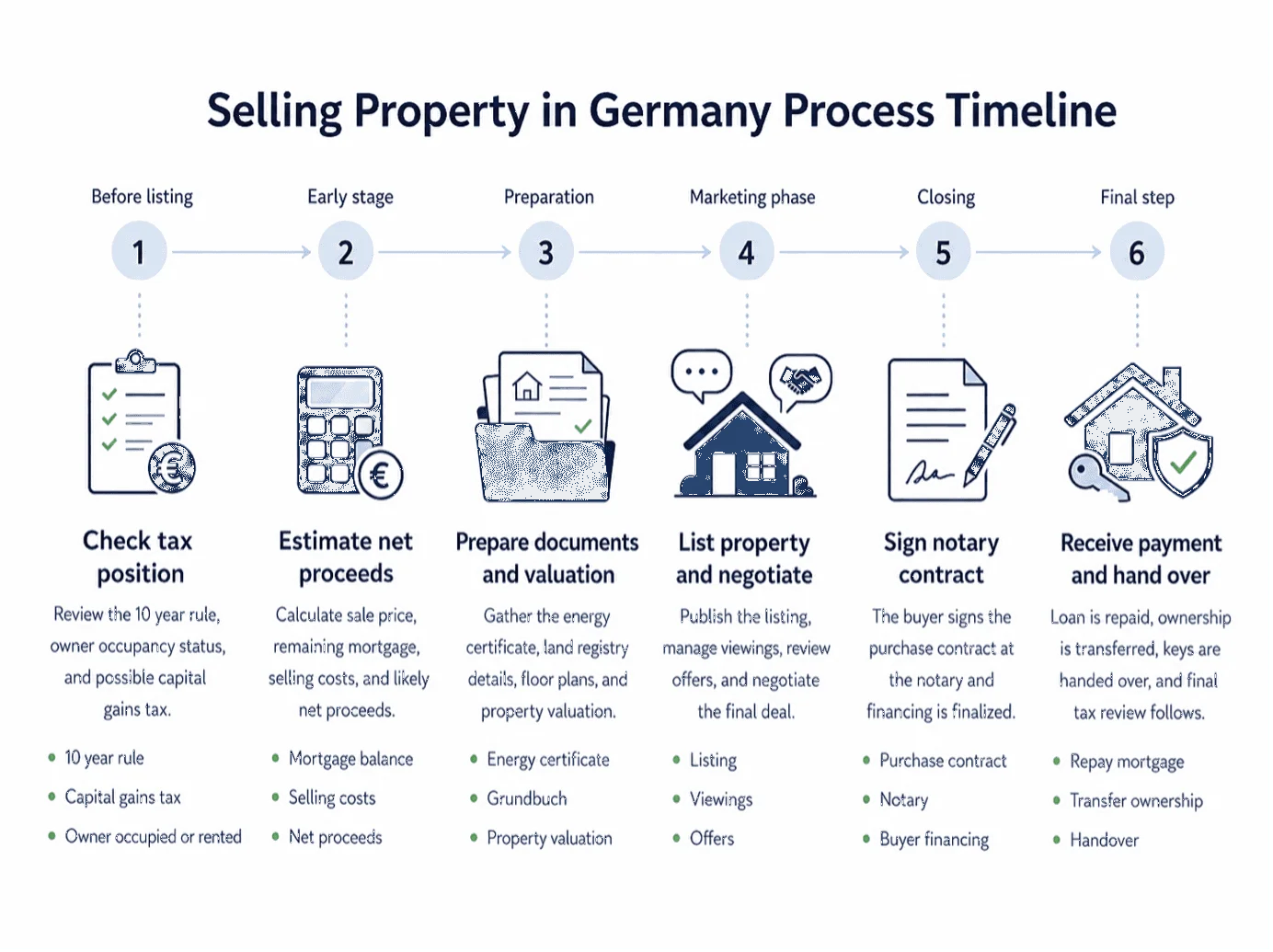
Step by Step Property Sale Process
- Check capital gains tax and 10 year rule. Before starting the selling process, find out whether you have any tax to pay. The capital gains tax 10 year rule is a single key step that can have a huge impact on your selling strategy.
- Inform your bank of your intention to sell and find out whether any prepayment penalties will apply and what documentation is needed to release the land charge.
- Value the property. Get a realistic view of the property's value on the current market.
- Gather documents. Land register extract, energy certificate, floor plans, building plans and other relevant documents.
- Decide on agent or private sale. Factor in commission costs against the practical value of professional support, especially if selling from abroad.
- List the property and negotiate. Marketing, viewings, offers and negotiation.
- Sign the notary contract. Signed by buyer and seller in person or by the authorized person holding power of attorney.
- Buyer payment and mortgage repayment. The buyer pays the purchase price and the seller repays the mortgage. As soon as the mortgage has been repaid the land charge is released.
- Handover and final tax review. Keys are handed over and any outstanding tax matters for the year of sale are resolved.
Missing documents and outstanding tax liabilities are by far the most common causes of delay. There are also situations where the seller halts the process to clarify tax liability, or where the buyer's finance fails to materialise.
Should You Sell Now or Wait?
Deciding when to sell entirely depends on your personal circumstances as well as the current market. Key factors include:
- Where you are relative to the 10 year mark
- Current market price and whether it is increasing in the meantime
- The size of any prepayment penalty on your mortgage
- Whether you need the proceeds or could afford to wait to reach the tax free threshold
- Rental income generated in the meantime
- Your personal circumstances and future plans
The decision to sell must be based upon the seller's net proceeds after sale costs and the prepayment penalty on the mortgage have been deducted from the sale price. The gain before tax is of little use to a seller. You can also refer to our Property Investment Calculator to take an informed decision if you are comparing selling now with keeping and renting the property.
Reinvesting After Selling Property in Germany
For many expats, their German properties have a large equity content. The equity released can be put to work elsewhere, to repay other debt, to invest in another property in Germany or abroad, or to diversify into other asset classes such as shares, funds or bonds. The funds can also be held for relocation or retirement planning:
- Paying down other debt
- Reinvesting into another German or international property
- Diversifying into other asset classes
- Holding as liquidity for relocation or retirement planning
Remember that your net proceeds will be reduced by your mortgage repayment, the costs of the sale, and your capital gains tax liability. Therefore, please act calmly and do not let yourself be pressurised into making a decision close to the date of completion.
If you are considering reinvesting into another German property, our article on real estate investment in Germany can help you understand rental yield, property tax and real returns before making a new decision. You can also use the Real Estate Search Engine to compare potential investment opportunities after you know your real net proceeds.
How Finance for Expats Can Help Property Sellers
Financing and selling property in Germany can present a number of challenges for expats. First there is the matter of the tax. Then there is the mortgage that is outstanding on the property. And last but not least, there are the holding costs that are often far greater than the tax savings of waiting 1 or 2 years to cross the 10 year threshold.
A personal review of an expat's circumstances prior to listing the property for sale will ensure that he or she realises the full potential of their assets, covering:
- Capital gains tax implications and expected liability
- Where you stand relative to the 10 year rule
- The prepayment penalty charged by your bank
- A realistic calculation of net proceeds after mortgage, selling costs and capital gains tax
- Whether to sell now, hold for a while, or rent out instead
If you want to review your situation before listing your property, you can contact Finance for Expats for a personal review.
Frequently Asked Questions About Capital Gains Tax Germany and Selling Property
Do I pay capital gains tax when selling property in Germany?
The capital gains tax depends on two criteria: how long you have held the property and how you have used it. If held for more than 10 years as a privately held rental property or investment property, you will usually not have to pay any capital gains tax. If held for less than 10 years, you may pay capital gains tax on the gain at your personal income tax rate, unless an exemption applies.
What is the 10 year rule Germany for property?
Privately held rental or investment properties can usually be sold tax free if sold after a holding period of more than 10 years, calculated from the date of purchase as stipulated in the notary contract to the date of sale.
Can I sell my German property tax free?
Selling an owner occupied or partially owner occupied property can also result in tax free gains, within the limits of the personal use provisions. The exact treatment depends on how the property was used and should be checked before listing.
What is Spekulationssteuer Germany?
"Spekulationssteuer" is the common German term for the taxation of a capital gain realised on the private sale of a property within the speculation period.
How is capital gains tax Germany calculated?
A simplified calculation is: selling proceeds minus acquisition costs minus eligible selling expenses minus eligible improvement costs equals taxable gain. This gain is then taxed at the seller's marginal tax rate if the sale is taxable.
What costs do sellers pay in Germany?
Typical seller related costs can include real estate agent commission, property valuation, preparation of documents, possible costs connected to the notary process, prepayment penalty for a fixed rate mortgage, and capital gains tax depending on the period of time the property was held and its use.
What happens to my mortgage when I sell?
The mortgage will typically be repaid from the sale proceeds on the date of completion. If the sale takes place before the end of a fixed rate period, an early redemption penalty may be charged.
Is capital gains tax Germany the same for property and investment income?
No. For private individuals holding real estate for more than 10 years, the sale can often be tax free. This is different from many other forms of investment income, such as dividends or stock gains, which follow other tax rules.
Can expats sell property in Germany from abroad?
Yes. Taxation of capital gains on the sale of German real estate by non resident expats is generally subject to German rules because the property is located in Germany. However, tax planning, notary coordination, certified documents and payment handling can be more challenging than for local property owners.
Final Thoughts: Calculate the Tax Before You List the Property
The key to a successful sale is financial planning before listing your German real estate. Many expats have property in Germany but lack financial planning for the sale. Once they have listed their property and had several offers, it is too late to consider the financial impact on their sale proceeds.
The key for the sale of your German property is the calculation of the net proceeds, which will be the basis for your decision whether to put your German property for sale now or in some months from now. So, before you start listing your property, calculate your potential return and then you can make an informed decision on whether to sell your German property now or wait a few months for a better return.