

Why Due Diligence in Germany Is Critical for Expats
Buying a home in Germany is exciting. For many expats, it feels like putting down real roots, a sign that this chapter of life is permanent. But that's not to say that there aren't any hidden costs and potential surprises lurking in the purchase of any big ticket item, especially one as expensive as a property. At first, when home hunters first begin to search for properties, they are drawn to images of the property itself, pictures of floors, of balconies, of a property situated on a street. It is only when they have signed the purchase contract and have settled into their new home several months later that the less desirable aspects of the property will start to reveal themselves.
Property due diligence in Germany is not a mere formality that needs to be complied with before a home or apartment can be purchased. For many people, due diligence in Germany is even more complicated than it is in other countries, because the German property market is characterized by a very different language and a range of different legal structures, which are unknown to most expats.
The majority of problems in relation to properties in Germany become apparent later on rather than right from the start. They can be hidden in documents that the buyer is not shown, later costs of which are to be borne by the buyer. Problems are also caused by third parties who are unknown to the buyer and whose decisions in some way or other affect the real estate investment of the buyer. However, all of these problems can be identified prior to an investment in the German real estate market.
This article aims to help the expat interested in buying property in Germany to make informed decisions. It describes what expats have to be aware of, which important documents the potential buyer has to check, what costs a property owner in Germany has to pay and how the buyer can make a well informed decision to buy the right property. This practical guide to property due diligence in Germany helps expats understand property documents, ownership costs and hidden risks before buying real estate in Germany.
What Due Diligence Means in German Real Estate
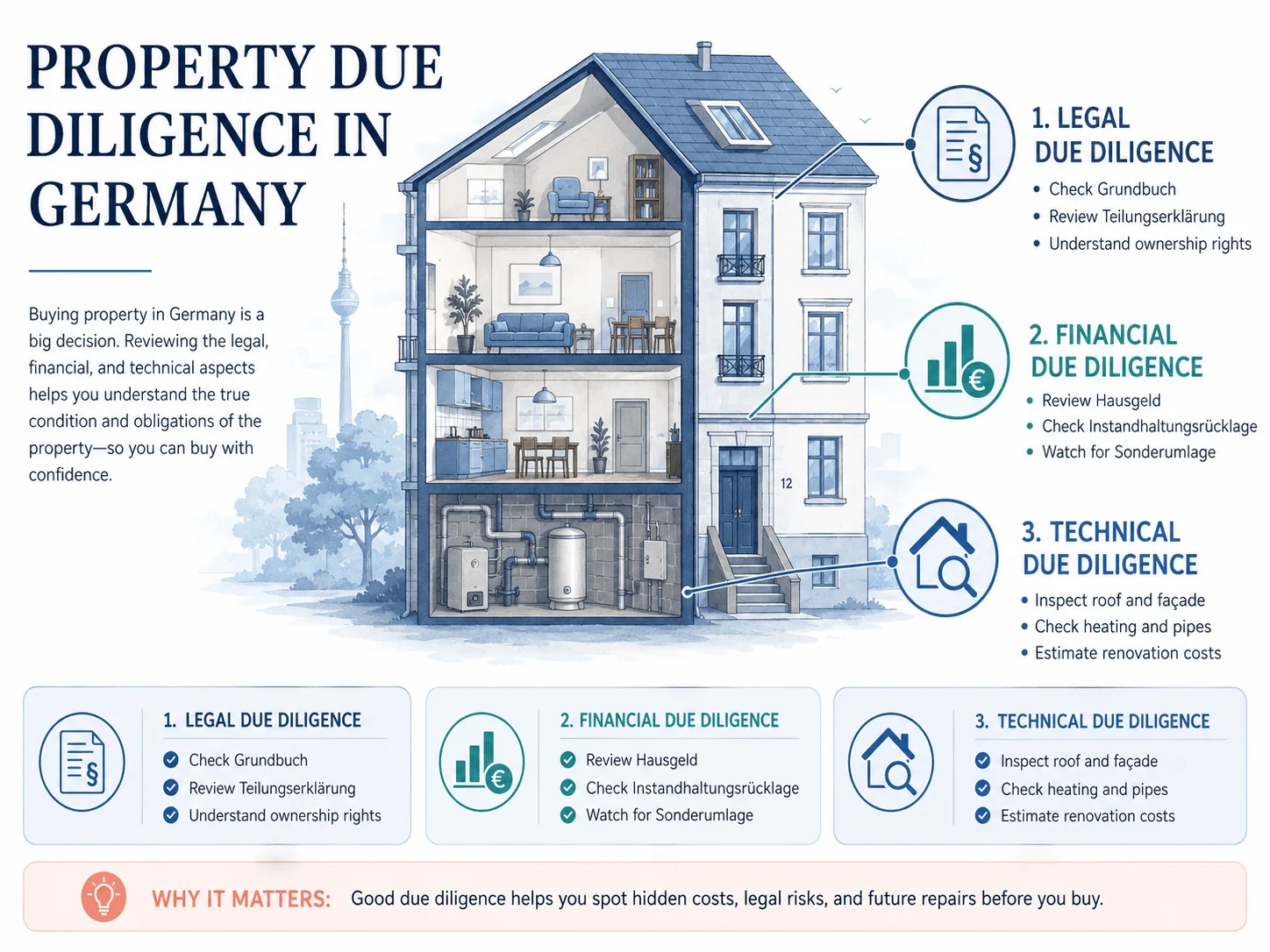
Due diligence is an examination to check as many things as possible before buying real estate. As a buyer of real estate in Germany, you have to be aware that buying a house involves more than just viewing a property and signing a purchase contract. In a structured process, you go through all the documents of the seller of the property and verify their content. Furthermore, you have to establish the full costs of owning a house and check for potential risks for the property as well as for your personal life as a house owner.
It breaks down into three core areas. This due diligence process is a structured risk evaluation process and an essential due diligence checklist for anyone considering property due diligence Germany or real estate due diligence Germany.
Legal Due Diligence
Legal due diligence includes checking the documents of a property in order to verify the ownership of the property. This means that the seller of a property has to be the owner of the property or he has to have a power of attorney granted to a third party. Property documents are registered in the "Grundbuch", the land registry. A "Grundbuchauszug", or land registry extract, is used to check the ownership of a property and other information registered in the Grundbuch such as outstanding debts, registered liens on a property and other third party rights on a property.
A special aspect of property due diligence for expats in Germany is the review of the legal due diligence of a property. It is important to clarify if the seller of a property is really the owner of the property and if he is allowed to sell the property. The review of the official property documents buyers need usually starts with the "Grundbuchauszug". The "Grundbuchauszug" shows the owner of the property and if there are any registered debts, loans or other third party rights against the property. The legal due diligence of a property also clarifies the structure of a property within a building. An apartment owner is for example subject to several documents that define what part of the property the owner is entitled to and what part of the property is owned by other owners.
Technical Due Diligence
The second area of property due diligence is the technical inspection of a property. This will typically cover the roof, windows, doors, walls, floors, kitchen and bathroom, heating and ventilation, the plumbing and the electrical installation. The technical inspection of a property will identify all the wear and tear of a property and provide an estimate of how much it will cost to repair any defects as well as how much it will cost for future maintenance. It is easy to underestimate the potential repair costs of the smallest defects. For example, a small patch of damaged roof tiles could potentially cost many thousands of Euros to repair if they were to leak and require the bulk of the roof to be rebuilt. Give old areas of a property a good going over with a coat of paint and you can often hide many flaws in a property.
Technical due diligence is therefore not just about the visible condition of the apartment, but about the wider building condition Germany buyers inherit together with future repair obligations. A proper german property inspection process helps identify building defects buyers in Germany may otherwise miss.
Financial Due Diligence
The costs of property in Germany for the purchase as well as after completion of the property as expenses of the property owner have to be clarified in a financial due diligence. In addition to the interest rate on the mortgage, the funds to be paid into the shared costs of the building, the special parts, as well as the contributions to the reserve fund for the maintenance of the building have to be taken into account. In many cases, additional costs occur, which are not taken into account by the property buyer for Germany before the purchase. These costs are often paid by the property owner for the first time with the first bill and are then a surprise for the property buyer for Germany.
All three areas of due diligence are important and have to be checked. If one area is neglected, serious problems can occur. Financial due diligence in particular shows that the real cost of ownership is not the same as the purchase price alone. Real ownership in Germany costs buyers face often continue long after completion.
The Most Important Property Documents to Check
Most property buyers are misinformed by their estate agent. Many property buyers rely on their estate agent to check property documents. In our experience this will lead to the most serious of mistakes as the property documents registered at the Grundbuch of the land registry are the only reality for a property. Thus the property documents must be read and checked by the buyer himself or herself. This is one of the most important parts of apartment ownership Germany and one of the most critical sections for buyers, because the documents define what you actually own and what you are responsible for.
For many buyers, these are the most important property documents Germany requires you to understand before signing a purchase contract.
"Grundbuch" and "Grundbuchauszug"
The "Grundbuch", or land registry, for every property in Germany is an official document and a very important document for property transactions. It has to be studied carefully before buying a property. An official extract from the land registry, the "Grundbuchauszug", has to be checked for any unusual entries.
The "Grundbuchauszug" is a document that contains the details that are registered in the "Grundbuch". The most important information is the legal owner or owners of a property and any registered debts or outstanding mortgages on the property. In addition to this, there are any registered "Eingriffsrechte", for example for use by utilities or neighbors, or other third party rights. A clean "Grundbuchauszug" is important when searching for a property to buy. It is essential that any unusual entries are explained to the buyer before they buy the property. Sometimes unusual entries can be removed from the "Grundbuch" but this can take a long time and in some cases it is not worth the hassle.
"Teilungserklärung" and "Aufteilungsplan"
We mention the two most important documents regarding the ownership structure of an apartment building: the "Teilungserklärung", or declaration of division, and the "Aufteilungsplan".
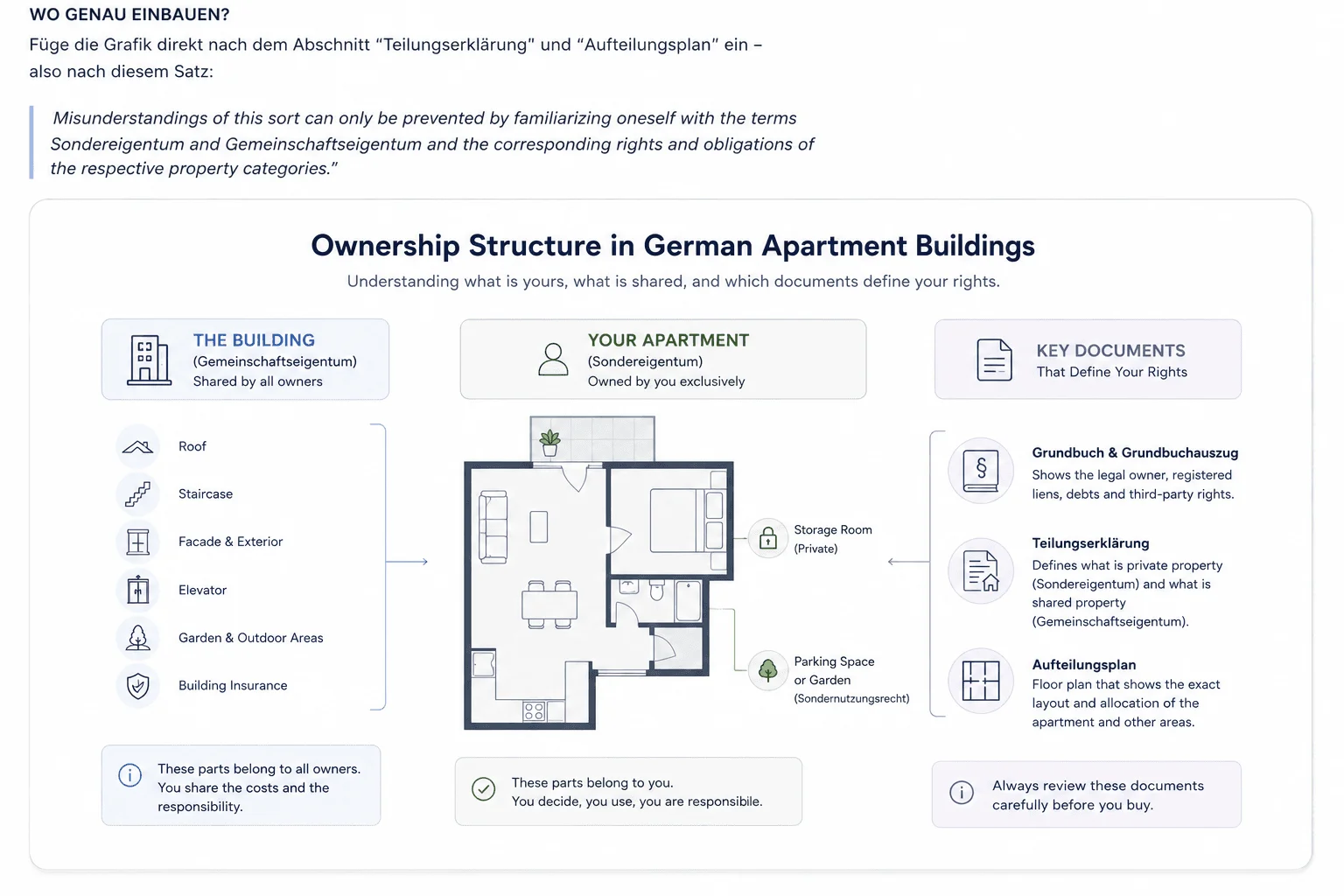
The declaration of division is the basic document which describes the ownership structure of an apartment house. The declaration of division contains a description of the separate properties within an apartment house, for example apartments, storage rooms and similar areas. The declaration of division defines the extent of private property, called Sondereigentum, and joint property, called "Gemeinschaftseigentum", within an apartment house. The stairway, the roof, the garden, the facade of a house and similar parts are joint property of all the apartment owners in the house. The individual apartments are private property, assigned storage rooms are also private property of the respective apartment. Storage rooms without assignment to an apartment are joint property of all the apartment owners in the house. There is also the term "Sondernutzungsrecht", meaning a special usage right. These rights allow the owner of a "Sondereigentum" part to make use of a part of the shared ownership component for his own purposes.
After you have verified the structure of ownership in the "Teilungserklärung" it is also important to take a closer look at the "Aufteilungsplan". This is the floor plan of the building as it has been divided into individual apartments. On this plan you will be able to see whether a storage room shown to you by your agent is part of the apartment you are interested in purchasing or part of another apartment. If the storage room is part of the shared ownership of the building then it is referred to as a "Sondereigentumsverhältnis" mit "Sondernutzungsrecht". This means that even though the storage room is part of the shared ownership of the building, you as the owner of the apartment have an exclusive usage right to it.
Another very important topic are so called "Sondernutzungsrechte". These rights allow the owner of a "Sondereigentum" part to make use of a part of the shared ownership component for his own purposes. For example, a parking space or a part of a garden that is assigned to a "Sondereigentum" part but is shared with other parts of the building, could be assigned with a "Sondernutzungsrecht". It is extremely important to document such rights in sufficient detail in order to prevent them from being lost during the transfer of ownership. Many buyers already have made terrible mistakes due to an inadequate understanding of the respective "Teilungserklärung". They bought a garden for example, which they are not even allowed to use because it is part of the shared ownership. They were sold an attic storage, which actually is part of the shared ownership as well.
Misunderstandings of this sort can only be prevented by familiarizing oneself with the terms "Sondereigentum" and "Gemeinschaftseigentum" and the corresponding rights and obligations of the respective property categories.
"Eigentümergemeinschaft" and Meeting Records
Every single apartment owner is member of the so called "Eigentümergemeinschaft", the owners association of a building. All owners together decide about the management of a building, repairs of a building and all the other costs incurred by a building. The minutes of all meetings of the owners of a building are crucial before buying an apartment in a building. Decisions of the owners association taken prior to the purchase of an apartment by a new owner are also binding for the new owner. Often these decisions can be very costly for the new owner, for example for repairs of a building. Thus, prior to the purchase of an apartment it is very important to study the minutes of all meetings of all owners of a building.
Even more important than handing you a set of papers on the day of the purchase are the meeting minutes of the owners. It will become apparent after reading them that there are some differences between some of the owners, that some decisions have already been made and that there is provision for major work on the building, for example a new roof. In addition, the meeting minutes will inform you of how much has already been spent on maintenance and repairs and whether the building is making a profit or loss. You will also be able to see if there are any outstanding disputes between some of the owners and whether some of the owners are in arrears with their payments. It is also sensible to read the meeting minutes to see if there are any plans for future major work on the building and, if so, how much has already been spent on provisions for a "Sonderumlage".
It is also very important to check for any financial problems of previous owners, possible disputes between owners, major repairs or newly completed work. It is quite common that a special charge, a "Sonderumlage", is needed for very expensive work to be done on a building. These charges are usually unexpected and can become a heavy financial burden on new owners.
Hidden Ownership Costs Most Buyers Miss
More about hidden ownership costs most buyers miss. This is the section many buyers underestimate most, because property costs in Germany are often judged only by the purchase price and mortgage payment, not by the real running costs Germany after completion.
This is why hidden ownership costs german buyers overlook can be more important than a slightly lower purchase price.
"Hausgeld" and Monthly Costs
"Hausgeld": the annual payment to the owners association. As a co owner of an apartment you will be required to pay an annual "Hausgeld" to the owners association. This payment is intended to cover the costs of maintaining and repairing the building, including cleaning the stairways and entrance halls, maintaining the lighting, insuring the building and paying the "Hausverwaltung" for their management services. The majority of the "Hausgeld" is put into the "Instandhaltungsrücklage", the building's maintenance reserve fund. The amount of the "Hausgeld" will be stated in the "Teilungserklärung" and will usually be a few hundred euros per year for smaller apartments. The payment is usually made on a monthly or annual basis. The current "Hausgeld" for each apartment is usually stated in the meeting minutes of the owners association. You should therefore always ask to see the current "Hausgeld" for the apartment you are interested in purchasing.
You will find that the "Hausgeld" is not included in your loan repayment installments. This means that in addition to your loan installments you shall have to include the current "Hausgeld" in your monthly expenditures as a homeowner. In terms of average amounts of "Hausgeld" paid by homeowners for average apartments in Germany, this can amount to a few hundred Euros per month or even more. For this reason it is very important that you not only get informed about the current "Hausgeld" but also find out in more detail about your future expenses as a homeowner.
"Instandhaltungsrücklage"
As to the "Instandhaltungsrücklage", this is the building's maintenance reserve. Here, the past owners of the apartments have put money into a pool which can then be used to repair major defects of the building or for large scale renovations of the building.
A good filled "Instandhaltungsrücklage" means that the building is well managed by the owners association. When a building gets older it needs repairs for the roof, facade, the boiler and so on. All these repairs are to be paid for from the "Instandhaltungsrücklage". If the building has already had some expensive repairs and the "Instandhaltungsrücklage" hasn't been fully rebuilt yet or if the owners have been underpaying into the fund for a long time, then there is a good chance that a Sonderumlage is pending for all the owners.
Have a look at the current amount of the "Instandhaltungsrücklage", compare it with the age of the building and its condition. A low amount of funds in the maintenance reserve indicates the risk of a special surcharge for future repairs and maintenance that are needed in the near future.
"Sonderumlage"
"Sonderumlage", also referred to as a special levy or special contribution, is a one time payment per owner required to cover major repairs of the building that cannot be covered by the building's "Instandhaltungsrücklage". A typical example for a "Sonderumlage" would be the replacement of the roof, facade, heating system or the installation of a lift. "Sonderumlagen" can be very expensive, often thousands of Euros per apartment. Some owners even get surprised with a bill for a "Sonderumlage" before they even have moved into their apartment. This can happen when the owners association has voted for the "Sonderumlage" before the apartment was even sold.
A special additional payment is an extraordinary one time payment by all apartment owners in a building to cover extraordinary structural defects, which the "Instandhaltungsrücklage" cannot cover. A typical example for a "Sonderumlage" is the cost for a new roof. Other examples could be facade repair work, or even the complete replacement of a heating system by a modern gas central heating system. The amount of a "Sonderumlage" is usually between several thousand Euros per apartment and is usually decided upon by the owners association prior to the time the apartment is bought by a new buyer. The buyer has no knowledge of the "Sonderumlage" until he receives the meeting minutes from the sellers. Then it suddenly becomes clear that he as well becomes liable for the payment of the already incurred costs of others.
If you want to compare these hidden ownership costs Germany more realistically against returns and financing, use the Property Investment Calculator.
Buying Costs That Belong to Due Diligence
Additional costs when buying a property that have to be included in your planning when calculating how much you can afford to spend. These buying costs Germany, also described as property purchase costs Germany or closing costs Germany, are a crucial part of due diligence because they directly affect how much capital you need on day one.
In practice, buying costs Germany buyers face can significantly raise the total capital needed for a property purchase, even before the first mortgage payment begins.
"Notarkosten", "Grunderwerbsteuer", "Maklerprovision"
The notary fees for the purchase of a property in Germany amount on average to 1.5 to 2 percent of the contractual value. The notary is a neutral party and legally authenticates the transaction. The "Grunderwerbsteuer" is charged by the state government. The rate can vary between the federal states. For example, in Baden Württemberg it is 3.5 percent of the purchase price, in Bavaria it is 3.3 percent and in Hesse it is 5.5 percent as of 2023. This property transfer tax is one of the largest single additional costs when buying a property and is not negotiable.
Maklerprovision, or agent commission: before 2020 the buyer's agent used to charge 4 to 7 percent of the purchase price. Under the newer laws the commission is split between the seller's agent and the buyer's agent. It is typical for both agents to charge 3 percent of the purchase price, with a maximum of 6 percent. This makes the agent commission a lot more affordable for the buyer when calculating the added costs to the purchase price.
Why "Kaufnebenkosten" Change the Investment
These costs have to be included in your initial fund for a property purchase. They are in addition to the purchase price of a property and most mortgage institutions will not finance these costs. They can quickly add up to a lot of money. For a property purchase price of €400,000 the additional costs could be in the region of €50,000 to €60,000.
Your required funds are higher than the published purchase price of 400,000 Euro. They equal the sum of the building's purchase price plus all of the various costs above which in total equal the "Kaufnebenkosten". In this case, your required funds would equal 400,000 Euro plus 55,380 Euro. So your required funds would be 455,380 Euro. Now the impact of these costs on your entry price and thus your return on your investment should you decide to resell the property must also be considered.
To see how "Kaufnebenkosten", financing and ownership costs affect your liquidity and return, you can also use the Property Investment Calculator.
Technical Red Flags Before Buying
Building Condition and Systems
What the view doesn't reveal, a contrasting reality to due diligence. A buyer views a vacant property as it has been presented on the market for sale. Often the apartment has been freshly painted in a desirable color and decorated with a neutral interior design scheme in an attempt to present a neutral environment and create an acceptable first impression. While the property is shown as it would appear after the completion of any outstanding maintenance or repairs, this may not necessarily reflect the full true reality of the current building condition. There are several critical areas of interest to a prospective buyer to complete a professional technical due diligence including but not limited to the roof, heating system, electrical and plumbing systems as well as the exterior facade of the building.
List of key items to check. Roof: age, damaged parts, leaks. Heating: age, type, efficiency class. Electrical installation: are the electrical installations up to date, or even modern? Sanitary: corrosion, age of pipes. Windows: are there any single paned windows in the old building which would then have to be renovated at cost for the entire building? Facades: cracks, stains, uninsulated areas.
Older Buildings and Hidden Risks
It's common for apartments in Germany to be quite old, to have originated in the last decades of the past century. Many have already been the subject of renovation, but some require further work before they are in good condition. Pre war apartments offer plenty of course many advantages. Their ceilings are tall and rooms are spacious. The original details make every apartment unique and of high quality.
Decades of deferred maintenance, large numbers of owners and lack of organization within the "Eigentümergemeinschaft", the owners' community, all these are very common problems with old buildings. However, the costs to bring the building and each apartment up to a satisfactory condition are to be borne by the Eigentümergemeinschaft regardless. Whether one person or several were responsible for the necessary work is irrelevant.
Most of the older german buildings for sale have out of date electrical installations, old heating systems, or have been filled with all sorts of building materials containing asbestos in insulation and or in sealants. The necessary renovation costs are then in the end to be borne by the Eigentümergemeinschaft. This is why technical due diligence, property inspection Germany and building defects Germany should never be treated as optional extras.
Due Diligence Checklist for Expats
A clear due diligence checklist can turn a confusing purchase into a structured decision. The more systematically you review documents, ownership costs and building condition, the easier it becomes to compare different apartments on equal terms. A strong property due diligence checklist also makes it easier to compare listings objectively instead of relying on first impressions alone.
Legal Checklist
- Check the entry in the "Grundbuch" to establish ownership of the property.
- Check the "Grundbuchauszug" for any outstanding debts, liens or other third party rights against the property.
- Are there any legal restrictions for use, renting or selling the property?
- Make a close examination of the "Teilungserklärung" in order to know the structure of ownership within the building.
- Clarify the extent of the property that is defined by you as sole owner, "Sondereigentum", as opposed to that which is jointly owned by other co owners in the building, Gemeinschaftseigentum.
- Use the "Aufteilungsplan" to show what exactly you buy.
- Make sure the areas which have been presented to you within the viewing are allocated to the property in question, "Sondereigentum".
- Check for special use rights, "Sondernutzungsrecht", such as parking spaces, a garden, a roof terrace, storage facilities and similar areas which are often recorded in the property documents.
- Get documents of the owners community to see if there are any conflicts within the community or decisions pending.
- Check for any future legal duties of the owners or any potential financial obligations that they may place on you.
Financial Checklist
- Double check if your "Hausgeld" includes any operating expenses, for example for a shared garden, as well as any obligatory savings contributions.
- Make a clear distinction between the operating costs of the property and the savings for major repairs that are already included in the "Hausgeld".
- How much is saved for repairs and maintenance in the "Instandhaltungsrücklage"?
- Is the sum of money reserved for future repairs and maintenance sufficient?
- Is there a risk of paying extra for renewal work in the future?
- Estimate the total monthly costs for the property in Germany in addition to mortgage repayments.
- Add property tax, building insurance and maintenance to your estimate of the monthly ownership costs of a property in Germany beyond the interest payments on your mortgage.
- Include the "Notarkosten", "Grunderwerbsteuer" and "Maklerprovision" in your financial checklist to form a complete list of upfront costs for your calculation.
Also note the upfront costs of the property, the "Kaufnebenkosten", in addition to the "Notarkosten", "Grunderwerbsteuer" and "Maklerprovision".
Test how sustainable the property will be in the long term.
Technical Checklist
- Assess the general condition of the property and not only apartment condition.
- Check roof, facade and foundation for proper condition.
- Check the condition of main installations such as heating, sanitary and electrical systems.
- Look for visible defects such as cracks, dampness or outdated equipment in common areas.
- How old are the components of the building and when do they have to be replaced?
- Review energy efficiency and potential modernization needs.
- Are there any obvious signs of deferred maintenance or serious problems with the building?
- Estimate potential future repair and renovation costs.
- What impact can technical problems have on your monthly costs and the value of your property in the long term?
- Compare the property's defects with the seller's price.
Final Decision Questions
Before signing anything ask yourself these three questions and make sure you can give a clear answer to all of them.
- Can I afford it in the long run, including newly found costs?
- Am I 100% sure of all costs involved?
- Are there any risks that I haven't thought of yet?
The answer to these three questions is your answer.
How Due Diligence Helps You Find Better Properties
A very important function of due diligence when buying a property is that it helps you become a better buyer. During your due diligence on the required and optional documents for a property for sale you also become better equipped to check out other potential real estate offers. This is because a close inspection of a seemingly perfect property will reveal issues like a low reserve for repairs and replacements or outstanding payments for special fees, known as Sonderumlagen. You can even discover issues with a well prepared Teilungserklärung.
Looking for a property with the right features can be a long and difficult process. After viewing a few apartments you might start to feel a little disappointed and wonder whether they are all as mediocre as they seem. In reality, it is only by conducting real estate due diligence Germany that you will be able to discover the true potential of a property. It is possible that a property that seemed ideal at first could turn out to have very low reserves, there could be a pending Sonderumlage, or there could be problems with the "Teilungserklärung". On the other hand, the property that seemed ordinary at first could be a very well managed and financially stable home. This is what real estate due diligence Germany can do for you: it can turn your anxiety and uncertainty into clarity and allow you to compare the merits of different properties.
When you start comparing several listings in a more structured way, the Real Estate Search Engine can help you review and compare opportunities more effectively.
Frequently Asked Questions About Due Diligence
What is due diligence?
Due diligence is the process of checking documents, costs and risks before buying a property.
What documents should I check?
You should review the "Grundbuch", "Teilungserklärung" and "Aufteilungsplan" to understand ownership and legal structure.
What are hidden ownership costs?
Hidden costs include "Hausgeld", "Instandhaltungsrücklage" and potential "Sonderumlage" payments.
What is "Hausgeld"?
"Hausgeld" is the regular payment for shared building costs, maintenance and management.
What is "Sonderumlage"?
"Sonderumlage" is a one time extra payment for major repairs or renovations.
What is "Teilungserklärung"?
The "Teilungserklärung" defines what you own privately and what is shared in the building.
Final Thoughts on Due Diligence in Germany
Buying property in Germany for expats is not particularly difficult, but it can be a real disaster for the inexperienced. In this article we are going to discuss due diligence on german real estate. It's not particularly exciting to read about the various property documents that you can expect to find in a German real estate purchase, but when you are looking to compare offers on different German real estate for expats, it can be a real game changer. As we said, the aim of the article is to provide a guide to due diligence on German real estate, and hopefully by the end of it, you will have a good idea of what to look for in a property purchase, and what to watch out for in order to avoid making a costly mistake.
In summary, there are three things you need to understand before buying a property. First, you need to understand the documents for your property. Secondly, you need to understand all of the costs for the property that you have discovered after doing your research. And last but not least, you need to understand the risks for your property. Some of the risks are obvious for property buyers but others are less obvious and are referred to as hidden ownership costs Germany for property buyers.
The best buyers understand documents, understand costs and understand risks before they commit.
If you are unsure where to start with due diligence, or need some additional guidance and advice on your specific circumstances, then please do not hesitate to contact us.