


Table of Contents
- Introduction: The German Real Estate Market at a Turning Point
- Overview of the German Property Market Today
- Supply and Demand Dynamics in German Housing Market
- Property Investment Risk Map for Expats
- Real Estate Investment Strategies That Make Sense in 2026
- Cost Structure and True Investment Returns
- When It Makes Sense to Buy in 2026
- Tools That Support Better Decisions
- Frequently Asked Questions
- Final Thoughts: Investing With Clarity Instead of Headlines
The question of whether to buy property in Germany has always been a blend of cold financial math and life stage planning. The conversation around German real estate has shifted. We aren't stuck in the 2023 sticker shock anymore, and the long pause of 2025 is over. We’re finally seeing the market wake up.
Instead, the real estate market is finding a new, albeit more demanding, equilibrium, shaped by changing real estate trends, investor sentiment and long term economic outlook.
Introduction: The German Real Estate Market at a Turning Point
For the first time in nearly a decade, 2026 is widely discussed as a turning point for the German property market. "The days of 'free money' and negative interest rates are officially behind us. We’ve finally seen the wild price swings of the last three years settle down, especially in the Big 7 cities. But for expats today, it’s a bit of a puzzle. You’re balancing mortgage rates that have leveled off around 3.5% against a housing shortage that feels like it’s never-ending, all while trying to decode a mountain of new green energy laws. It’s a strange paradox to navigate.
On one hand, the fear of missing out has been replaced by a fear of overpaying. On the other hand, rent prices are climbing at record speeds, making the "renting is cheaper" argument harder to sustain. This article aims to pull back the curtain on these market trends to help you decide if 2026 is your year to transition from tenant to owner under the current economic outlook and your personal real estate investment strategy.
Overview of the German Property Market Today
The germany real estate market and overall housing market is notoriously polycentric, and 2026 continues to highlight the bifurcation of the property market where high quality, energy efficient assets are thriving while neglected properties are seeing their housing prices stagnate.
Where the Market Stands Right Now
After the roller coaster of price drops we saw in the early 2020s, the property market and broader real estate market finally feels like it’s catching its breath.
In major hubs like Munich and Berlin, that downward slide has hit a floor. In fact, if you look at certain neighborhoods, prices are already starting to creep back up. But it’s not a ‘one-size-fits-all’ recovery; we’re seeing a very clear split in the market.
A Cities: Munich remains the price leader, followed by Frankfurt and Berlin.
Secondary Markets: Secondary Markets: Regional centers like Leipzig and Potsdam are becoming "investor darlings" due to more attractive purchase price multiples and higher rental yield potential for property investment.
The liquidity slowdown we saw in 2024 has eased. While the "quick flip" is dead, long term housing market demand remains the fundamental bedrock of the market, driven by structural supply and demand imbalances.
Interest Rates and Financing Conditions
Interest rates have transitioned from a source of panic to a predictable variable within the real estate market.
Most buyers are now securing mortgage rates between 3.2% and 3.8%. While this has reduced overall affordability compared to the 1% era, it has also killed off speculative competition and improved buyer negotiation leverage during financing and strengthened long term investment strategy decisions.
Banks have not necessarily become more restrictive, but they are significantly more selective. A solid profile combined with sufficient Eigenkapital is now the gold standard for securing the best terms.
For many investors, real estate is still seen as a key inflation hedge and a core component of portfolio diversification and asset allocation.
Supply and Demand Dynamics in German Housing Market
The single biggest driver of the germany housing market and broader real estate market in 2026 is the widening gap between people and rooftops.
Housing Shortage and Demographic Pressure
The German government’s goal of 400,000 new builds per year remains a distant dream. In 2025, completions dropped significantly, and 2026 is expected to see even lower numbers due to high construction costs. Meanwhile, population growth driven by both high skilled immigration and urbanisation continues to put pressure on the existing stock. For an investor, this translates into nearly zero vacancy risk in top tier locations. So there’s always a demand and supply problem, reinforcing long term real estate investment fundamentals.
Regional Differences That Matter for Investors
In 2026, the smart property investment move and overall investment strategy is shifting toward commuter regions. As hybrid work models stabilize, the rental demand for more space outside the city center has kept prices resilient in regions surrounding Berlin, Hamburg, and Munich.
West vs. East: The "new" East offers higher rental yields for property investment, while the West offers more price stability and long term capital appreciation within the real estate market.
Property Investment Risk Map for Expats
Navigating a foreign market requires a clear market analysis framework. We use a property investment risk map to categorize locations based on their risk return profile.
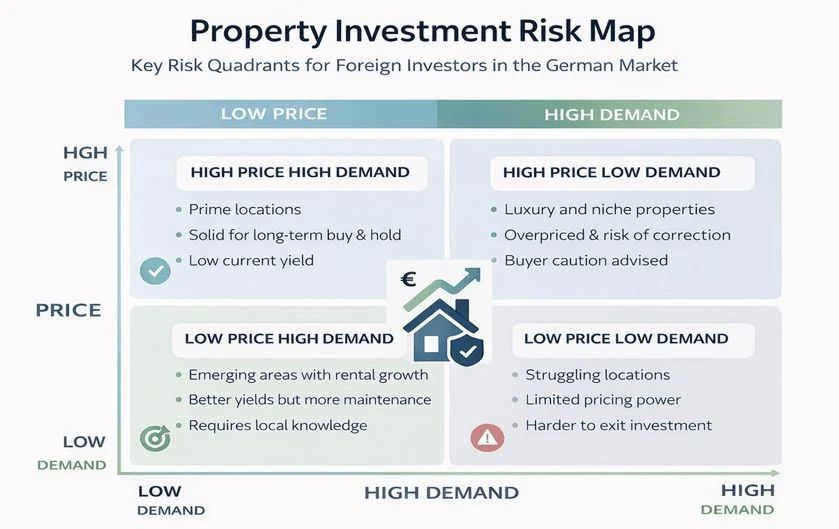
How to Read the Property Investment Risk Map
This map is designed as an orientation tool for expats. It balances current property prices against long term demand, supply and demand dynamics and overall investment strategy.
High Price High Demand Locations
Strategy: Pure long term investment. These areas offer the lowest rental yield but the highest liquidity and safety. These are prime locations for those seeking an inflation hedge in the real estate market and long term portfolio diversification.
Low Price High Demand Locations
Strategy: Focus on rental property cash flow. These areas in the real estate market are emerging hubs where demand is growing faster than prices, offering yields of 4% to 5% and attractive entry points for long term real estate investment.
High Price Low Demand Locations
Strategy: High investment risk. These are most susceptible to price corrections if the local economy dips. This requires careful market timing and also some bit of a market analysis.
Low Price Low Demand Locations
Strategy: Usually unsuitable without local insight. These areas suffer from liquidity risk and weak population trends, making an exit strategy and long term capital allocation difficult.
These categories help investors align their risk profile with the right investment strategy and improve decision making in the german real estate market.
Real Estate Investment Strategies That Make Sense in 2026
The "get rich quick" days are over. Success in 2026 requires a disciplined real estate investment strategy aligned with long term investment goals and market conditions.
Buy and Hold Versus Timing the Market
Trying to "time the bottom" of the real estate market is a difficult task and rarely a successful investment strategy. In Germany, high transaction costs mean that market timing rarely works. The most successful investors in 2026 are those with a long term investment horizon and a clear focus on price stability rather than short term speculation.
Owner Occupied Versus Investment Property
- Owner Occupied: Driven by life stability, affordability and personal financing conditions.
- Investment: Driven by tax considerations, rental yield and overall capital allocation strategy. For expats, buying a rental property can often be more tax efficient due to interest and depreciation deductions. Investment:
Cost Structure and True Investment Returns
Understanding your capital allocation and overall investment returns means looking beyond the sticker price.
Purchase Costs Beyond the Property Price
In Germany, ancillary costs are significant. Property transfer tax varies by state, often reaching 6.5%. When you add notary and land registry fees, your total transaction costs can reach 10% or more of the property prices.
Ongoing Costs and Risk Buffers
Ownership involves more than just a mortgage. You must account for maintenance reserves and the investment risk associated with vacancy and fluctuating rent prices. In 2026, building in a liquidity buffer for energy efficient upgrades is mandatory for any serious investor.
When It Makes Sense to Buy in 2026
Signals That Support a Purchase Decision
- You plan to stay in Germany for a long period.
- You have a stable income and a clear long term horizon.
- You have enough capital for asset allocation into real estate as part of a broader portfolio diversification strategy.
Situations Where Waiting May Be Smarter
- You are on a short term contract with high liquidity risk.
- Your household income is highly variable.
- You are counting on immediate, aggressive price growth to justify the purchase.
Ultimately, the decision to invest in property depends less on market timing and more on individual affordability, financing structure and long term investment strategy.
Tools That Support Better Decisions
Before signing a contract, you should pressure test your assumptions using the right real estate investment tools and market analysis.
- Property Investment Calculator: Use this to test affordability, financing scenarios and how mortgage rates change your monthly cash flow.
- Real Estate Search Engine: Filter by region to find locations where the property market and housing market offer yields that cover interest payments and support your investment strategy.
Frequently Asked Questions
Is 2026 a good year to buy property in Germany?
Yes, for long term investors with stable financing who want to invest in property within the current real estate market conditions while competition is lower.
Will property prices fall further?
In some regions, it is possible. However, the germany housing market is structurally undersupplied, which supports price stability in the long run.
How risky is German real estate for expats?
The investment risk mainly comes from the structure of the deal, financing and taxes, not necessarily the real estate market itself.
Do high interest rates make buying unattractive?
Not for long term investment strategies. While mortgage rates are higher than in previous years, they often allow for better negotiation on property prices and the interest is tax deductible for rental property investments.
Is renting better than buying?
It depends on your personal long term horizon and stability. If you plan to stay in Germany for more than five to seven years, the equity built through a mortgage often outweighs the sunk cost of rent prices.
Which regions offer the best opportunities?
Areas with high property demand and limited supply, driven by strong supply and demand dynamics. This includes commuter regions around A cities and university towns where urbanisation keeps vacancy rates near zero.
Final Thoughts: Investing With Clarity Instead of Headlines
The real estate market in Germany and broader germany housing market is no longer a place for spectators. While headlines focus on the housing crisis, the underlying reality is one of structural demand.
Risk in 2026 doesn't come from the real estate market or market timing it comes from poor capital allocation, financing structure and preparation. If you align your investment strategy with long term goals, property remains one of the best ways to build wealth in Germany as part of a long term investment strategy and portfolio diversification.
Making the right decision means aligning affordability, investment strategy and market conditions rather than relying on short term headlines.