


Short answer
The "Beleihungswert" is the value a German bank accepts as security for your mortgage. It is not automatically the same as the purchase price. If the bank value is lower than the price you agreed with the seller, you may need more own funds, face a higher "Beleihungsauslauf", receive different mortgage conditions or run into a financing gap before the notary appointment.
Table of Contents
- What does Beleihungswert mean in simple English?
- Why the bank Beleihungswert is not automatically the purchase price
- LTV on purchase price vs LTV on bank value
- Beleihungswert vs Kaufpreis vs Verkehrswert vs Marktwert
- How do banks determine the Beleihungswert of a property?
- How the Beleihungswert affects Beleihungsauslauf
- What is the Beleihungsgrenze?
- Why a low Beleihungswert can create a financing gap
- How the Beleihungswert affects mortgage approval
- Can the Beleihungswert affect your mortgage rate?
- Beleihungswert and Vollfinanzierung
- What can expats do if the bank value is too low?
- Owner occupied home vs investment property
- What to check before signing the notary contract
- Simple example: how Beleihungswert changes your mortgage numbers
- FAQs about Beleihungswert in Germany
- The bank Beleihungswert is a reality check before buying
What is the "Beleihungswert", and why does your bank care so much about it? If you're buying property in Germany as an expat, there's a good chance you first heard this word somewhere in the middle of the mortgage process. Maybe your advisor mentioned it in passing. Maybe the bank's offer came back with a smaller loan than you expected, and suddenly everyone was talking about it. Either way, it's one of those German terms that sounds far more complicated than it really is.
Here's the short version. The "Beleihungswert" is the value the bank is willing to accept as security for your mortgage. Think of it as the bank value, or what English speakers might call the lending value or collateral value. And here's the part that surprises a lot of buyers: it's not automatically the same as the purchase price you agreed with the seller.
That small detail can have a big impact on your mortgage in Germany:
- It can make or break your mortgage approval.
- It can change how much own funds, or "Eigenmittel", the bank wants to see from you.
- It sets your "Beleihungsauslauf", which plays a big role in your mortgage rate.
- It can leave you with a financing gap you didn't see coming.
If you're just getting started, our guide to getting a mortgage in Germany is a good place to get the bigger picture. In this article, we'll zoom in on one thing: why your bank might look at the same property and see a lower number than you do, and what that means for your home loan in Germany.
What does Beleihungswert mean in simple English?
The "Beleihungswert" is the bank's lending value for your property, sometimes called the security value or collateral value. It's the amount the lender is willing to treat as real, dependable security behind your loan.
Behind the term sits one fairly blunt question the bank has to ask itself: if this borrower can't repay, how strong is this property as collateral? Not today, in a good market, but at some unknown point over the next 20 or 30 years.
That's why the "Beleihungswert" definition is deliberately cautious. You might love the view from the balcony, the neighbourhood or the fact that you finally found something after months of searching. The bank doesn't price any of that in. It looks at what would still hold its value if the property had to be sold by someone with no emotional attachment to it at all.
Two German words come up a lot here, so it helps to know them:
- "Sicherheiten" simply means securities or collateral: whatever backs up the loan.
- The "Grundschuld" is the land charge entered in the land register. It's the legal instrument that lets the bank sell the property if the loan isn't repaid.
So when someone asks what the "Beleihungswert" is, the short answer is: it's the bank's careful estimate of what your property is worth as security, not what you're paying for it.
Why the bank Beleihungswert is not automatically the purchase price
The "Kaufpreis" and the bank "Beleihungswert" answer two completely different questions, and that's the root of most of the confusion.
The purchase price is what you and the seller agreed on. It's a negotiation result. The bank value is what your lender accepts as security for the mortgage. The bank isn't financing your opinion of what the property is worth, and it isn't financing the seller's opinion either.
There are plenty of good reasons a buyer pays more than a lender would count. Maybe three other people wanted the same apartment. Maybe you needed to move before the school year started. Maybe supply in your area is simply thin and you decided the premium was worth it. None of that is irrational, but none of it makes the property better collateral.
When the "Immobilienbewertung" by the bank comes back lower than expected, a gap opens up between four numbers:
- The purchase price you signed up for
- The bank's "Beleihungswert Immobilie"
- The loan amount you wanted
- The "Eigenmittel" you actually need to bring
If you have plenty of savings, this valuation gap is annoying but manageable. If you were planning on high financing with limited own funds, it can change your whole plan. Our article on bank value vs purchase price covers the wider valuation picture if you want the background first.
The practical consequence of all this has a name in German, and it's probably the single most useful term in this article: "Beleihungsauslauf", or loan to value.
LTV on purchase price vs LTV on bank value
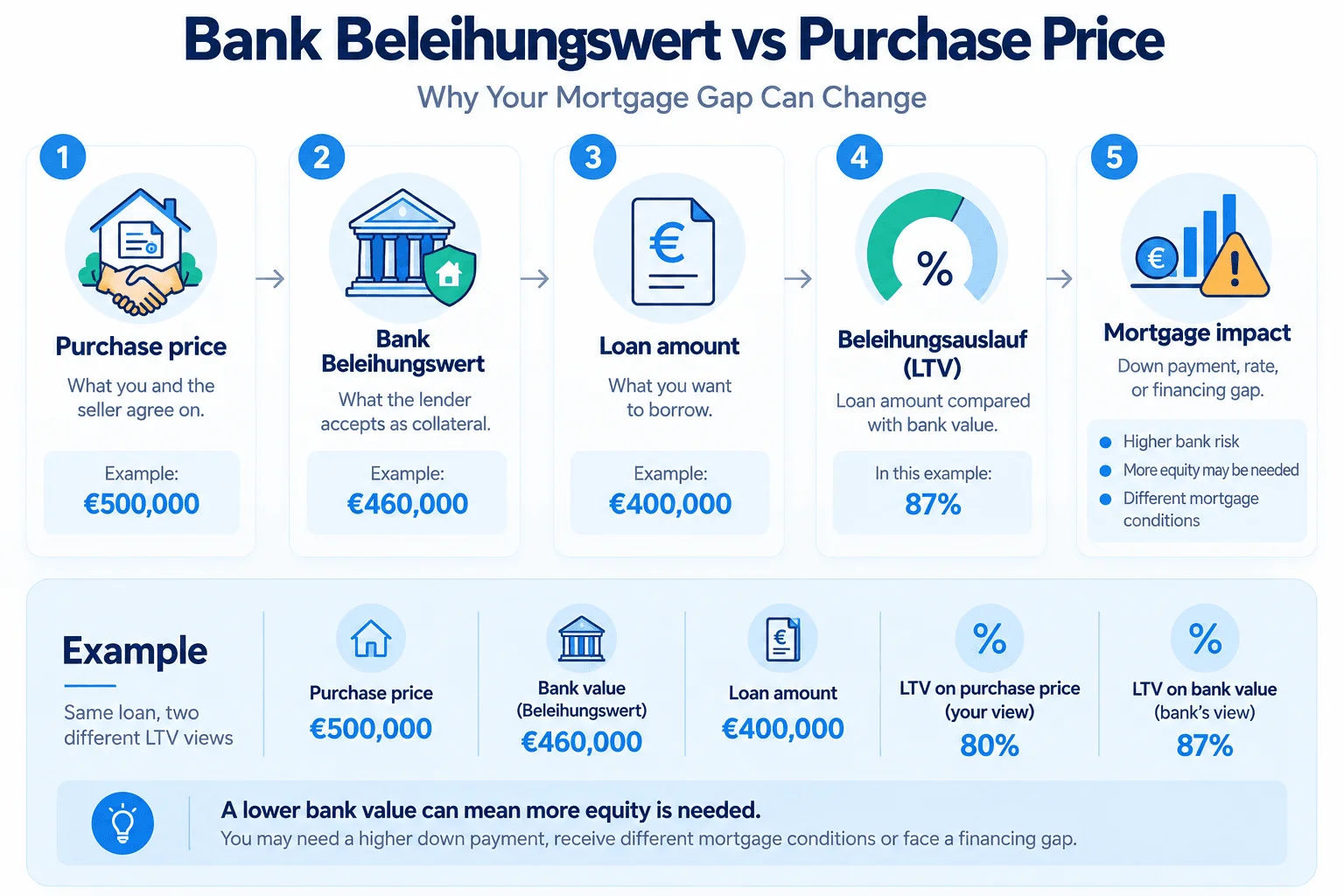
Here's where most buyers get caught out. You calculate loan to value against the price you're paying. The bank calculates its risk against its own valuation. Same loan, two very different percentages.
The numbers:
- "Kaufpreis": EUR 500,000
- Bank "Beleihungswert": EUR 460,000
- Desired "Darlehenssumme": EUR 400,000
Your view: EUR 400,000 divided by EUR 500,000 equals 80 percent LTV on purchase price.
The bank's view: EUR 400,000 divided by EUR 460,000 equals roughly 87 percent LTV on bank value.
You walk in thinking this is a comfortable 80 percent case. The bank files it closer to 87 percent. That difference can affect your mortgage approval, how much "Eigenmittel" the lender wants to see, and the conditions you're offered.
Which is exactly why the purchase price on its own tells you very little about how risky your financing looks from the other side of the desk.
Example
Why the bank sees a different LTV than the buyer
Buyer view: EUR 400,000 loan divided by EUR 500,000 purchase price equals 80 percent.
Bank view: EUR 400,000 loan divided by EUR 460,000 "Beleihungswert" equals roughly 87 percent.
Result: The bank may see more risk, ask for more own funds or offer different mortgage conditions.
Beleihungswert vs Kaufpreis vs Verkehrswert vs Marktwert
Four German words, all of them about value, all of them meaning something slightly different. Here's the plain version.
Simple comparison
Four property values buyers often confuse
"Kaufpreis": What you agree to pay.
"Verkehrswert" / "Marktwert": What the property may be worth in the market today.
"Beleihungswert": What the bank accepts as security for the loan.
"Beleihungsauslauf": Your loan amount compared with the bank value.
Kaufpreis
The "Kaufpreis" is the purchase price agreed in the property transaction. It's what you actually pay, it's what goes into the notary contract, and it's the number everyone quotes at dinner parties.
What it isn't: automatically the value your bank works with.
Verkehrswert and Marktwert
"Verkehrswert" and "Marktwert" both sit close to market value. They describe what the property could realistically fetch on the open market, based on comparable sales, location, size and condition.
They're more objective than a purchase price, since they're not the result of one particular negotiation. But when you compare "Verkehrswert" and "Beleihungswert", they still aren't the same thing: a market value is a snapshot of today, and the bank is thinking about the whole life of your loan.
Beleihungswert
The "Beleihungswert" is the bank's financing and security value. It exists to answer an internal question: how safe is this property as collateral if things go wrong?
It's usually more cautious than the property value you have in your head, and it's the number that drives the lender's mortgage decision. In short: "Kaufpreis" is what you pay, "Verkehrswert" is what the market says, "Beleihungswert" is what the bank will stand behind.
How do banks determine the Beleihungswert of a property?
Honest answer first: you can't know your final bank value with certainty until the lender has reviewed your case. That's frustrating, but it's how "Beleihungswertermittlung" works.
What the bank typically looks at during its "Objektbewertung":
- The property documents you submit
- Location, down to the street and the surrounding area
- Size and layout
- Year of construction
- Overall condition
- The energy certificate, or "Energieausweis"
- Any renovation backlog
- Comparable properties nearby
- Realistic rental potential, especially for an investment property
- How easily the property could be sold if the bank ever had to recover the loan
Two banks can look at the same apartment and land on different numbers. One might be comfortable with older buildings in your district, another might not lend on them at all. This is normal, and it's one of the reasons comparing lenders is worth the effort.
A lot of people search for how to calculate the "Beleihungswert", hoping there's a formula. There are rules of thumb, and a common one is to take the market value and subtract a "Sicherheitsabschlag" of roughly 10 to 20 percent. Treat that as orientation only. The number that counts is the one the lender produces.
What you can do before that point is get an initial property value indication from a data driven "Immobilienbewertung", so you at least know whether the asking price is in a sensible range.
Finance for Expats Tool
Get an initial property value indication
Use the Real Estate Valuation Tool to get a market based first impression before the bank completes its own valuation.
This is orientation only. The final "Beleihungswert" is determined by the lender.
How the Beleihungswert affects Beleihungsauslauf
"Beleihungsauslauf" is the German term for loan to value, and it's where the bank value stops being abstract and starts costing you money.
In words: your "Darlehenssumme" divided by the "Beleihungswert" gives you the "Beleihungsauslauf".
"Beleihungsauslauf" = "Darlehenssumme" divided by "Beleihungswert".
Back to our example:
- "Kaufpreis": EUR 500,000
- Bank "Beleihungswert": EUR 460,000
- "Darlehenssumme": EUR 400,000
You see 80 percent, because you're dividing by the price. The bank sees around 87 percent, because it's dividing by its own valuation.
Why this matters in practice:
- A higher "Beleihungsauslauf" means more risk on the bank's books.
- The lender may ask for more "Eigenmittel" to bring the ratio down.
- Your conditions can get less attractive as you cross the usual thresholds.
- In tighter cases, approval itself becomes harder.
Banks tend to price in steps rather than smoothly, so a few percentage points either side of a threshold can matter more than you'd expect. If you want to see how the pieces interact, you can use the Interest and Repayment Calculator to calculate loan amount, interest and repayment impact and test a few scenarios before you commit to anything.
What is the Beleihungsgrenze?
"Beleihungsgrenze" sounds like a twin of "Beleihungswert", but it's a different idea:
- The "Beleihungswert" is the value.
- The "Beleihungsgrenze" is the lending limit built on top of that value.
In other words, the bank first decides what your property is worth as security, then decides what share of that it's willing to lend against under its safest terms. For Pfandbrief financing, that limit sits at 60 percent of the bank value, which is why people who look up how to calculate the "Beleihungsgrenze" usually land on that figure.
Don't read this as a cap on your mortgage. Most lenders go well beyond it. What it really tells you is where the cheap, comfortable part of the loan ends and the riskier, more expensive part begins.
For a buyer, the practical takeaway is simple: the bank may not finance as much as you assumed, and the portion above its comfort zone will cost you more.
Why a low Beleihungswert can create a financing gap
Here's the chain of events that catches people out:
- You agree on a price with the seller.
- The bank values the property lower than that price.
- You still owe the agreed price at the notary.
- The loan doesn't stretch far enough to cover it.
- The difference has to come out of your own pocket.
That's a financing gap, and for expats it can be a genuine shock, because the purchase price feels like the value. You negotiated it, someone else was willing to pay nearly the same, the listing said so. But none of that binds your lender.
What makes it sting is the timing: the gap lands on top of the "Kaufnebenkosten", which you also have to pay from your own savings. Those typically include:
- Notary fees
- Land registry fees
- Real estate transfer tax, or "Grunderwerbsteuer", between 3.5 and 6.5 percent depending on the federal state
- Broker commission, where one applies
Together these usually add up to something in the region of 10 percent of the purchase price. So a buyer who planned carefully around price plus costs can still end up short once the bank value comes in lower than expected.
Before you make an offer, it's worth running the full picture. Use the Total Cost of Ownership Calculator to calculate acquisition costs and total ownership costs, so you can see how much "Eigenkapital" you really need rather than discovering it three weeks before the notary appointment.
Finance for Expats Tool
Check the full cash requirement before making an offer
The Total Cost of Ownership Calculator helps you estimate purchase costs, taxes, notary costs, ownership expenses and the cash you may need before moving toward the notary.
This calculator provides orientation only and does not replace lender approval or individual advice.
How the Beleihungswert affects mortgage approval
It's tempting to think mortgage approval is all about you: your salary, your contract, your savings. That's half of it. The property has to pass its own test.
A German lender is weighing up two sides at once:
- You: income, employment stability, residence situation, SCHUFA and overall credit profile, and your "Eigenmittel".
- The property: its value, its risk, and how well it works as "Sicherheiten".
A strong salary genuinely helps. What it doesn't do is fix a weak valuation. If the bank only counts EUR 460,000 of security, a high income won't persuade it to count EUR 500,000. The loan still has to sit on collateral the bank is comfortable with.
This is also why two applicants with identical finances can get different answers on different properties, and why the same property can get different answers from different banks.
We've covered the borrower side of German mortgage approval in detail elsewhere. This article is deliberately about the other half: the property and what the bank thinks it's worth.
Can the Beleihungswert affect your mortgage rate?
Yes, indirectly but reliably. Lenders price according to risk, and the bank value is a core input into how risky your case looks.
Run the same loan against a lower valuation and the ratio gets worse without anything about you changing. A EUR 400,000 loan looks like 80 percent against a EUR 500,000 price and closer to 87 percent against a EUR 460,000 bank value. The second version simply prices differently.
What a lower bank value can influence:
- Your mortgage rate and overall "Finanzierungskonditionen"
- How much "Eigenmittel" the lender wants before saying yes
- Your chances of approval at that particular bank
- Which lenders are realistically worth approaching at all
What nobody can promise you is a specific number. Rates move, banks weight risk differently, and a case that one lender prices awkwardly can look perfectly ordinary to another. For the wider picture on where rates sit and when to fix, our article on the current mortgage rate context is a better place to look than any single quote.
Beleihungswert and Vollfinanzierung
The less equity you bring, the more the bank value decides your fate. That's why "Vollfinanzierung" deserves its own section.
The terms you'll hear:
- "Vollfinanzierung": financing with little or no equity of your own.
- "100 Prozent Finanzierung": the loan covers the property price, and you pay the acquisition costs yourself.
- "110 Prozent Finanzierung": the loan covers the price and the "Kaufnebenkosten" too.
All of them depend heavily on three things: the bank value, your "Eigenmittel" and your borrower profile.
Here's the catch that trips people up. 100 percent financing usually refers to 100 percent of the purchase price. But your bank isn't working from the purchase price, it's working from the "Beleihungswert". Borrow EUR 500,000 against a EUR 460,000 valuation and your "Beleihungsauslauf" is about 109 percent. What you called a 100 percent case is, in the bank's file, something considerably more ambitious.
This isn't impossible. It is harder, and it's harder still for expats with a short German credit history or a temporary residence status. If you're weighing up how much to put in, our FAQ on the deposit and own funds for expat buyers sets out what's realistic for a home loan in Germany.
What can expats do if the bank value is too low?
A disappointing valuation feels final. It usually isn't. Here's what's actually on the table.
Ask another lender. Banks assess the same property differently, sometimes by a wide margin. One bank's cautious number is another's normal one.
Increase your "Eigenmittel". More equity means a smaller loan, a lower "Beleihungsauslauf" and a case the bank finds easier to say yes to.
Renegotiate the "Kaufpreis". A professional valuation coming in below the asking price is a legitimate argument with the seller. Raise it before the notary appointment, not after.
Reduce the loan amount. Sometimes the fix is a smaller mortgage rather than a bigger fight over value.
Improve the documentation. Missing floor plans, an old energy certificate or no evidence of recent renovation work all push a valuation downwards. Fill the gaps and resubmit.
Look at comparable properties. If similar homes nearby sold for more, that's useful context for the conversation with your lender or the seller.
Walk away if the gap is too big. This one is worth taking seriously. A low bank valuation is sometimes an expensive stranger telling you, for free, that you're overpaying.
Talk to a broker before you commit. An independent adviser knows which lenders suit which property types and which ones work well with expat applicants. Our guide on how to compare lender options explains how that comparison usually works in practice.
Owner occupied home vs investment property: why Beleihungswert matters differently
The same valuation gap means different things depending on why you're buying.
If you buy for yourself
Here the question is affordability and safety. A gap between price and bank value means you need more savings, full stop.
The risk with a home you'll live in is emotional overpaying. You've seen twenty apartments, you like this one, and the extra EUR 30,000 feels like a rounding error spread over 25 years. If the bank value doesn't support the price, that premium is money you may not see again for a long time.
One piece of advice worth repeating: don't drain every last euro of savings to close the gap. After the down payment and the purchase costs, you still want a buffer for the boiler, the moving costs and the months when life gets expensive. Your own funds are not only for the purchase.
If you buy as an investment
For an investment property, a lower bank value changes your leverage, and leverage is where a lot of the return comes from. More equity in the deal means a lower return on that equity, even if the property itself performs exactly as planned.
So the financing gap isn't just an inconvenience, it can change whether the investment still makes sense at all. Before you decide, look at the full calculation:
- Realistic rental income
- Non recoverable costs
- Maintenance and reserves
- Financing cost over the fixed period
- The tax impact on your situation
If the numbers only worked at the original leverage, that's worth knowing now. You can use the Property Investment Calculator to test whether the investment still works with the higher equity share before you sign anything.
What to check before signing the notary contract
In Germany, the notary appointment is the point of no return. Once you've signed, you owe the money whether or not your bank agrees with the price. So the financing questions belong before that date, not after it.
Run through this list first:
- Has the bank actually reviewed the property documents, or is it working from the listing?
- Is your mortgage approval final, or still only indicative?
- Has the bank confirmed how it arrived at its valuation?
- Do you know how much "Eigenmittel" you have left after the "Kaufnebenkosten"?
- What's your plan if the bank value comes in below the price?
- Are renovation costs in your budget at a realistic level?
- Do comparable listings support the price you agreed?
- What deadlines are already running in the purchase process?
- Would a second lender look at this case differently?
If more than a couple of these make you uncomfortable, slow the process down. It's much cheaper to lose a property than to sign for one you can't finance.
It also helps to know what else is out there before you make an offer. You can use the Real Estate Search Engine to compare properties before making an offer and sanity check the price. Our guide to the complete buying process walks through each step of buying in Germany as an expat.
Simple example: how Beleihungswert changes your mortgage numbers
One last look at the numbers, all in one place.
- "Kaufpreis": EUR 500,000
- Bank "Beleihungswert": EUR 460,000
- Desired "Darlehenssumme": EUR 400,000
Your view: EUR 400,000 divided by EUR 500,000 equals 80 percent of the purchase price.
The bank's view: EUR 400,000 divided by EUR 460,000 equals roughly 87 percent of the bank value.
What follows from that one gap:
- The bank sees more risk than you do on the same deal.
- You may need more "Eigenmittel" to bring the ratio back down.
- Your mortgage rate can be affected once you cross a pricing threshold.
- Approval may depend on better documentation, or on a different lender entirely.
To see what it means month to month, run your total purchase cost and then the monthly repayment impact at both loan amounts. The difference is usually smaller than people fear, or much bigger. Better to know which.
FAQs about Beleihungswert in Germany
What is Beleihungswert in Germany?
"Beleihungswert" is the value the bank accepts as security for your mortgage. It can differ from the purchase price because the bank looks at the property as long term collateral, not only at what buyer and seller agreed today. In most cases, it is more cautious than the price you are willing to pay.
Is Beleihungswert the same as Kaufpreis?
No. The "Kaufpreis" is the price you and the seller agreed on. The "Beleihungswert" is your bank's lending value for the same property. The two numbers can be close, but they do not have to be identical, because they answer different questions.
What is the difference between Beleihungswert and Verkehrswert?
"Verkehrswert" sits close to "Marktwert", or market value: what the property could sell for now. The "Beleihungswert" is the lender's more cautious value, built for the whole life of the loan rather than only for today's market conditions.
Can I calculate the Beleihungswert myself?
You can estimate the property value and get a useful sense of the range. The final "Beleihungswert" is determined by the bank, so treat any "Beleihungswert Rechner" as orientation rather than an answer. The Real Estate Valuation Tool is a good starting point before you speak to a lender.
What happens if the bank values the property too low?
You get a financing gap: the loan does not stretch to the agreed price, and the difference has to come from your savings. The usual responses are more "Eigenmittel", renegotiating the price, reducing the loan amount or trying a lender that views the property differently.
What is Beleihungsauslauf?
"Beleihungsauslauf" compares your loan amount with the bank value: "Darlehenssumme" divided by "Beleihungswert". The higher it goes, the more risk the lender is carrying, and the more that tends to show up in your conditions.
What is Beleihungsgrenze?
"Beleihungsgrenze" is a lending limit or threshold based on the bank value rather than a value itself. Think of it as the line beyond which the bank considers the loan riskier and prices it accordingly.
Does Beleihungswert affect mortgage approval?
Yes, it can. It decides how much of your loan the bank treats as properly secured by the property. Approval still depends on the rest too: income, residence status, "Eigenmittel" and each lender's own criteria.
The bank Beleihungswert is a reality check before buying
Strip away the German vocabulary and the idea is simple. The "Kaufpreis" is what you agreed to pay. The "Beleihungswert" is what your bank is willing to stand behind. When the second number is lower than the first, you need more own funds or a different loan structure, and it's far better to find that out early.
The terms worth carrying with you as an expat buyer:
- "Kaufpreis", the agreed purchase price
- "Verkehrswert" and "Marktwert", close to market value
- "Beleihungswert", the bank's lending value
- "Beleihungsauslauf", your loan against that value
- "Eigenmittel", the own funds you bring
- "Kaufnebenkosten", the purchase costs you pay yourself
None of this is a reason to be nervous about buying in Germany. It's a reason to check the bank's view before you raise your offer, rather than after.
If you're close to a decision, it's worth a conversation. You can speak with Finance for Expats before committing to a purchase price and go through your numbers with someone who does this daily.
Before you raise your offer or sign the notary contract, make sure the bank's view of the property value supports your loan amount, down payment and long term plan in Germany.