

Table of Contents
- What is Sondertilgung in a German mortgage?
- How does Sondertilgung reduce your mortgage balance?
- Is Sondertilgung worth it?
- Sondertilgung vs cash reserve vs investing
- When should expats use Sondertilgung?
- When should expats not use Sondertilgung?
- How much Sondertilgung should you negotiate in your mortgage contract?
- Sondertilgung and the end of the fixed interest period
- Sondertilgung vs Vorfälligkeitsentschädigung
- Sondertilgung for owner occupied property vs investment property
- Sondertilgung for expats with bonuses, foreign income or self employment
- How to calculate Sondertilgung before deciding
- Sondertilgung Impact Calculator
- Sondertilgung checklist before signing a German mortgage
- FAQs about Sondertilgung in Germany
- Sondertilgung can be powerful, but only if it fits your wider plan
If you're buying property in Germany, you've probably come across a word in your mortgage contract that nobody translated for you properly: "Sondertilgung". It sounds technical, and honestly, it is, but it's also one of the more important clauses in a German mortgage contract, and most expats don't fully understand it before they sign.
A "Sondertilgung" is an optional extra repayment on a German mortgage, usually allowed only if the mortgage contract includes this right. It reduces the remaining loan balance and can lower total interest costs. Whether it makes sense depends on the mortgage rate, available cash reserves, investment alternatives and the borrower's long term plans.
In simple terms, "Sondertilgung" means an extra repayment on top of your regular monthly mortgage instalment. It's a right that either exists in your contract or doesn't, and if you don't ask about it before signing, you may not have it when you actually want to use it.
Making a "Sondertilgung" can reduce your interest costs and your remaining debt faster than your normal repayment schedule would. But that's not the whole story: it isn't automatically the best move for every buyer. Whether it makes sense for you depends on a handful of concrete factors:
- Your mortgage rate
- Your cash reserve or "Liquiditätsreserve"
- How long your fixed interest period runs
- Your future refinancing risk
- What else you could do with that money, including investment alternatives
- Whether the property is owner occupied or an investment
- Your job, visa and relocation situation
Quick decision rule
Sondertilgung is useful only when the money is truly spare
Extra repayment can be powerful, but it should usually come after a stable cash reserve, not before it. For many expats, liquidity, visa flexibility, moving costs and income uncertainty matter just as much as interest savings.
This article is here to help you work through that decision: whether to actually use "Sondertilgung", negotiate it into your mortgage contract, or prioritise keeping cash on hand instead. If you're still working out the basics of financing a property here, it's worth reading Mortgage in Germany: What Expats Need To Know Before Applying first.
What is Sondertilgung in a German mortgage?
In plain English, "Sondertilgung" is an additional repayment made outside your regular monthly instalment. Instead of just paying what's due each month, you pay in an extra lump sum, and that money normally goes straight toward reducing your loan principal, not toward interest.
The exact rules, though, depend entirely on your mortgage contract. Some banks build in a defined annual "Sondertilgung" allowance as a standard feature. Others don't offer it at all unless you specifically negotiate it, and any extra repayment outside the agreed terms might require the bank's approval, or could even trigger additional costs.
A few German terms worth knowing before you go further:
- "Sondertilgung": the extra repayment itself
- "Sondertilgungsrecht": your contractual right to make one
- "Sondertilgungsmöglichkeit": the option or possibility to make extra repayments under agreed conditions
- "Tilgung": repayment of the loan principal in general
- "Tilgungssatz": the repayment rate agreed in your mortgage
- "Anfangstilgung": the initial repayment rate at the start of the loan
- "Restschuld": the remaining debt still owed on the loan
Under German consumer mortgage law, there's an important distinction between a repayment right that's already agreed in your contract and broader early repayment situations. Repaying part or all of your loan early during a fixed interest period can be restricted, and may come with compensation costs depending on your specific legal and contractual situation. More on that later.
How does Sondertilgung reduce your mortgage balance?
To understand why "Sondertilgung" matters, it helps to understand how a typical German mortgage, an "Annuitätendarlehen", actually works.
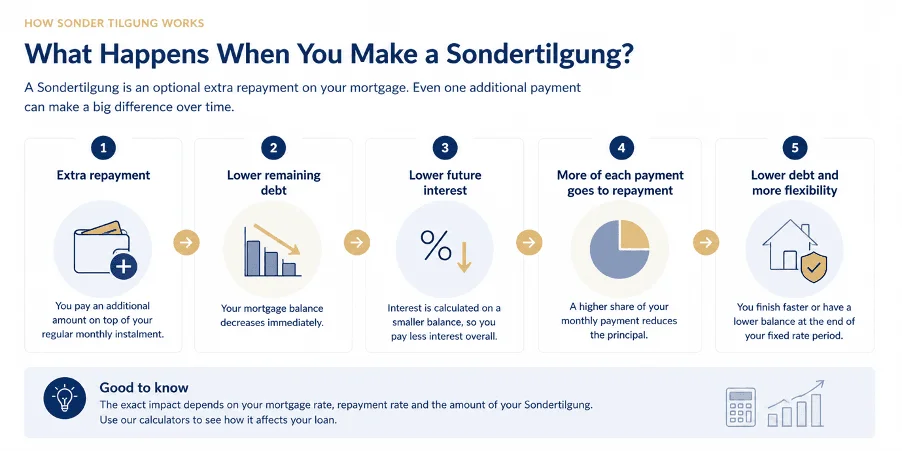
Each monthly payment you make is split into two parts: interest and repayment. The interest portion is calculated on whatever debt is still outstanding. So the more debt you're carrying, the more of your payment goes toward interest rather than actually paying down the loan.
When you make a "Sondertilgung", you lower that outstanding remaining debt immediately. From that point forward, interest is calculated on a smaller balance, which means a bigger share of your future monthly payments can go toward the principal instead of interest. Over time, this can mean you finish repaying the loan earlier, or that you're left with a meaningfully lower remaining debt by the time your fixed interest period ends.
One thing worth being clear about: making a "Sondertilgung" doesn't automatically change your monthly instalment amount. Whether your monthly rate drops, or you simply shorten the loan term instead, depends entirely on what your contract says. If you want to see this play out with real numbers, use the Pre Closure Calculator to compare the repayment path with and without additional payments.
Is Sondertilgung worth it?
This is really the core question, so let's tackle it directly.
"Sondertilgung" is financially attractive when the mortgage interest you save is worth more to you than whatever else you could do with that money. That sounds obvious, but it's worth breaking down:
- If your mortgage rate is relatively high, making extra repayments can be genuinely attractive: you're guaranteed to save that rate of interest.
- If you don't have a solid cash reserve, using spare money for "Sondertilgung" can create real liquidity risk. You don't want to be house-rich and cash-poor.
- If your mortgage rate is low, keeping cash liquid or investing it elsewhere may end up being the smarter move.
- If refinancing risk looks high, meaning rates could be much higher when your fixed period ends, reducing your debt now can be a useful hedge.
There's also an opportunity cost angle here: money used for "Sondertilgung" is money that can't be used for anything else. That doesn't mean you should turn this decision into a deep dive on ETFs and portfolio theory. It just means the right answer depends on both the numbers in front of you and your own tolerance for risk.
It's also worth understanding the current mortgage rate environment in Germany, since where rates sit right now affects how attractive extra repayment actually is.
Sondertilgung vs cash reserve vs investing
This is probably the most useful section for actually making a decision, because "Sondertilgung" is only one of several things you could do with spare cash.
Broadly, you have three options for any extra money sitting in your account:
- Use it for a "Sondertilgung" on your mortgage
- Keep it as a cash reserve, liquidity reserve or "Notgroschen"
- Invest it, for example in an ETF portfolio
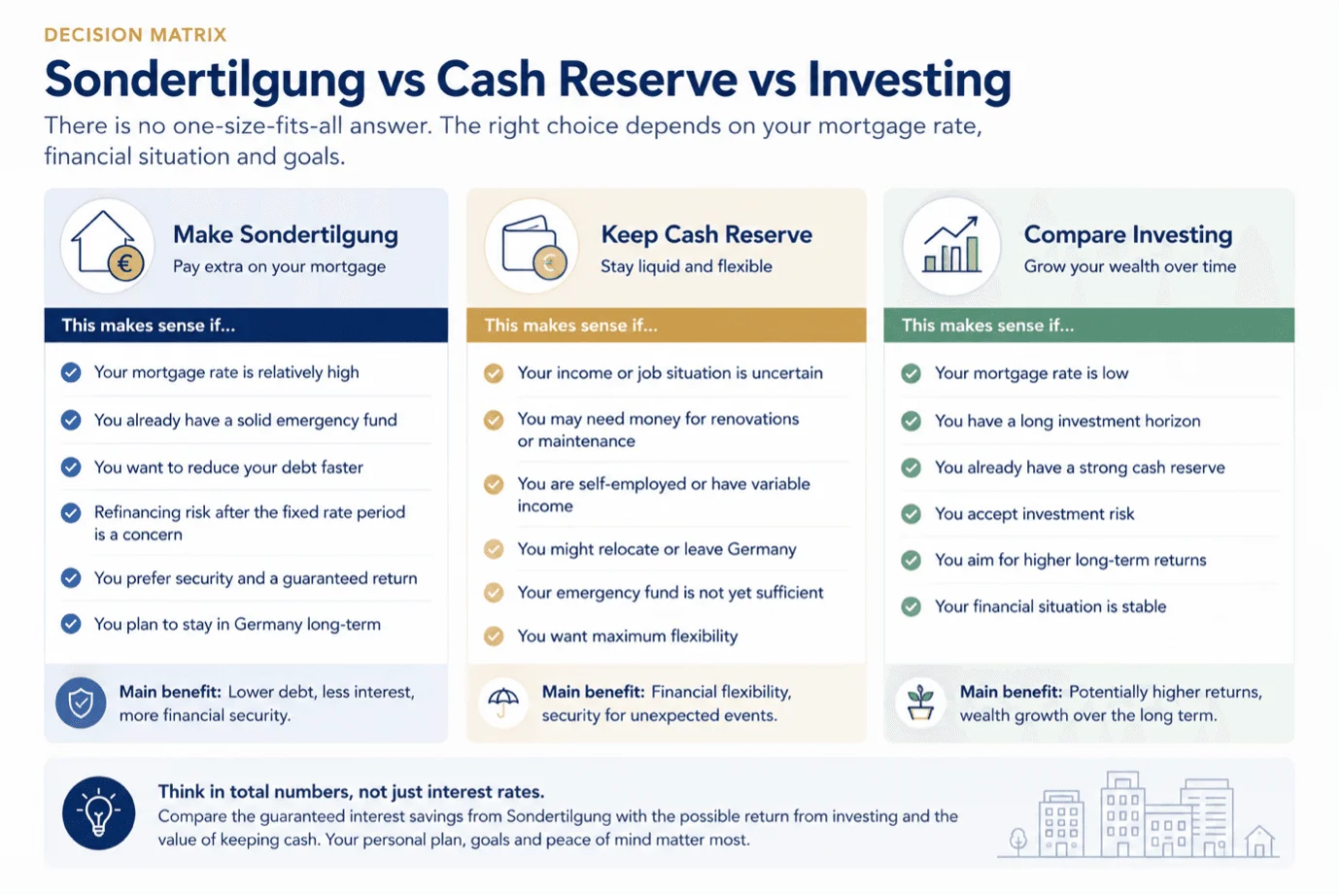
The key difference is certainty. A "Sondertilgung" gives you a guaranteed interest saving, or "Zinsersparnis": you know exactly what you're getting. Investing, on the other hand, offers a potentially higher return, but it's uncertain, and markets don't always move in your favour on your timeline.
For expats specifically, a cash reserve often deserves more weight than it might for a long-settled local buyer. Consider how many of the following apply to you:
- Possible job changes
- Visa or residence status uncertainty
- Relocation plans, even ones that aren't fully decided yet
- Family costs that can appear with little warning
- Renovation needs on the property itself
- Self-employment or bonus-based income that isn't perfectly predictable
If several of these apply, it's usually worth building a solid emergency fund before committing extra cash to the mortgage. "Sondertilgung oder ETF", "Sondertilgung oder anlegen": these are genuinely common questions among expats, and there's no single right answer. It comes down to your own opportunity cost calculation and how much uncertainty you're comfortable carrying.
A simple way to think about it
"Sondertilgung" gives you a certain interest saving. Investing gives you a possible return. Cash gives you flexibility. The right choice depends on which of those three is most valuable for your situation right now.
When should expats use Sondertilgung?
There are specific situations where making extra repayments tends to make real sense. Here are the ones worth paying attention to:
- Your mortgage rate is meaningfully higher than the safe return you'd get keeping the money in cash.
- You already have a strong emergency fund in place, so extra cash is genuinely spare.
- You want to lower your remaining debt before hitting "Anschlussfinanzierung", your follow-up financing once the fixed period ends.
- Your fixed interest period is on the shorter side, which makes refinancing risk a bigger factor.
- You receive annual bonuses or otherwise irregular income and want a productive place to put windfalls.
- You want to reduce your debt load before eventually leaving Germany.
- You're simply not comfortable holding a large amount of leverage, even if it's financially efficient.
- The property is your own home, and becoming debt-free is a personal priority, not just a financial one.
If any of these sound like you, it's also worth thinking about flexible mortgage terms, including home loan Germany options with strong "Sondertilgung" rights, before you sign anything. A mortgage broker in Germany can help you compare offers on exactly this basis.
When should expats not use Sondertilgung?
To keep this article balanced, it's just as important to flag when extra repayments are probably not your best move. "Sondertilgung" isn't a universal good, and treating it that way would be one-sided advice.
Think twice about it if:
- You don't have an emergency fund built up yet.
- You might need cash for relocation, family costs, or visa-related uncertainty in the near future.
- You're expecting renovation or maintenance expenses on the property.
- The property is rented out, and keeping a cash flow reserve for tenants, vacancies, or repairs matters more than shaving down the loan.
- Your mortgage rate is quite low compared with realistic alternative returns.
- You're carrying more expensive consumer debt, such as credit cards or personal loans, that should be paid off first.
- You may need liquidity for taxes or moving costs down the line.
- The "Sondertilgung" option itself made your mortgage offer more expensive, and you're not actually confident you'll use it.
If you're still comparing properties and haven't committed to one yet, you can use the Real Estate Search Engine to shortlist homes, and then test whether each property realistically leaves enough liquidity for both reserves and future "Sondertilgung".
How much Sondertilgung should you negotiate in your mortgage contract?
Here's something a lot of buyers miss: "Sondertilgung" matters most before you sign, not after. Many borrowers focus almost entirely on the headline interest rate and treat repayment flexibility as an afterthought, but it can meaningfully affect how much control you have over the loan later.
When comparing a German "Immobilienkredit" or "Baufinanzierung", do not only look at the interest rate. Also check the "Darlehenssumme", "Tilgungssatz", "Anfangstilgung", "Sollzinsbindung" and any "Sondertilgungsmöglichkeit".
Before signing, it's worth asking your bank or mortgage advisor Germany contact these questions directly:
- Is annual "Sondertilgung" allowed at all?
- What is the maximum amount permitted per year?
- Is that limit based on the original loan amount or the current remaining debt?
- Can it be made once a year, or at any point?
- Is there a minimum payment required to use the right?
- Does an unused "Sondertilgungsrecht" carry forward to the next year?
- Does having this option increase your interest rate?
- What happens if you want to repay more than your contract allows?
The right amount of flexibility to negotiate depends on your realistic savings capacity, not an ambitious guess. Paying for flexibility you'll likely never use isn't necessarily worth it if it comes at the cost of a better base rate. It's worth running the numbers before you decide what to ask for, and comparing lender conditions with a mortgage broker in Germany before signing.
Sondertilgung and the end of the fixed interest period
Even if you're not planning to pay off your mortgage anytime soon, "Sondertilgung" can still matter, because the real goal for many borrowers is reducing the remaining debt before "Anschlussfinanzierung", the refinancing that happens once your "Zinsbindung" or "Sollzinsbindung" runs out.
A lower remaining balance at that point means less refinancing pressure overall. This becomes especially relevant if current mortgage rates in Germany end up sitting higher than your original fixed rate, a real possibility depending on how the market moves. Expats who might move abroad before their fixed period ends should think about their exit and refinancing options early, rather than waiting until the decision is forced on them.
That said, reducing debt isn't automatically the better move over keeping cash flexible. It depends on your personal situation. If you want to see how this plays out numerically, the Interest and Repayment Calculator lets you simulate your remaining debt after the fixed interest period, with and without extra repayments.
Sondertilgung vs Vorfälligkeitsentschädigung
This is a distinction worth getting right, because the two terms get confused often.
"Sondertilgung" is an agreed extra repayment right, built directly into your mortgage contract. It's expected, allowed, and typically free within whatever limit was negotiated.
"Vorfälligkeitsentschädigung", on the other hand, is a compensation payment that can become relevant if you repay outside your agreed terms, for example if you want to pay off more than your "Sondertilgung" allowance, or terminate the loan early altogether.
This isn't legal advice, and it shouldn't be treated as such. If you're considering repaying beyond your allowed "Sondertilgung" amount, check your mortgage contract carefully and speak with your lender or an advisor first. Full early repayment and an annual "Sondertilgung" are simply not the same thing, and German law contains specific rules around early repayment and prepayment compensation that make this distinction important to get right.
Sondertilgung for owner occupied property vs investment property
The right approach can shift quite a bit depending on what kind of property you're financing.
For an owner occupied mortgage
- Emotional security often matters as much as the numbers.
- Debt freedom can be a genuine personal goal, not just a financial one.
- There's no rental income to protect, so cash flow pressure is lower.
For an investment property mortgage
- A liquidity reserve tends to matter more, since vacancies and repairs are real possibilities.
- Tax treatment can affect the actual net result of extra repayments.
- Rental income, maintenance costs, and vacancy risk all need to be factored in.
- Investing surplus cash elsewhere may fit better with an income-generating strategy.
Worth being cautious here: this isn't a tax guide, and the tax treatment of "Sondertilgung" on investment properties can get complicated depending on your situation. If you're weighing this for a rental property, it's worth testing rental cash flow before making extra repayments using the Property Investment Calculator, which factors in property details, rent, costs, reserves and loan terms together.
Sondertilgung for expats with bonuses, foreign income or self employment
Variable income is common among expats, and it changes how you should think about extra repayments. You might have:
- An annual bonus
- RSUs or other stock compensation
- Income earned outside Germany
- Self-employed or freelance income
- Generally irregular savings patterns
"Sondertilgung" can be a useful outlet here, since it lets you make a bonus payment mortgage contribution without committing to a permanently higher monthly rate. But the flip side is that unstable income also makes cash reserves more important, not less. If your income varies a lot, it's usually smarter not to lock too much liquidity into the mortgage. Keep enough buffer to cover lean months before you commit extra money toward self employed mortgage repayment.
For expats with freelance or business income, it can also help to understand how lenders assess self-employed profiles before choosing your repayment flexibility. Our guide on self employed mortgages in Germany explains what banks usually check before approving a home loan.
How to calculate Sondertilgung before deciding
You don't need complicated formulas to make this decision. You just need to compare the right numbers side by side:
- Remaining debt without a "Sondertilgung"
- Remaining debt with a "Sondertilgung"
- How much interest you'd actually save
- Your cash reserve after making the payment
- The return you might get if you invested that money instead
- The effect on your refinancing amount at the end of the fixed period
The effect compounds over time, which is exactly why an online calculator is genuinely useful here rather than optional. Searches such as "Sondertilgung berechnen", "Tilgungsrechner mit Sondertilgung", "Kreditrechner mit Sondertilgung" or "Darlehensrechner mit Sondertilgung" all point to the same basic need: buyers want to understand how an extra repayment changes the remaining debt and interest cost.
A quick example makes this concrete. Say you have a EUR 400,000 mortgage at a 3.8 percent interest rate, with a 2 percent initial repayment rate, and a 10-year fixed interest period. If you make a EUR 5,000 "Sondertilgung" each year within your allowance, your remaining debt at the end of the fixed period will usually be meaningfully lower than if you'd made none. The exact result depends on repayment timing, lender calculation rules and contract terms, so this example should be calculated with a proper tool before making a decision.
Sondertilgung Impact Calculator
Finance for Expats Tool
Pre Closure Calculator
Use the Pre Closure Calculator to estimate how an additional mortgage payment may affect your remaining debt, interest costs and refinancing amount.
Compare remaining debt with and without an extra payment
Estimate potential interest savings
Understand how additional payments may reduce refinancing pressure
Check whether your cash reserve remains strong enough after the payment
For regular interest and repayment scenarios without a pre-closure case, use the Interest and Repayment Calculator as a second orientation tool.
Calculate the impact of extra payments
This calculator provides orientation only. It does not replace your mortgage contract, lender confirmation or individual financial advice. Always check whether extra payments are allowed under your agreed "Sondertilgungsrecht".
Important before signing
Sondertilgung is a contract feature, not an automatic right
Do not assume that every German mortgage allows extra repayments. The amount, timing, unused rights and possible costs depend on the exact wording of your mortgage contract. Clarify this before signing, because negotiating flexibility later is much harder.
Sondertilgung checklist before signing a German mortgage
Before you sign anything, run through this list:
- Is "Sondertilgung" included in the mortgage offer at all?
- What annual amount are you actually allowed to repay?
- Is that limit based on the original loan or the current remaining debt?
- Is "Sondertilgung" free within the agreed limit, or does it cost extra?
- Can unused "Sondertilgung" be carried forward to future years?
- Does having this option increase your interest rate?
- Realistically, how much extra repayment could you make each year?
- Do you already have an emergency fund in place?
- Will you need cash for renovation or moving costs soon?
- Are you planning to stay in Germany long term?
- Could the property become a rental property later on?
- What's your refinancing risk at the end of the fixed interest period?
- Have you compared "Sondertilgung" against keeping a cash reserve and investing?
- Have you actually tested the numbers with a calculator?
- Have you reviewed the exact contract wording with a mortgage advisor Germany?
FAQs about Sondertilgung in Germany
What is Sondertilgung?
"Sondertilgung" is an agreed extra repayment made beyond your regular mortgage instalment. It reduces your remaining debt faster than scheduled, but only if your mortgage contract specifically grants this right. It is sometimes referred to in English as a special mortgage repayment, and the exact terms, including how much and how often, vary from one lender's offer to the next.
Is Sondertilgung worth it?
"Sondertilgung" can be worth it when the mortgage interest you save is more valuable than whatever else you'd do with that money. If you have a solid cash reserve already and your mortgage rate is relatively high, it often makes sense. If you're short on liquidity or your rate is low, the opportunity cost of tying up cash may outweigh the benefit.
Does Sondertilgung reduce the monthly mortgage payment?
Usually it reduces the remaining debt and your future interest burden rather than the monthly amount itself. Whether your actual monthly payment changes as a result depends entirely on what your mortgage contract specifies. Some contracts adjust it, while others keep the monthly payment the same and shorten the loan term instead.
Does Sondertilgung shorten the mortgage term?
It can shorten your effective repayment period, or reduce the remaining debt you're carrying into refinancing, depending on how your contract is structured. The effect shows up clearly on a full repayment schedule comparison, with and without extra payments factored in.
Can unused Sondertilgung be carried forward?
This depends entirely on your mortgage contract. Some contracts allow unused "Sondertilgung" rights to carry forward, but many do not. Rather than assuming unused rights simply roll over to next year, ask your bank directly and get the answer in writing before you rely on it.
What is the difference between Sondertilgung and Vorfälligkeitsentschädigung?
"Sondertilgung" is an agreed repayment right that's already built into your contract. "Vorfälligkeitsentschädigung" is compensation that may apply if you repay outside those agreed terms, or end the loan early altogether. They are related but distinct situations, and mixing them up can lead to costly surprises.
Should expats make Sondertilgung or invest in ETFs?
This comes down to certainty versus potential. "Sondertilgung" guarantees an interest saving, while ETF returns are uncertain and can move against you in the short term. Most buyers should build a solid cash reserve first, before weighing extra mortgage repayment against investing with whatever is left over.
How much Sondertilgung should I choose in my German mortgage?
Match the flexibility you negotiate to what you can realistically save each year, not an optimistic guess. Too little flexibility limits your future options; too much unused flexibility may not be worth it if it makes the overall mortgage offer more expensive. The right amount depends on income, savings pattern, cash reserve and long term plans.
Sondertilgung can be powerful, but only if it fits your wider plan
"Sondertilgung" can genuinely reduce your debt, your interest costs, and your refinancing risk, but it works best when you already have enough liquidity and a mortgage rate that makes the trade-off worthwhile. It works less well when you're short on cash reserve, facing real uncertainty, or when that money has a better use elsewhere.
The decision is best made before you sign your mortgage contract, not after, because by then, your flexibility is already locked in. Compare the numbers, read the contract terms carefully, and be honest with yourself about how much personal flexibility you actually need.
Before choosing a mortgage with or without "Sondertilgung", compare the long term numbers and ask an advisor how the repayment flexibility fits your income, residence plans and property strategy. If you want support before signing your loan offer, speak with a mortgage advisor at Finance for Expats. It is a conversation that can save you real money either way.