


Most people obsess over getting their first mortgage right. They compare lenders, negotiate the rate, and sign with relief once the property is finally theirs. Then they forget one thing: that rate is not permanent. At some point, the Zinsbindung (the fixed rate period) runs out, and a new financing decision has to be made, often for a Restschuld that is still substantial.
For many homeowners, the Anschlussfinanzierung (the follow-up financing) turns out to be one of the biggest financial moments of owning property in Germany, arguably bigger than the original purchase decision. This is where the Forward Darlehen comes in: a mortgage product that lets a homeowner agree today on the rate for a loan that will not start until later, once the current fixed rate period ends.
Used well, it offers genuine peace of mind. Used at the wrong moment, it can lock someone into a rate that looks expensive a few years down the line.
This article walks through what a Forward Darlehen is, how it compares with waiting, and how expats should think about the decision given residency, income structure, remaining debt and long-term plans in Germany. You will also find a comparison with Prolongation, Umschuldung and Bausparvertrag, plus a practical checklist before signing anything.
Finance for Expats – Quick Answer
Should you consider a Forward Darlehen?
A Forward Darlehen is a German mortgage product that lets homeowners secure the interest rate for their future Anschlussfinanzierung before the current fixed rate period ends. It can be useful when borrowers want protection against rising mortgage rates, but it may be less suitable if they expect rates to fall, may sell the property, plan to leave Germany or need maximum flexibility.
Before going further into the forward mechanics, it helps to understand how a German mortgage works before you sign , since the same underlying logic around Zinsbindung and repayment structure carries over into refinancing decisions.
What is a Forward Darlehen in Germany?
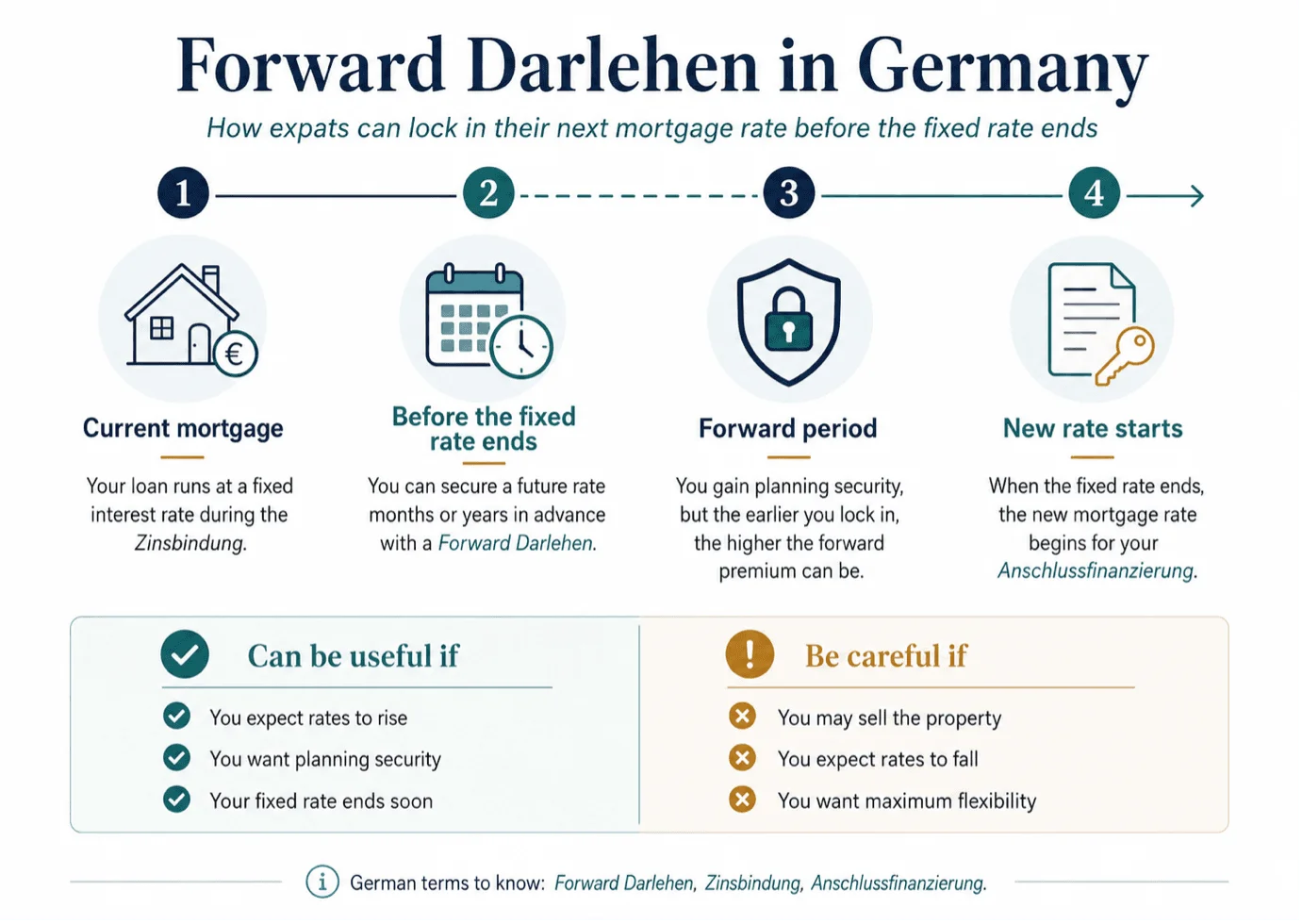
A Forward Darlehen is not a mortgage for buying a new property. It is almost always used to prepare for a future Anschlussfinanzierung, the continuation of financing on a property someone already owns.
The mechanics are:
- The borrower signs before the current fixed rate period (Sollzinsbindung) ends.
- The new loan typically begins once the existing Zinsbindung expires.
- The amount is usually based on the expected Restschuld remaining at that point.
- The purpose is to lock in the future mortgage rate before the new financing actually begins.
- In exchange, the bank generally prices a Forward Aufschlag into the rate.
You may also see the product written as Forwarddarlehen.
A quick note for an international audience: “forward loan” can be misleading, since it sounds like something different elsewhere. In Germany, it refers specifically to this advance rate agreement tied to an existing mortgage, so it is worth keeping the original term, Forward Darlehen.
How does a Forward Darlehen work before the fixed rate ends?
First, the borrower checks the expected Restschuld, the remaining debt owed once the current Zinsbindung ends, since this is the amount that will need refinancing. From there, the borrower compares refinancing routes: staying with the current bank, switching lenders, or exploring a Forward Darlehen.
If a forward loan looks appealing, the bank offers a rate that applies from a future start date, sometimes years ahead.
Once the borrower signs, the terms are generally binding. During the remaining time on the current mortgage, known as the Forward Periode, nothing changes day to day; the existing loan simply continues as agreed. Only once the fixed rate period genuinely ends does the new loan take over.
No new money changes hands immediately. This is not a cash-out product or a way to access funds for a current purchase. It is purely a rate agreement for the future, and once signed, backing out is rarely simple or free.
Why expats should plan Anschlussfinanzierung early
It is tempting to leave the Anschlussfinanzierung decision until a few weeks before the fixed rate expires, but for expats that timeline can be tighter than it looks. Banks reviewing a refinancing case may look again at things already checked during the original mortgage application, including:
- residence permit status
- income stability
- foreign income sources
- self-employment situations
- family circumstances
- current property value
- remaining debt level
Starting early gives enough runway to properly compare Prolongation, Umschuldung and Forward Darlehen rather than defaulting to whatever the current bank offers because time has run out.
It also gives borrowers time to understand their Zinsänderungsrisiko: how strongly a higher future mortgage rate could affect the monthly payment.
There is also a practical reason to think ahead if there is any chance of leaving Germany. A signed forward agreement does not bend easily around a change of plans, so expats weighing a future move or a property sale need to think that through before locking anything in.
Timing matters even more for anyone who signed during a period of unusually low rates, where the jump to current mortgage rates in Germany can be significant.
See the current German mortgage rate environment and the general refinancing process in Germany for more context.
Forward Darlehen vs normal Anschlussfinanzierung
Both a standard Anschlussfinanzierung and a Forward Darlehen deal with what happens once the current Zinsbindung ends. The real difference is timing and pricing.
A normal Anschlussfinanzierung is typically arranged closer to the end of the fixed rate period, sometimes just months before, which keeps options open longer.
A Forward Darlehen, by contrast, is arranged well in advance to secure a rate ahead of time. This offers more certainty, but that certainty comes at a cost and reduces flexibility if circumstances or the market shift.
Neither approach is automatically smarter. It depends on how much the borrower values predictability versus the ability to adapt later.
Forward Darlehen vs Prolongation vs Umschuldung
Prolongation with the current lender
Prolongation simply means staying with the same bank for the next financing period. It tends to be the path of least resistance, with less paperwork and a quicker process.
It will not always be the cheapest option, but for someone who values convenience and receives a competitive rate from the existing lender, it can still make sense.
Umschuldung to a new lender
Umschuldung means switching to a different bank for the Anschlussfinanzierung. This can pay off if another lender offers meaningfully better terms, but it requires more comparison work and documentation, plus some administrative cost.
Expats considering an Umschuldung Baufinanzierung or Umschuldung Immobilienkredit should look at the total cost of the new offer, not just the headline interest rate.
Forward Darlehen before the fixed rate ends
A Forward Darlehen locks in a rate ahead of the current mortgage's expiry. It reduces uncertainty about future rates, but it comes with the Forward Aufschlag and, once signed, considerably less room to change course.
Before settling on any of these three, compare lender offers before choosing your next mortgage , since the right path often depends on details specific to each lender's terms.
What is the Forward Aufschlag?
The Forward Aufschlag, also known as a Zinsaufschlag, is the rate premium associated with securing a mortgage rate for a future start date.
Because the interest rate is agreed well before the new loan starts, lenders generally price the Forward Periode into the offer. The exact premium varies by lender, market conditions and how far in advance the new loan is arranged.
Comparing a forward rate only against today's immediate mortgage rate misses the point. The more relevant comparison involves:
- the forward rate on offer today
- a realistic estimate of future refinancing rates
- the value of having planning certainty
- the Forward Aufschlag
- the risk involved if rates end up falling instead
Exact premiums vary by lender, market conditions and the length of the Forward Periode, so it is worth comparing the actual offers available for the specific timeframe.
Is a Forward Darlehen worth it when mortgage rates may rise?
There is a real case for a Forward Darlehen when:
- current rates feel acceptable relative to where things could be heading
- there is a reasonable expectation that future rates may rise
- the remaining debt will still be significant by the time the fixed rate ends
- the household places a high value on payment certainty
- a sharp rate increase would genuinely strain monthly affordability
- the current Zinsbindung ends within a planning horizon that feels close enough to matter
None of this depends on predicting rates with precision, which nobody can do. It is about reducing the risk of an Anschlussfinanzierung that stretches the household budget past what is comfortable.
For expats with long-term residence plans in Germany, families working with a relatively fixed household budget, or borrowers with a more limited set of lender options, certainty can carry extra weight.
When should expats be careful with a Forward Darlehen?
The same certainty that makes a Forward Darlehen appealing in one scenario can become a liability in another. It tends to be a less comfortable fit when:
- there is a real expectation that rates will fall rather than rise
- the property might be sold before the new loan is even due to start
- there is a chance of leaving Germany before the forward period ends
- employment or residence status still feels uncertain
- Sondertilgung payments are expected to bring the remaining debt down significantly
- the quoted forward premium looks high relative to the rate certainty it buys
- flexibility matters more than predictability for this household
Signing too early, before life plans are settled, risks a mismatch between a binding contract and where someone ends up living or working. Rate security only pays off if the loan is genuinely needed on the terms agreed.
Readers with variable or self-employed income should also review mortgage planning for self-employed or variable income situations , since income structure affects both eligibility and the value of locking in a rate this far ahead.
What happens if interest rates fall after signing a Forward Darlehen?
This is one of the most common worries expats raise. Once a Forward Darlehen is signed, the borrower is generally bound to the agreed rate regardless of where market rates move afterward.
If rates fall significantly, the forward agreement can look expensive in hindsight, so check the specific contract terms carefully rather than assuming cancellation will be simple.
Depending on the agreement and the circumstances, deciding not to take an already agreed loan can also have financial consequences. Borrowers may encounter the term Nichtabnahmeentschädigung in this context.
The exact consequences depend on the contract and legal situation, so withdrawal, cancellation and non-acceptance provisions should be reviewed before signing. This article provides general information and is not legal advice.
Think of the decision like buying protection against rising rates. Sometimes it pays off; other times rates move the other way and waiting would have been cheaper. There is no way to know for certain in advance, which is why running through scenarios matters more than guessing the outcome.
What happens if you wait and mortgage rates rise?
The opposite risk deserves equal attention. If a borrower waits and rates rise in the meantime, the eventual Anschlussfinanzierung can become noticeably more expensive.
Monthly payments can climb and affordability can get tighter, particularly if the remaining debt at the end of the Zinsbindung is still high. The higher that Restschuld, the stronger the effect of a rate increase on monthly costs.
Making extra repayments through Sondertilgung before the fixed rate ends can reduce the loan amount exposed to a future rate change, softening the impact either way the market moves.
How to calculate whether locking your next mortgage rate early makes sense
This works better as a scenario comparison than a gut call.
Borrowers should compare:
- the estimated Restschuld at the end of the current Zinsbindung
- the forward rate being offered today
- a realistic range for possible future refinancing rates
- the size of the Forward Aufschlag
- how long the remaining fixed period actually is
- the difference in monthly payment between locking now and waiting
- total interest cost over the next fixed period under each scenario
- possible Sondertilgung before refinancing
- how much personal flexibility the household actually needs
The cheapest option is only ever known in hindsight. The goal is not a guaranteed answer but a level of Zinsrisiko the household can live with, whichever way rates move.
A simple example
Imagine an expat homeowner who still expects a substantial Restschuld when the current Zinsbindung ends. A Forward Darlehen would make the next mortgage payment more predictable. Waiting could produce a cheaper Anschlussfinanzierung if rates fall, but a significantly higher payment if rates rise.
The relevant question is therefore not only which direction rates might move, but how much payment uncertainty the household can realistically absorb.
Finance for Expats Tool
Compare Your Future Mortgage Payment
Use the Interest and Repayment Calculator to estimate how different interest rates and repayment assumptions could affect your future monthly payment and remaining debt.
Compare different interest-rate assumptions
Estimate your future monthly payment
Test different repayment rates
See how the remaining debt may develop
Calculate your mortgage scenario
This calculator provides orientation only. It does not replace an individual mortgage assessment or financial advice.
Forward Darlehen and Bausparvertrag: two ways to secure future rates
Both a Forward Darlehen and a Bausparvertrag can play a role in planning for future rates, though they work quite differently.
A Forward Darlehen secures the rate for the next loan period directly, tied to an existing mortgage already running. A Bausparvertrag combines a savings phase with a later entitlement to a loan, and it is a broader topic on its own not repeated in full detail here.
Relevant comparison factors include:
- timing of when funds or rate certainty are actually needed
- flexibility if plans change
- how transparent the costs are upfront
- overall complexity of the product
- how suitable each option is for an expat situation
- whether the person already owns the property in question
Neither product is universally better. It comes down to which factors matter most for the household.
Readers wanting a fuller picture can check whether a Bausparvertrag makes sense as an alternative rate planning tool .
Forward Darlehen for owner occupied homes vs investment properties
The right approach can shift depending on how the property is used.
For an owner occupied home, priorities center on keeping monthly payments predictable, protecting family budget stability, and avoiding the discomfort of a sharp, unplanned rate increase.
For an investment property, the calculation looks different. Rental cash flow becomes a central concern, alongside vacancy periods and maintenance reserves. Tax treatment and interest deductibility can affect the net outcome, and cash reserves may matter more than maximum rate certainty.
Get individual tax advice rather than treating general guidance as a substitute.
If a rental property's rate is about to change, check how the next mortgage rate could affect rental cash flow with the Property Investment Calculator .
What expats should check before signing a Forward Darlehen
- When does your current Zinsbindung end?
- What is your expected Restschuld at that point?
- How high is the Forward Aufschlag on the offer?
- How long is the Forward Periode?
- What monthly payment could you afford under the new rate?
- Could Sondertilgung reduce your remaining debt before refinancing?
- Are you planning to stay in Germany long term?
- Could you sell the property before the new loan starts?
- How stable is your residence and employment situation?
- Have you compared this offer against Prolongation and Umschuldung?
- Have you compared several lenders, not just your current bank?
- Does the offer leave you enough flexibility if plans change?
- What happens if you decide not to take the loan?
- What is your plan if rates fall?
- What happens to your budget if rates rise?
- Have you looked at total cost, not just the interest rate?
Working through this list with a mortgage broker in Germany can help catch details that are easy to miss on your own, especially when foreign income, residence permits or lender-specific requirements affect the available options.
Before committing, compare the Forward Darlehen offer with other lender options .
FAQs about Forward Darlehen in Germany
What is a Forward Darlehen?
A Forward Darlehen is a loan agreement for a future Anschlussfinanzierung. The rate is agreed today even though the loan only starts once the current fixed rate period ends. It allows a homeowner to secure future German mortgage conditions before the existing Zinsbindung expires. The main advantage is greater planning certainty. The tradeoff is that the borrower commits earlier and the lender may include a Forward Aufschlag in the rate.
When should I start planning Anschlussfinanzierung?
It is sensible to start planning before the final months of the Zinsbindung. The exact timing depends on how much of the fixed period remains, current mortgage rates in Germany, the expected Restschuld and your personal plans. Starting early does not mean you need to sign a Forward Darlehen immediately. It gives you more time to compare Prolongation, Umschuldung and different lender offers without making the decision under time pressure.
Is a Forward Darlehen worth it?
A Forward Darlehen can be worth considering if rate security matters to you. It may be particularly useful when a significant increase in future mortgage rates would put pressure on your household budget or your Restschuld will still be high. It can be less attractive if rates fall, you expect to reduce the remaining debt substantially, or you may sell the property or leave Germany before the future loan begins.
What is the Forward Aufschlag?
The Forward Aufschlag is the rate premium associated with securing a future mortgage rate in advance. You may also see it described as a Zinsaufschlag. The exact amount depends on the lender, market conditions and the length of the Forward Periode. This is why a forward rate should not be compared only with today's immediate mortgage rate. The relevant comparison is between the cost of locking now and the risk of waiting.
Can I cancel a Forward Darlehen?
Whether a Forward Darlehen can be cancelled depends on the contract and legal circumstances. Borrowers should not assume they can simply switch to a cheaper mortgage if rates fall after signing. Depending on the agreement, not taking the agreed loan may have financial consequences, including a possible Nichtabnahmeentschädigung. Withdrawal, cancellation and non-acceptance provisions should therefore be reviewed carefully before signing. This is general information and not legal advice.
What happens when my Zinsbindung ends?
If the mortgage is not fully repaid, the remaining Restschuld needs follow-up financing. This may take the form of a Prolongation with the current lender, Umschuldung to another bank, or a Forward Darlehen that was arranged in advance. Which option makes sense depends on the available interest rates, remaining debt, monthly affordability, lender conditions and how much flexibility you want to retain.
Is Forward Darlehen better than Bausparvertrag?
Neither option is universally better. Both can support future interest-rate planning but work differently. A Forward Darlehen directly secures the rate for a future Anschlussfinanzierung. A Bausparvertrag generally combines a savings phase with a later loan entitlement. The right choice depends on timing, flexibility, costs, existing savings and how certain your future property and financing plans are.
Should expats use a mortgage broker for a Forward Darlehen?
A mortgage broker can be useful when comparing several lenders and refinancing structures. This may be particularly helpful for expats with foreign income, self-employment, residence permit questions or limited experience with German mortgage contracts. A broker can help compare interest rates, timing and lender conditions. Borrowers should still understand the total cost and contractual commitments themselves before signing a Forward Darlehen.
Forward Darlehen can reduce rate risk, but it should fit your life plans
A Forward Darlehen can genuinely help expats who want to secure their future mortgage rate before the Zinsbindung runs out, especially those who expect rates to rise, still carry a substantial Restschuld, or place a high value on planning certainty.
It can be a poor fit for anyone who might sell, might leave Germany, significantly reduce the remaining debt or expects rates to fall. The commitment is real and worth taking seriously before signing.
The decision comes down to running the numbers and being honest about how much flexibility you need. Comparing a Forward Darlehen against Prolongation and Umschuldung before committing gives a clearer picture of what fits your situation.
Before signing a Forward Darlehen, compare the offer against your remaining debt, expected future rate, flexibility needs and long-term plans in Germany.