


Table of Contents
- What is a Bausparvertrag in Germany?
- How does a Bausparvertrag work?
- Why do German banks and advisors recommend Bausparverträge?
- When can a Bausparvertrag make sense for expats?
- Bausparvertrag vs Mortgage vs ETF: Which option fits your property plan?
- When is a Bausparvertrag not a good idea?
- Bausparvertrag vs normal mortgage in Germany
- Bausparvertrag vs ETF: Which is better for saving toward property?
- Can a Bausparvertrag help with Anschlussfinanzierung?
- What costs and risks should expats understand before signing?
- Does a Bausparvertrag affect mortgage approval in Germany?
- Should expats use a Bausparvertrag to buy property in Germany?
- Checklist before signing a Bausparvertrag
- FAQs about Bausparvertrag in Germany
- Bausparvertrag in Germany: useful product or unnecessary complexity?
When you sit down with a German bank or mortgage advisor to talk about buying property in Germany, there is a good chance the conversation will turn to something called a "Bausparvertrag". If you have never heard of it, you are not alone. Most expats have not. It is a product built deep into the German home financing tradition, and advisors here reach for it almost automatically.
But automatic does not mean right for everyone. A "Bausparvertrag" can be a genuinely useful tool in the right situation, and a surprisingly expensive complication in the wrong one. It can offer interest rate security for a future German mortgage or home loan Germany strategy, but it can also be complex, inflexible and unsuitable for some expats. This article explains how it works, when it makes sense for expats, and when a normal mortgage in Germany, an ETF savings approach or another Bausparvertrag alternative might serve you better.
What is a Bausparvertrag in Germany?
A "Bausparvertrag" is a home savings contract you take out with a building society, known in Germany as a "Bausparkasse". The most well known names are Schwäbisch Hall, Wüstenrot and LBS, though most major banks in Germany also offer their own versions.
What makes it distinctly German is the combination of a savings phase and a loan phase under one roof, at pre agreed terms. Crucially, before the savings phase has even begun, both phases are fixed with their respective conditions. This means that before you start saving, you already know the interest rate, called "Bausparzinsen", that will apply to the loan you receive after reaching "Zuteilungsreife", which means allocation readiness.
The appeal is predictability. You know what rate you will pay on the "Bauspardarlehen" before you have saved a single euro.
Expats often first encounter "Bausparverträge" when speaking to German mortgage advisors or bank managers. It is treated almost as a default part of property planning conversations here, which can make it feel more essential than it sometimes is.
How does a Bausparvertrag work?
The product has three main phases.
- The contract amount, called "Bausparsumme". When you sign, you agree on a target amount, say €100,000. This is not the amount you will save; it is the total around which the contract is structured.
- The savings phase. You save regularly until you have put in roughly 40 to 50 percent of the target amount. During this phase, you earn interest on your savings, though the rate is typically very low, often between 0.1 and 1 percent per year.
- Allocation, called "Zuteilungsreife". Once you have saved enough and the contract has run for the required period, it becomes zuteilungsreif, ready to be allocated. At this point, you can apply to draw the remaining amount as a loan at the interest rate locked in when you signed the contract.
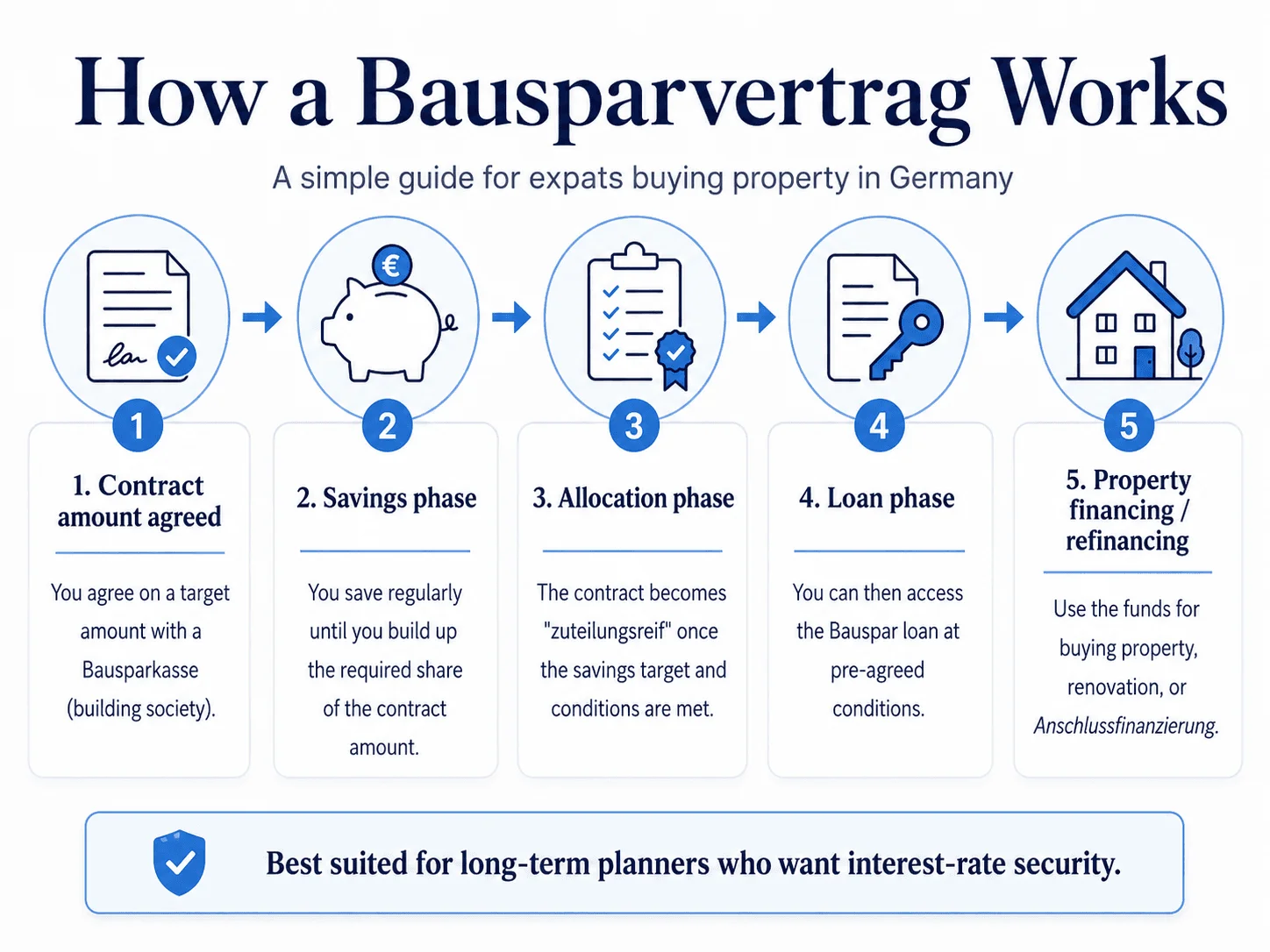
Important: A "Bausparvertrag" typically takes seven to ten years to become zuteilungsreif. This is not a short term financing tool. It is built for long range planning.
Why do German banks and advisors recommend Bausparverträge?
A "Bausparvertrag" fits the German savings culture well, planning ahead, avoiding financial surprises and securing future conditions. For this reason, it appears in property planning conversations almost as standard.
For buyers who already have a German mortgage with a fixed interest period ending in several years, a "Bausparvertrag" can help lock in borrowing conditions now for "Anschlussfinanzierung", the follow up financing that kicks in when the fixed period ends. If mortgage rates in Germany rise significantly in the meantime, the pre agreed "Bauspar" loan rate could be considerably cheaper than whatever the market is offering at that point.
Advisors also recommend it because it is familiar. It is a long established product in the German mortgage landscape, and many genuinely believe in its benefits for the right client.
What they do not always spell out clearly enough: this product was designed for German buyers with long planning horizons and stable residential plans. It does not automatically translate well to every expat situation.
When can a Bausparvertrag make sense for expats?
A "Bausparvertrag" is not a general savings product. It is better suited to people with a fixed time frame and settled residential plans in Germany. If you are an expat with a flexible or uncertain planning horizon, savings products or ETFs may be more appropriate. But if you are a settled expat with long term plans in Germany, a Bausparvertrag could be worth exploring.
It tends to make most sense if you plan to stay in Germany long term, ideally for at least the next ten to fifteen years. It also makes practical sense if you already own property in Germany and your current fixed rate mortgage period ends in five to eight years. Taking out a "Bausparvertrag" now could give you a locked in loan rate for the refinancing phase, protecting you against the interest rate environment at that future point.
| Your situation | What might fit best |
|---|---|
| Buying in the next 1 to 2 years | Normal German mortgage |
| Planning to buy in 5 to 10 years | Bausparvertrag worth exploring |
| Already have a mortgage, refinancing coming up | Bausparvertrag for Anschlussfinanzierung |
| Unsure whether you will stay in Germany | ETF or flexible savings |
| Buying is uncertain, want maximum flexibility | Skip Bausparvertrag entirely |
Bausparvertrag vs Mortgage vs ETF: Which option fits your property plan?
The following small decision tool gives a first orientation. It does not replace individual advice, but it can help you understand whether a "Bausparvertrag", a normal mortgage in Germany or ETF based flexible savings may fit your property plan better.
When is a Bausparvertrag not a good idea?
This is where honest advice matters most.
Most expats in Germany are on a contract, assignment or visa and stay for two to five years. This is far too short for a long term fixed interest savings contract. In the worst case, you will pay high fees and charges for a product that has not yet returned any benefit by the time you leave Germany.
The saved amounts are also tied up. They are not liquid. You cannot withdraw them freely during the savings phase, and early redemption is possible but often results in lower returns and potential penalties.
The fees also add up quickly. Upfront contract fees, called "Abschlussgebühr", of around 1 to 1.6 percent of the contract amount are standard. On a €100,000 contract, that is between €1,000 and €1,600, paid before a single euro of savings begins. On a €150,000 contract, the upfront fee alone can reach €2,400.
The savings interest, called "Bausparzinsen", is also low. If the "Bausparvertrag" is never used for an actual loan, because you leave Germany, change plans or find a cheaper home loan in Germany elsewhere, the locked in loan rate you paid fees to secure delivers no benefit whatsoever.
A "Bausparvertrag" is unlikely to be suitable if:
- You are unsure how long you will stay in Germany.
- You need flexible access to your savings.
- You want to buy property very soon.
- You are not certain you will buy property in Germany at all.
- The fees are high compared with the actual benefit.
- The contract does not match your real mortgage timeline.
Bausparvertrag vs normal mortgage in Germany
For most expats buying a house in Germany in the near term, a standard German mortgage, called "Annuitätendarlehen", is simpler, faster and more straightforward.
| Factor | Bausparvertrag | Normal Mortgage |
|---|---|---|
| Speed to finance | Often 7 to 10 years | Immediate |
| Interest rate security | Pre agreed from day one | Fixed for a set term, often 5 to 15 years |
| Flexibility | Low | Higher |
| Upfront fees | Often around 1 to 1.6 percent of contract sum | Usually simpler to compare |
| Savings interest | Very low | Not applicable |
| Loan amount | Partial, remainder of "Bausparsumme" | Full property financing structure possible |
| Best for | Long term planning, Anschlussfinanzierung | Immediate property purchase |
A normal home loan in Germany gives you a clear fixed rate for a defined term, often ten or fifteen years, with transparent monthly payments and no multi year savings phase required beforehand. For most expats, that simplicity is worth a great deal.
Bausparvertrag vs ETF: Which is better for saving toward property?
For expats who are not planning an immediate property purchase, it is worth comparing a "Bausparvertrag" directly with a broadly diversified ETF, an Exchange Traded Fund.
ETFs offer higher potential returns over the medium to long term. A globally diversified equity based ETF has historically achieved stronger long term return potential than the fractional savings interest of a "Bausparvertrag". However, ETFs carry market risk. In a bad year, or a bad sequence of years before your intended purchase, your portfolio could be worth less than you invested.
A "Bausparvertrag" offers certainty of a specific future loan rate. An ETF offers uncertainty on both sides: it could outperform or underperform, depending on timing.
The practical question is how certain you are about buying property in Germany. If you are committed to a purchase within a defined timeframe and want to lock in loan terms, the "Bausparvertrag" has genuine merit. If you are unsure, and want the option to deploy savings elsewhere, a flexible ETF is easier to exit. There is no universally right answer. It depends on your timeline, risk tolerance and how firm your German property plans actually are.
Can a Bausparvertrag help with Anschlussfinanzierung?
This is one of the strongest genuine use cases for the product.
"Anschlussfinanzierung" means follow up financing when your fixed mortgage period ends. It is a real concern for anyone who has already bought property in Germany. When the fixed term expires, you either renegotiate with your existing bank or refinance elsewhere at whatever "Anschlussfinanzierung" Zinsen, or refinancing rates, the market is offering at that point.
If interest rates in Germany rise sharply before your fixed term ends, you could face significantly higher monthly payments. A "Bausparvertrag", if timed correctly, lets you lock in a loan rate today for a loan you will draw down in several years, precisely to cover that refinancing moment.
The critical issue is timing. The "Bausparvertrag" must become "zuteilungsreif" around the time your fixed rate expires. If it matures too early or too late, it may not actually solve your refinancing problem. This is where speaking to an independent mortgage advisor, one not tied to a specific Bausparkasse, becomes genuinely valuable.
KfW also offers various refinancing and energy efficiency loan products that are sometimes worth comparing alongside or instead of a "Bausparvertrag" for "Anschlussfinanzierung" purposes. The important point is not whether the product sounds attractive in isolation, but whether it works better than your other "Anschlussfinanzierung" alternatives at the time you actually need the money.
What costs and risks should expats understand before signing?
Before signing a "Bausparvertrag", work through the actual numbers carefully.
- The upfront "Abschlussgebühr" is typically around 1 to 1.6 percent of the contract sum, paid before any saving begins.
- The savings interest, called "Bausparzinsen", is very low, often between 0.1 and 1 percent. Compare this with what you could earn elsewhere.
- The effective loan interest rate, called "Bauzins", may look attractive, but must be weighed against the opportunity cost of the savings phase and the upfront fees.
- The Bausparvertrag is managed as part of a pool by the Bausparkasse. You have no control over exactly when it becomes zuteilungsreif. You might plan for year seven and find it arrives in year nine.
- If you leave Germany, you can continue the contract from abroad or surrender it. Early surrender typically means receiving only your saved amount plus minimal interest, while the pre agreed loan rate you paid fees to secure is lost.
Before signing, expats should calculate whether the contract really improves affordability compared with a normal mortgage in Germany. A mortgage calculator Germany can help estimate monthly payments, but the effective cost of a Bausparvertrag also depends on fees, savings interest, future loan interest and timing.
To compare monthly repayment and interest in a normal home loan Germany structure, you can use the Interest and Repayment Calculator as a first orientation.
Does a Bausparvertrag affect mortgage approval in Germany?
A "Bausparvertrag" does not automatically improve your chances of mortgage approval in Germany. Banks still assess your income, existing debts, property value, own funds and overall creditworthiness when deciding whether to lend.
A bank will still check the usual mortgage requirements, including income, affordability, own funds, property value, residence permit and creditworthiness. For some expats, the "SCHUFA" score can also play a role, but a "Bausparvertrag" alone does not solve a weak mortgage profile.
For expats, additional factors come into play, including your type of residence permit, the stability and source of your income, and how long you have been resident in Germany. A "Bausparvertrag" does not compensate for a weak application on those fundamentals.
What it can do is support the picture. A consistent savings history, including regular "Bauspar" contributions over several years, can signal financial discipline, something German lenders value. But it plays a supporting role only, and is not sufficient on its own to secure a German mortgage.
Should expats use a Bausparvertrag to buy property in Germany?
A "Bausparvertrag" may be worth checking if you plan to stay in Germany long term, want interest rate security and are preparing either a future property purchase or a future "Anschlussfinanzierung". It can also make sense if you understand the fees, accept the long timeline and value predictability more than flexibility.
It may be less suitable if you are unsure whether you will stay in Germany, need flexible access to your savings, want to buy very soon or find the contract too complex or expensive. In these cases, a normal German mortgage, ETF savings or another alternative to the "Bausparvertrag" may be more suitable.
For expats especially, the decision should not be based on a single advisor recommendation. It should be compared with a standard mortgage in Germany, a normal home loan Germany structure, ETF savings and your own residence plans. For a broader overview of mortgage support, you can also read our guide on Mortgage Broker in Germany: Home Loan Support for Expats.
Checklist before signing a Bausparvertrag
Before committing, work through these questions:
- Do I know when I want to buy property in Germany?
- Am I likely to stay in Germany long term?
- What is the total upfront fee, and what exactly am I being charged for?
- What is the actual savings interest rate, and how does it compare with alternatives such as ETFs or high yield savings accounts?
- What is the pre agreed loan interest rate, and how does it compare with current mortgage rates in Germany?
- When will the contract become zuteilungsreif, and does this match my property plans?
- What happens to this contract if I leave Germany in three years?
- How does this compare with a normal home loan in Germany?
- How does this compare with ETF savings or other Bausparvertrag alternatives?
- Have I used a mortgage calculator Germany to estimate affordability under a normal mortgage structure?
- Has an independent mortgage advisor compared the effective cost and given me an impartial view?
FAQs about Bausparvertrag in Germany
What is a Bausparvertrag in Germany?
A "Bausparvertrag" is a home savings contract with a German building society, called a "Bausparkasse". It combines a savings phase and a loan phase in a single contract. Before you start saving, both the savings interest and the future loan interest rate are already fixed.
How does a Bausparvertrag work?
You save until you have deposited around 40 to 50 percent of the target sum, called the "Bausparsumme". After typically seven to ten years the contract becomes "zuteilungsreif" and the remainder can be drawn as a loan at the interest rate agreed at the start.
Is a Bausparvertrag worth it for expats?
It can be, if you plan to stay in Germany long term, want interest rate security for a future purchase or "Anschlussfinanzierung", and fully understand the fees involved. It is not suitable for expats who are uncertain about their plans or want flexibility.
Is a Bausparvertrag better than a normal mortgage?
For immediate property purchases, a normal German mortgage is simpler and more appropriate. A "Bausparvertrag" is better suited to long term planning or securing future refinancing rates, not buying a property right now.
Is a Bausparvertrag better than an ETF for saving?
ETFs offer higher potential returns but carry market risk. A "Bausparvertrag" offers a locked in future loan rate but very low savings interest and less flexibility. The right choice depends on your timeline, certainty about buying property in Germany and your personal risk tolerance.
Can a Bausparvertrag help with Anschlussfinanzierung?
Yes, this is one of its strongest use cases. If your fixed mortgage rate in Germany expires in several years and you are concerned about rates rising, a "Bausparvertrag" started now can help secure your "Anschlussfinanzierung" rate in advance. Timing is critical.
Bausparvertrag in Germany: useful product or unnecessary complexity?
The honest answer is: it depends entirely on your situation.
For settled expats with a long planning horizon, a clear property goal five or more years away, and genuine concern about future interest rates in Germany, a "Bausparvertrag" can be a sensible part of a financing strategy, particularly where "Anschlussfinanzierung" is involved.
For many expats, however, the combination of upfront fees, low savings interest, timing uncertainty and long lock in adds complexity without adding value. A normal home loan in Germany, or a flexible ETF savings approach, will often be simpler and more suitable.
Before signing anything, compare the "Bausparvertrag" carefully with a standard German mortgage and other alternatives. The product deserves proper analysis, not a default recommendation. An independent mortgage broker in Germany can give you a realistic comparison of the effective costs and help you decide whether a Bausparvertrag genuinely fits your plans, or whether a simpler path to buying property in Germany makes more sense for your situation.
If you want to review your individual financing situation before signing a Bausparvertrag or choosing a mortgage structure, you can contact Finance for Expats for personal guidance.