


Table of Contents
- What is Dread Disease Versicherung in Germany?
- How critical illness cover works in practice
- Dread Disease vs German health insurance
- Dread Disease vs Berufsunfähigkeitsversicherung
- Which illnesses are usually covered by Dread Disease Insurance?
- Is Krebsversicherung the same as Dread Disease Versicherung?
- Who should consider critical illness cover in Germany?
- Dread Disease Versicherung Kosten: what affects the price?
- Health questions, waiting periods and exclusions
- Dread Disease Versicherung Vergleich: what expats should compare
- Dread Disease, life insurance and mortgage protection
- Common mistakes expats make with Dread Disease Insurance
- Quick self-check: could Dread Disease cover make sense for you?
- FAQs about Dread Disease Versicherung in Germany
- Dread Disease Insurance is about financial breathing room, not just medical treatment
If you moved to Germany, you probably learned early on that health insurance is mandatory. You have your card, you know your doctor visits are covered, and if something serious happened, the hospital bills would be taken care of. That part feels reassuring.
What many expats do not think about until much later is the other side of a serious illness: the money. What happens to your salary if you are off work for months? Who covers the rent or the mortgage? What if your partner needs to take time off to look after you or the kids? And what if your family lives thousands of kilometres away and cannot simply drop by to help?
This is where Dread Disease Versicherung comes in. In English, it is usually called critical illness cover or severe illness insurance. It is not standard German health insurance. The idea is simple: if you are diagnosed with a covered serious illness and the policy conditions are met, the insurer pays you a one-time lump sum. Common examples include cancer, heart attack and stroke, although the exact list depends on the policy.
This guide explains how critical illness insurance in Germany works, in plain English. It is meant to help you understand the topic, not to sell you a product. If you would like to see how this cover is set up in practice, you can read more about Dread Disease Insurance for expats in Germany.
We will also compare it with German health insurance, life insurance and "Berufsunfähigkeitsversicherung", because those are the areas where most of the confusion comes from when people look into expat insurance in Germany.
What is Dread Disease Versicherung in Germany?
Dread Disease Versicherung, also written as "Dread-Disease-Versicherung", is a type of critical illness insurance. It pays out money if you are diagnosed with one of the serious illnesses listed in your contract.
In Germany, the term is closely connected with "Schwere-Krankheiten-Versicherung", which literally means severe illnesses insurance. In everyday use, the two terms usually describe the same kind of product.
The key point is that the policy focuses on a defined list of illnesses, the so-called "versicherte Krankheiten". The trigger for a payout is usually the diagnosis of one of these conditions, and that diagnosis has to match the definition in the policy terms.
That is quite different from:
- Simply feeling unwell or being ill for a while
- Needing medical treatment in general
- Being temporarily unable to work
Critical illness cover does not pay because you are on sick leave. It pays because a specific, defined condition has been diagnosed and the policy conditions are met.
The payout is usually a one-time capital payment, called an "Einmalzahlung" or "Kapitalzahlung" in German. It is not a monthly pension. You receive the agreed amount in one go and can decide how to use it.
One more thing worth knowing from the start: every policy has its own illness definitions, exclusions and claim requirements. Two products with similar names can behave very differently when you actually need them.
How critical illness cover works in practice
Here is what the journey usually looks like, from applying to receiving money:
- You apply for cover. You choose the lump sum you want insured and how long the contract should run.
- You answer health questions. The insurer wants to understand your medical history.
- The insurer reviews your application. They may accept you as normal, add conditions, charge more or decline.
- The policy defines what is covered. Your contract lists the serious illnesses included and how each one is defined.
- A covered diagnosis occurs. For example, a doctor diagnoses a cancer that meets the policy definition.
- The claim is reviewed. The insurer checks the medical evidence against the policy conditions.
- The lump sum is paid. If the claim is approved, you receive the agreed one-time payout.
What makes critical illness cover attractive to many people is the flexibility. The lump sum payout is usually yours to use however you need. For expats, that might mean:
- Covering an income gap while you are in treatment or recovering
- Paying rent or mortgage costs so you do not have to worry about your home
- Funding childcare or help around the house
- Paying for family to fly in from abroad, or for you to travel to them
- Adapting your home if your mobility changes
- Creating some financial breathing room so you can focus on getting better
It is worth saying clearly: not every policy works in exactly the same way. Some have extra features, some pay partial amounts for less severe conditions, and some have different waiting rules. When it comes to severe illness insurance, the policy wording matters much more than the product name. If a claim payout depends on a precise medical definition, that definition is what counts.
Dread Disease vs German health insurance
This is the comparison that trips up a lot of people, so let us make it simple.
German health insurance, whether public or private, mainly covers medical treatment and approved healthcare costs. It helps pay doctors, hospitals, medication and therapies.
Dread Disease cover is about financial flexibility after a covered diagnosis. It does not pay your doctor. It pays you.
Health insurance is essential, but it does not automatically solve every financial consequence of a serious illness. Think about what can change in your life after a cancer diagnosis or a stroke:
- Your income may go down, especially once sick pay phases end
- Your partner may need to reduce hours or take time off
- Childcare costs may rise because you cannot manage as before
- Family may need to travel to Germany to support you
- Rent or mortgage payments continue as usual
- You may want private support services, like a cleaner or a care helper
- Recovery may bring lifestyle changes that cost money
This is the health insurance gap in Germany that many expats do not notice until they are in the middle of it. When people compare health insurance vs Dread Disease Insurance, the honxfdreest answer is that they do completely different jobs.
So critical illness vs health insurance in Germany is not an either-or decision. Dread Disease is an additional layer of financial protection and family protection, not a substitute for health insurance. You still need proper health cover. If you are still sorting that out, our guide to German health insurance for expats walks you through the options.
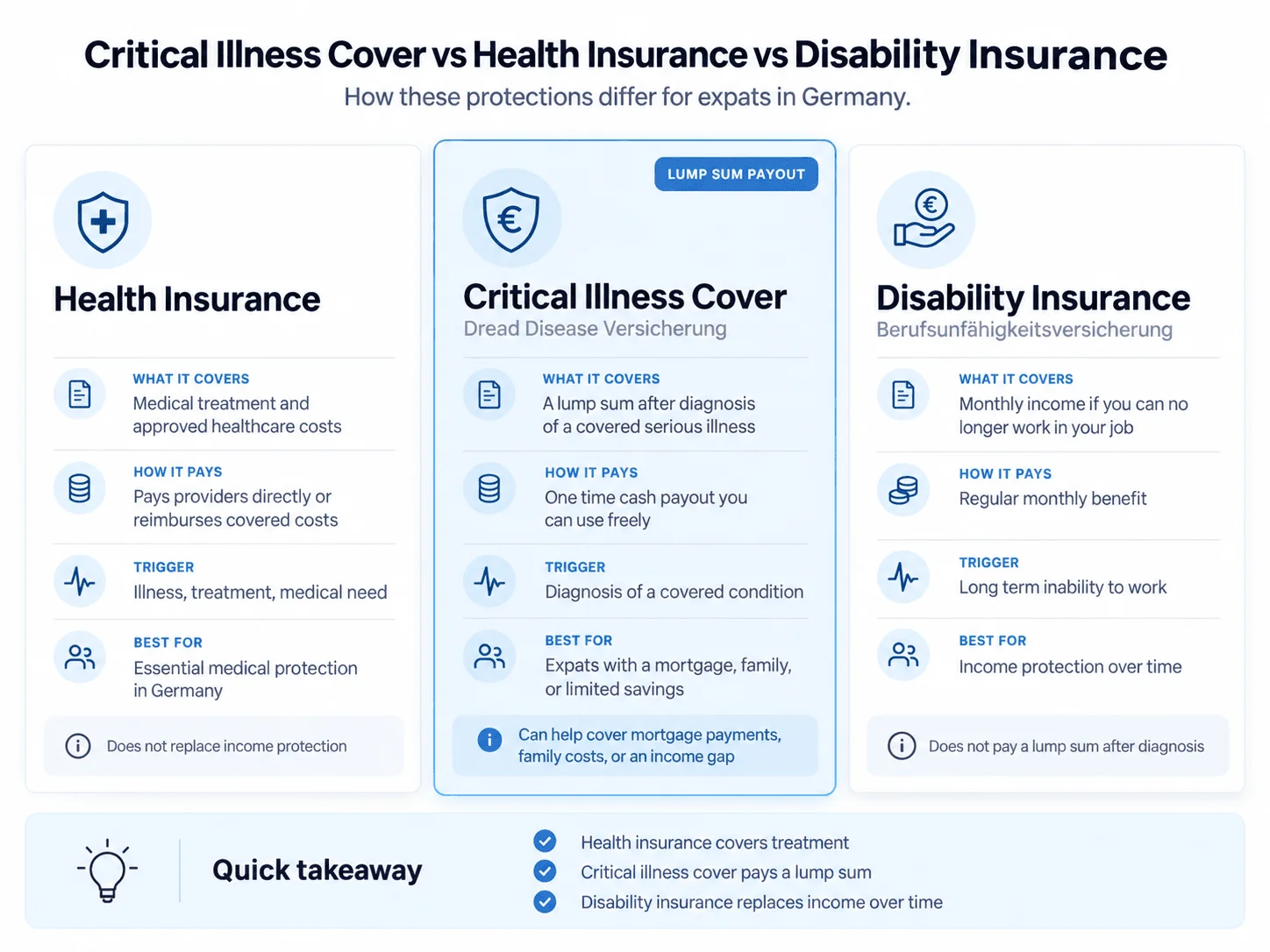
Simple comparison
Four types of protection that are often confused
German health insurance: Mainly covers medical treatment and approved healthcare costs.
Dread Disease Insurance: Can pay a lump sum after a defined serious diagnosis.
"Berufsunfähigkeitsversicherung": Usually pays monthly income protection if you can no longer work in your profession.
Life insurance: Usually supports dependents if the insured person dies.
Dread Disease vs Berufsunfähigkeitsversicherung
This is probably the most important comparison in the whole article, because the two products are often mixed up.
A "Berufsunfähigkeitsversicherung", often shortened to "BU Versicherung", protects your income if you can no longer work in your profession for health reasons. It is a form of disability insurance in Germany, and in practice it works a lot like income protection insurance in Germany. If the conditions are met, it usually pays a monthly benefit, often for many years.
A Dread Disease Versicherung works differently. It pays when a defined covered illness is diagnosed, even if you later go back to work. You might have a heart attack, recover well and be back at your desk after a few months. A BU policy might not pay anything in that case, while a Dread Disease policy could still pay the full lump sum if the diagnosis met the policy definition.
In simple terms, when looking at Dread Disease vs "Berufsunfähigkeitsversicherung":
- BU usually pays a monthly amount if you cannot work in your job.
- Dread Disease usually pays a single lump sum after a covered diagnosis.
That is why Dread Disease should not be seen as a full replacement for BU. If your main worry is "what if I can never work again?", BU is usually the more direct answer. The dread disease vs BU question is really about which problem you are trying to solve.
That said, critical illness vs disability insurance is not always a clear-cut choice. Dread Disease may still be relevant if:
- You want a lump sum on top of your income protection.
- You want money quickly after a diagnosis, rather than waiting for a disability assessment.
- Your main concern is protecting your family or your mortgage.
- BU is hard to get or very expensive because of your job or medical history.
If BU is unavailable or very expensive, Dread Disease cover may be one option to review, but it should not automatically be treated as the next best replacement. Other alternatives and the exact protection gap should be compared first.
If you want to dig deeper into the BU side, read our article on occupational disability insurance for expats in Germany.
Which illnesses are usually covered by Dread Disease Insurance?
The honest answer is: it depends on the policy and the exact definitions in it.
Most policies focus on serious, clearly defined diagnoses. The covered illnesses often include:
- Cancer
- Heart attack
- Stroke
- Multiple sclerosis
- Organ transplant
- Paralysis
- Blindness or deafness
- Severe burns
Some policies list only a handful of conditions, while others include dozens. This is why people searching for cancer insurance in Germany, heart attack insurance or stroke insurance often end up looking at Dread Disease products, because these three conditions are at the core of many serious illness cover policies.
Here is the catch: the diagnosis usually has to meet a specific severity definition in the contract. For example, a very early-stage cancer or a minor heart event might not qualify under some policies. The name of the illness alone is not enough.
So do not rely only on marketing names or a short list on a website. The "versicherte schwere Krankheiten" and their definitions are written in the "Versicherungsbedingungen", the policy conditions. That document is where you find out what is really covered. If the "versicherte Krankheiten" section is long and technical, that is normal, and it is also exactly the part worth reading carefully.
Is Krebsversicherung the same as Dread Disease Versicherung?
Not quite. "Krebsversicherung" simply means cancer insurance, sometimes also described as "Versicherung gegen Krebs" or "Versicherung bei Krebs".
A cancer policy can be narrower than Dread Disease Versicherung, because it may focus mainly or only on cancer. A "Schwere-Krankheiten-Versicherung" is often broader, covering other conditions such as heart attack, stroke and other defined severe illnesses.
If you are wondering whether a "Krebsversicherung" is sensible, or searching for "Krebsversicherung sinnvoll", the more useful question is: which risks do you actually want covered? Compare the list of covered illnesses, not just the name on the policy.
Who should consider critical illness cover in Germany?
There is no one-size-fits-all answer. Whether critical illness insurance for expats makes sense depends on your financial situation, your family obligations and the insurance you already have.
That said, some groups have good reasons to at least look into it:
- Expats with children
- Couples where one partner earns most of the income
- People with a mortgage or high rent
- Self-employed expats
- Business owners
- People with limited emergency savings
- People without close family support in Germany
- People who want a lump sum rather than only monthly income protection
For expats, there is often an extra layer of uncertainty. Your parents or siblings may live in another country. Your contracts are in a language you may not fully read. You might not be sure whether you will stay in Germany long term. Your finances might stretch across two or three countries. When something serious happens, those factors can make everything harder.
Critical illness cover for expats can help take some of that pressure off, especially where family protection and mortgage protection are concerns.
If you are self-employed, this may matter even more. Self-employed expat insurance often has gaps, because you do not have the same employer sick pay safety net as salaried workers.
Still, the right cover depends on your existing health insurance, any disability cover, your savings and your family situation. If you are unsure where you stand, it can help to speak with Finance for Expats before you make a decision about expat insurance in Germany.
Dread Disease Versicherung Kosten: what affects the price?
There is not one standard price. Dread Disease Versicherung Kosten depend on both you as a person and the contract you choose. The main factors that shape your insurance premiums are:
- Your age when you apply
- The insured lump sum
- How long the contract runs
- Whether you smoke
- Your occupation, where relevant
- Your health history
- Which illnesses are covered
- Whether you add cover for your partner or children
- The insurer and its tariff conditions
As a general rule, younger and healthier applicants often have more options and pay less. That is one reason why waiting a few years can make Dread Disease Insurance cost more than expected, since both age and health can change.
Your answers to the "Gesundheitsfragen" during the "Gesundheitsprüfung" also play a big role. Depending on your medical history, the insurer might add a "Risikozuschlag", which raises the premium.
Because prices vary so much, it is hard to give a meaningful universal figure for critical illness insurance cost in Germany. If you would like a feel for real numbers, you can check the example pricing for Dread Disease Insurance. Keep in mind that examples are only examples, not a personal quote.
Health questions, waiting periods and exclusions
This is the technical part, but it is also where many future problems start, so it is worth taking a few minutes to understand it.
Health questions and underwriting
When you apply, you will usually need to answer "Gesundheitsfragen", which are the health questions on the application form. The insurer then carries out a "Gesundheitsprüfung", which is basically medical underwriting or a health assessment.
If you have "Vorerkrankungen", meaning pre-existing conditions, this can affect:
- Whether your application is accepted
- Whether certain illnesses are excluded
- Whether you pay a "Risikozuschlag"
- How high the insured amount can be
- Whether a policy is offered at all
Please answer these questions carefully and truthfully. If something is left out, even by accident, the insurer may be able to refuse a claim or cancel the contract later. That is the last thing you want at the moment you actually need the money. If you are unsure whether a past doctor visit or diagnosis counts, ask before you submit.
Waiting periods
Many policies include a "Wartezeit", which is a waiting period after the contract starts before certain cover applies. For example, some policies do not pay for certain illnesses diagnosed within the first months of the contract. The rules for a "Wartezeit" in a "Versicherung" like this differ between providers.
You may also come across the term "Karenzzeit". Depending on the product and the policy wording, a "Karenzzeit" in a "Versicherung" can describe a waiting or deferred period. Because the meaning is not always the same, read how your specific contract uses the term rather than assuming.
Some policies also have a survival period, meaning you need to survive a certain time after diagnosis before the payout is made. This is not the case with every contract, so it is one more thing to check in the policy conditions. When comparing the waiting period in critical illness insurance, look at when cover starts and when a payout can actually be claimed.
Exclusions
"Ausschlüsse", meaning insurance exclusions, are situations or conditions the policy will not pay for. They can be general, for example certain causes of illness, or personal, for example a condition linked to your medical history.
German insurance language can be tricky, even for native speakers. If you are reading these documents in your second or third language, it is completely reasonable to want help. Getting English-speaking insurance advice can make a real difference here.
Dread Disease Versicherung Vergleich: what expats should compare
A good Dread Disease Versicherung Vergleich is not just about finding the cheapest monthly premium. When comparing policies, look at:
- The covered illnesses
- The severity definitions for each illness
- The payout amount
- Exclusions
- Waiting periods
- The health questions
- Family or children's cover
- Whether cover applies worldwide
- How long the contract runs
- How the claim process works
- Whether you can keep the policy if you leave Germany
- The language of the advice and the documents
The last two points matter a lot for expats. If you might move back home or on to another country, you want to know what happens to your cover.
It is tempting to search for a Dread Disease Versicherung Test and pick the winner. But cheapest is not always safest, especially if the illness definitions are narrow. A lower premium can sometimes mean a policy that pays in fewer situations. A proper critical illness insurance comparison in Germany looks closely at the policy conditions, the covered illnesses and the insurance exclusions, not just the headline price.
Once again, the wording matters more than the product name.
Dread Disease, life insurance and mortgage protection
Life insurance and Dread Disease Insurance are often discussed together, but they protect against different things.
Life insurance, including term life insurance, normally protects your dependents if you die. Dread Disease cover supports you and your family while you are still alive after a serious diagnosis. When people look at life insurance vs Dread Disease, or term life insurance vs critical illness cover, the real difference is timing: one pays on death, the other pays during illness.
For families and anyone with a home loan, this matters a lot:
- Mortgage payments or rent continue during treatment
- Income may drop, either temporarily or permanently
- The family may need extra cash quickly
- The healthy partner may need flexibility at work
- Childcare, travel and home adjustments can all add up
A lump sum payout can give you room to handle all of this without draining your savings. That is why many people see Dread Disease as part of their mortgage protection and wider family protection, alongside life insurance rather than instead of it.
For the bigger picture, see our guide to health and life insurance for expats in Germany.
Common mistakes expats make with Dread Disease Insurance
We see the same patterns come up again and again. Here are the most common ones:
- Assuming German health insurance covers everything. It covers treatment, but not every financial consequence of being seriously ill.
- Thinking Dread Disease and BU are the same. They solve different problems and pay out in different ways.
- Choosing only by price. A cheap policy with narrow definitions may not help when it matters.
- Not checking the list of covered illnesses. The list can vary a lot between policies.
- Ignoring exclusions and severity definitions. The insurance exclusions and fine print decide whether a claim is paid.
- Answering health questions too casually. Mistakes in the "Gesundheitsfragen" can cause serious trouble later.
- Choosing too low a lump sum. Think about how many months of costs you would want covered.
- Not checking family or children's cover. Some policies offer this, others do not.
- Waiting too long to apply. Age and new health issues can make cover more expensive or harder to get.
- Not asking what happens if you leave Germany. For expat insurance in Germany, this is a big one.
Most of these mistakes come down to not having the full picture of the policy conditions. If you would like someone to look over the details with you, you can get advice before choosing cover. Good critical illness cover for expats starts with understanding what you are signing.
Quick self-check: could Dread Disease cover make sense for you?
Self-check
Could critical illness cover make sense for you?
Do you have children or dependents?
Would your household struggle if income dropped for several months?
Do you have a mortgage or high rent in Germany?
Do you have limited emergency savings?
Are you self-employed or a business owner?
Would a lump sum help with treatment, travel, childcare or home adjustments?
Would your family need support if you had cancer, a heart attack or a stroke?
If you answered yes to several of these questions, Dread Disease cover may be worth reviewing as part of your wider insurance planning.
This is not a verdict, just a starting point. Dread Disease Versicherung is one tool for financial protection, family protection and mortgage protection, and critical illness cover for expats works best when it fits into a wider plan. If a few of these questions hit home, you can review Dread Disease Insurance options.
FAQs about Dread Disease Versicherung in Germany
What is Dread Disease Versicherung in Germany?
Dread Disease Versicherung is critical illness cover for defined serious illnesses, such as cancer, heart attack or stroke. In German, it is also known as "Schwere-Krankheiten-Versicherung". If you are diagnosed with a covered illness and the policy conditions are met, you receive a one-time lump sum payout.
Is Dread Disease Insurance the same as German health insurance?
No. German health insurance covers medical treatment and approved healthcare costs. Dread Disease cover pays you a lump sum after a covered diagnosis, which you can use for things like income gaps, rent, childcare or household support. When looking at health insurance vs Dread Disease Insurance, think of them as two separate layers. Critical illness insurance in Germany works alongside health insurance, not instead of it.
Which illnesses are usually covered by critical illness insurance?
Cancer, heart attack and stroke are common covered illnesses, and many policies also include conditions like multiple sclerosis, organ transplant, paralysis, blindness or deafness and severe burns. That is why many people looking for cancer insurance in Germany, heart attack insurance or stroke insurance end up comparing these policies. The final list and the definitions depend on your specific policy.
Does Dread Disease Insurance replace Berufsunfähigkeitsversicherung?
Usually not. A "Berufsunfähigkeitsversicherung" protects your income if you can no longer work in your profession, usually with a monthly benefit. Dread Disease pays a lump sum for defined serious diagnoses. When comparing Dread Disease vs BU, remember they solve different problems. For many people, disability insurance in Germany and critical illness cover work best together.
How much does Dread Disease Versicherung cost?
Dread Disease Versicherung Kosten depend on your age, health, insured amount, smoking status, contract length and policy conditions. The "Gesundheitsprüfung" can also affect the price if a risk surcharge applies. Because every situation is different, there is no single figure for critical illness insurance cost in Germany. You can see example Dread Disease pricing to get a rough idea.
What are Gesundheitsfragen in Dread Disease Insurance?
"Gesundheitsfragen" are the health questions you answer when you apply. They are part of the "Gesundheitsprüfung", the insurer's health assessment. Your answers, including any "Vorerkrankungen", can affect whether you are accepted, whether exclusions apply and whether you pay a "Risikozuschlag". They also matter for future claims, so answer them carefully and honestly.
What is Wartezeit in Dread Disease Insurance?
"Wartezeit" means waiting period. In a Dread Disease Versicherung, it is the time after the contract starts before certain cover applies. Not every policy uses the same "Wartezeit" rules, so check exactly when your cover begins and when a payout can be claimed. When comparing the waiting period in critical illness insurance, it is worth also asking whether a survival period applies.
Is Dread Disease Insurance useful if I already have life insurance?
It can still be useful, because life insurance and Dread Disease Insurance solve different problems. Life insurance normally supports dependents if the insured person dies. Dread Disease cover can support the household while the insured person is alive after a covered serious diagnosis. For families, mortgage holders and expats without nearby relatives, both forms of cover may play different roles in financial planning.
Can expats get Dread Disease Insurance in Germany?
Yes, in many cases. Whether you can get Dread Disease Insurance in Germany depends on your residence, health, age and the provider's criteria. Because policy wording is usually in German, many people find English-speaking advice helpful when looking into critical illness insurance for expats and wider expat insurance in Germany. If you would like support, you can speak with Finance for Expats.
Dread Disease Insurance is about financial breathing room, not just medical treatment
German health insurance takes care of your treatment. But a serious illness affects much more than your medical bills. It can touch your income, your home, your partner's work and your children's routines, often all at once.
Dread Disease Versicherung is designed for exactly that moment. After a covered serious diagnosis, a lump sum can give you and your family financial flexibility when you need it most.
It is not a replacement for health insurance, BU or life insurance. It works best when you look at it alongside those, together with your emergency savings and your family obligations. And as with any insurance, the details decide everything: the covered illnesses, the severity definitions, the health questions and the exclusions. If you are unsure how a payout may be treated in your personal situation, for example from a tax point of view, ask about that too.
Before choosing critical illness cover in Germany, make sure you understand what the policy pays for, what it excludes and how it fits your family, income and long-term plans. If you would like to talk it through in English, you can book a consultation with Finance for Expats.