Jung kauft Alt 2026: How KfW 308 Helps Families Buy Older Homes
Picture an expat family with two children who have been in Germany for a few years. They find an older house that costs far less than the renovated one down the street. Then the "Energieausweis" arrives: class G. The renovation costs look serious. Their mortgage adviser mentions KfW 308 and "Jung kauft Alt".
The program sounds great. It offers cheaper subsidized financing, a KfW loan of up to €180,000, access to older and potentially cheaper properties, and several years to complete the required energy renovation.
But it is not simply a cheap mortgage for any old house. Eligibility depends on your family structure, taxable household income, existing home ownership, self use, the energy class of the property and the renovation you commit to afterwards.
So the real question is this: can "Jung kauft Alt" actually make an older property affordable for your family, or do the renovation costs and remaining mortgage still make the purchase too expensive?
Not sure where KfW 308 sits among the other options? KfW Funding 2026 Explained for Property Buyers in Germany gives you the bigger picture. And if you are only just starting to look at homes, Buy Property in Germany: Complete Guide for Expats is a good place to begin.
Short Answer
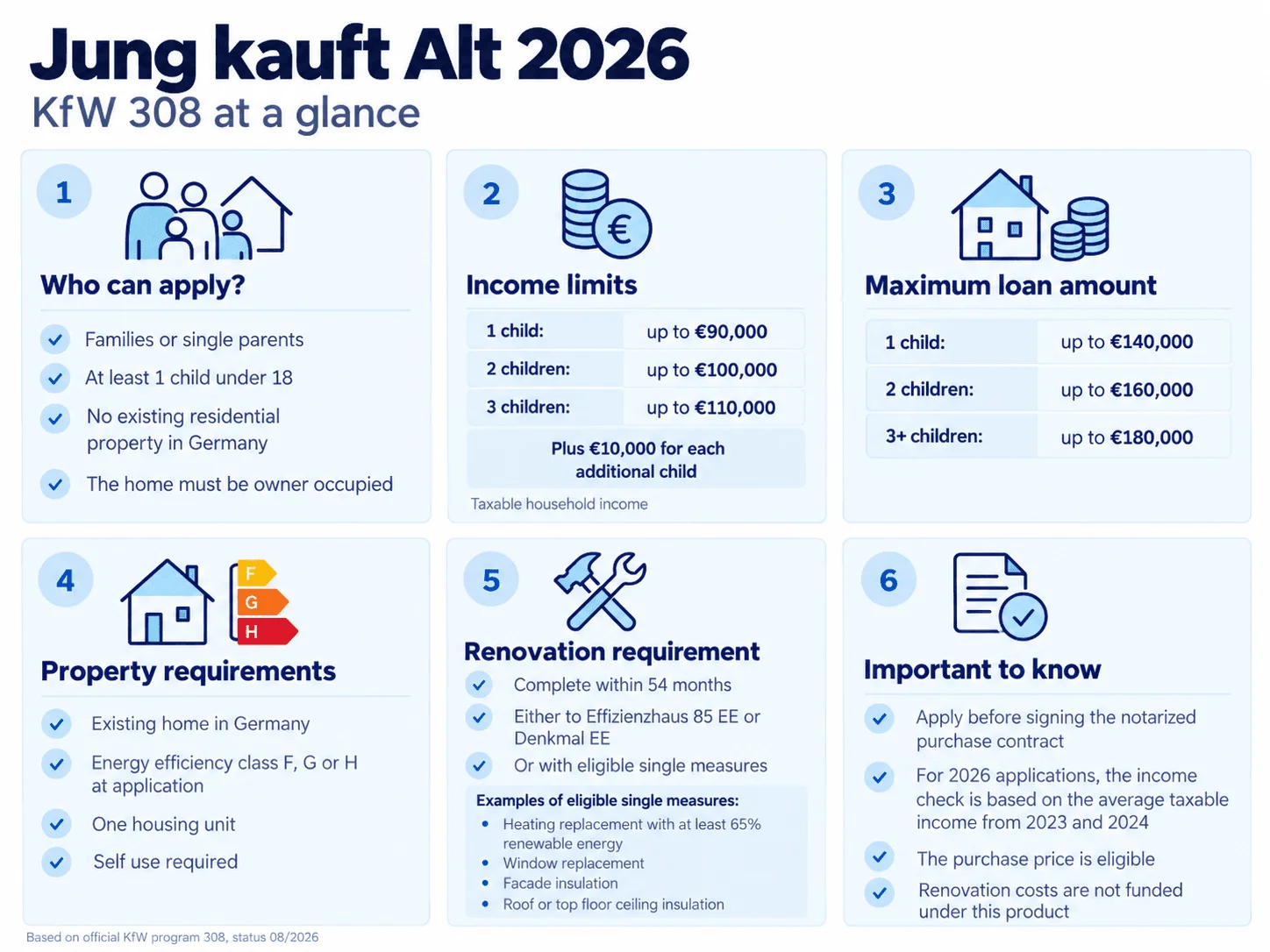
"Jung kauft Alt" is KfW program 308 for families and single parents buying an older home in Germany for their own use. At least one qualifying child must live in the household, income limits apply and the property must have "Energieeffizienzklasse" F, G or H. Depending on the number of children, the subsidized loan can reach €140,000 to €180,000. The property must then be energetically renovated within 54 months. Importantly, KfW 308 finances the eligible purchase price, not the renovation itself.
What Changed for "Jung kauft Alt" in 2026?
The program became considerably more attractive in August 2026. Two changes matter for anyone applying today.
Higher KfW 308 Loan Amounts
The maximum loans are now:
- 1 child: up to €140,000
- 2 children: up to €160,000
- 3 or more children: up to €180,000
The loan can never exceed the eligible purchase price, so a cheaper property will not automatically unlock the full amount.
More Flexible Renovation Options
Buyers now have two principal renovation routes: either the property is renovated to an eligible "Effizienzhaus" standard, or the renovation follows a defined route using eligible energetic "Einzelmaßnahmen".
The second option can make the renovation more flexible, but it does not mean that buyers can simply choose any individual measure they like. The permitted measures and technical requirements are defined by the applicable funding rules, and components that already meet the relevant standards may be treated differently.
Who Can Get KfW 308 "Jung kauft Alt"?
Here are the KfW 308 requirements in plain English.
You Need at Least One Child Under 18
At least one biological or adopted child under 18 must live in your household when you apply. The situation on the application date is what counts. The number of qualifying children also determines both your income threshold and your maximum loan.
What Is the "Jung kauft Alt" Einkommensgrenze?
The relevant figure is not your gross salary and not your net salary. It is your "zu versteuerndes Einkommen", your taxable income.
Expats often compare the limit with their annual gross salary, and that comparison is misleading. Deductions can leave your taxable income well below your gross pay.
The current income limits are:
- 1 child: €90,000
- 2 children: €100,000
- 3 children: €110,000
- Each additional child: + €10,000
For a 2026 application, KfW uses the average taxable income from 2023 and 2024.
You Must Live in the Property Yourself
"Selbstnutzung", also called "Eigennutzung", means the property must become your family's own home.
You must become an owner of the funded property with an ownership share of at least 50 percent.
KfW 308 is not intended for a normal buy-to-let investment.
You Must Not Already Own Residential Property in Germany
Existing ownership of a house, apartment or share in residential property in Germany can exclude you from KfW 308.
The published KfW eligibility condition specifically refers to residential property in Germany. If you own property abroad, that may still matter to your bank when it assesses your wider finances, so discuss it with your financing partner early.
Can Expats and Foreigners Apply for "Jung kauft Alt"?
Yes. German citizenship is not the core eligibility criterion.
But program eligibility and mortgage approval are two separate questions. You still need to satisfy your financing partner's normal requirements, such as:
- income stability and employment
- creditworthiness
- residence status
- complete documentation
For more context, read Can Foreigners Get a Mortgage in Germany Without Permanent Residency?
What if Your Tax Documents Are From Another Country?
This matters especially for recent arrivals who do not have German tax assessments for the relevant years.
KfW accepts foreign tax certificates if they are accompanied by a certified translation. If this applies to you, raise it with your financing partner early rather than discovering a documentation problem shortly before the application.
Which "Energieeffizienzklasse" Qualifies for "Jung kauft Alt"?
The program specifically targets inefficient existing homes. The property needs a valid "Energieausweis", and its "Energieeffizienzklasse" must be F, G or H at the time of application.
Not sure how to read the certificate? See our Energieausweis Germany: Energy Certificate Guide for Expats .
"Energieeffizienzklasse" F
Class F qualifies. It already signals relatively high energy consumption, so renovation planning should start before you buy, not after.
"Energieeffizienzklasse" G
Class G also qualifies. More substantial energy modernization may be necessary, so connect the renovation budget directly to your assessment of the property's value.
"Energieeffizienzklasse" H
Class H qualifies as well. It sits at the least efficient end of the standard energy scale, meaning that a low purchase price can quickly be offset by significant renovation costs.
Does "Energieeffizienzklasse" E Qualify for "Jung kauft Alt"?
No. KfW 308 currently requires F, G or H.
A more efficient class E home may still be a perfectly good purchase, but it does not meet this program's energy-class requirement.
Can You Buy a House or an Apartment With KfW 308?
Both. The program is not limited to detached houses.
An existing house or owner-occupied apartment in Germany can qualify, provided that you will live in it yourself and it meets the relevant energy-class and program requirements.
What Does Not Qualify?
- pure land purchases
- holiday homes and holiday apartments
- refinancing a purchase that is already completed
- later additional financing for a project already started
- certain applicants who have already received excluded previous ownership subsidies
- ordinary purchase costs such as "Grunderwerbsteuer", "Notarkosten" and "Maklerkosten"
How Much Can You Borrow With "Jung kauft Alt"?
| Children | Maximum taxable household income | Maximum KfW 308 loan |
|---|---|---|
| 1 child | €90,000 | €140,000 |
| 2 children | €100,000 | €160,000 |
| 3 children | €110,000 | €180,000 |
| 4 children | €120,000 | €180,000 |
The income limit keeps rising by €10,000 for each additional qualifying child, but the maximum loan amount reaches its ceiling at €180,000 from three children onwards.
Your KfW financing is also limited by the eligible purchase price.
KfW 308 interest rates change with the capital market, so the current rate should always be checked at the time of application rather than copied from an older article.
Useful terms to know include a loan term of up to 35 years, interest fixation of up to 10 years and a possible "tilgungsfreie Anlaufzeit" depending on the financing structure you choose.
What Does KfW 308 Actually Finance?
KfW 308 finances the eligible purchase price of the existing home. The land value included in the purchase can form part of that eligible price.
It does not pay for the renovation itself.
It also does not cover normal acquisition costs such as "Grunderwerbsteuer", "Notarkosten" or "Maklerkosten".
To see the full cost picture, use the Total Cost of Ownership Calculator .
How Must a "Jung kauft Alt" Property Be Renovated?
Buyers currently have two main ways of meeting the renovation requirements.
Option 1: Renovation to an Eligible "Effizienzhaus" Standard
The property can be renovated to at least the eligible "Effizienzhaus 85 EE" standard.
Higher qualifying EE standards can also be possible, while listed buildings can qualify under "Effizienzhaus Denkmal EE".
You do not need to calculate the technical standard yourself. An "Energieeffizienz-Experte" is involved in this route and confirms that the required standard has been met.
Option 2: Eligible Energetic "Einzelmaßnahmen"
The 2026 rules also allow the renovation to follow a defined set of eligible individual energy measures.
These can include:
- heating replacement
- window replacement
- façade insulation
- roof insulation
- insulation of the top-floor ceiling
This is not a completely free pick-and-choose system. The applicable KfW and BEG requirements determine which measures need to be completed. Components that already meet the required technical standards may not need to be replaced again.
How Do You Finance the "Energetische Sanierung"?
Since KfW 308 finances the purchase and not the renovation work itself, the "energetische Sanierung" needs its own financing plan.
Several funding programs may potentially help, depending on the project and whether the respective requirements are met.
KfW 261 for an "Effizienzhaus" Renovation
KfW 261 can be relevant for qualifying energy-efficient renovation projects, particularly where the building is renovated to an eligible "Effizienzhaus" standard.
KfW 458 for Heating Replacement
KfW 458 may be relevant when an eligible heating replacement forms part of the wider renovation project. Eligibility should not be assumed automatically.
BAFA and Other BEG Support
BAFA and other parts of the "Bundesförderung für effiziente Gebäude" can also be relevant for specific measures.
Funding programs, combinations and application timing should always be checked before work begins.
Our KfW Funding 2026 guide gives you the broader funding picture.
How Long Do You Have to Complete the Renovation?
Generally, you have 54 months from the KfW funding approval to complete the required energy renovation.
That is 4.5 years, and it is a program requirement rather than a suggestion.
Plan realistically for:
- contractor availability
- permits
- renovation financing
- energy planning
- temporary accommodation
- family logistics
Do You Need an "Energieeffizienz-Experte"?
For the "Effizienzhaus" Route
Yes. An "Energieeffizienz-Experte" must be involved and confirms that the required energy standard is met.
For Eligible Individual Measures
An energy-efficiency expert is not automatically required for every individual-measures route.
Where permitted, qualified tradespeople can provide the relevant technical confirmation. Even so, professional energy advice before buying an F, G or H property can be valuable because it helps you understand the likely renovation cost before committing to the purchase.
How Does KfW 308 Fit Into a Normal German Mortgage?
Usually KfW 308 is one component of the overall financing.
Take a €400,000 property purchase with two qualifying children:
- Purchase price: €400,000
- Maximum KfW 308 loan: €160,000
- Remaining purchase price: €240,000 before considering equity
That remainder may come from your "Eigenkapital", a normal German mortgage or other eligible financing sources. Renovation financing remains separate.
For the wider financing structure, read Mortgage in Germany: What Expats Need to Know Before Applying .
Can You Combine "Jung kauft Alt" With Other KfW Funding?
Potentially. Different programs can support different parts of a project, but you should not assume that every combination is automatically allowed.
- KfW 261 may be relevant for an eligible "Effizienzhaus" renovation.
- KfW 458 may be relevant for a qualifying heating replacement.
- BAFA or other BEG support may be relevant for specific measures.
Before any work starts, check which funding programs fit together and when each application needs to be submitted.
When Must You Apply for KfW 308?
You apply through a financing partner such as a bank, "Sparkasse", "Bausparkasse", financing intermediary or insurance company.
The application must generally reach KfW before the normal notarised purchase contract is concluded.
Sign first without the appropriate structure and you may lose eligibility.
Can You Use an "Aufschiebende Bedingung" in the Purchase Contract?
An "aufschiebende Bedingung" means that the purchase only becomes legally effective once a specified future event occurs.
In the KfW 308 context, that event can be the funding approval. A properly structured "Kaufvertrag" containing such a condition can therefore allow the parties to sign before final KfW approval without automatically creating a harmful early project start.
The exact contract wording matters, so coordinate it with your notary and financing partner rather than copying a clause from the internet.
Also read Reservation Agreement Germany: What Expats Risk Before Mortgage Approval to understand the risks of committing before your financing is secure.
Which Documents Do Expats Need for "Jung kauft Alt"?
Typical documents include:
- relevant income tax assessments – for 2026 applications, the 2023 and 2024 assessments
- birth certificates of qualifying children
- a valid "Energieausweis" showing F, G or H
- identity and mortgage documents requested by the financing partner
- foreign tax certificates with a certified translation where relevant
Your bank can request additional documents beyond the KfW minimum, so it is worth collecting everything early.
What Happens if You Sell the Property or Move Abroad?
KfW 308 is designed for owner-occupied housing, so changing how the property is used can affect the funding.
Under the current program terms, the funded property generally has to be used by you as an owner-occupier for at least five years from moving in. Additional use and notification obligations also apply.
Selling the home, renting it out, reducing your ownership share below the required level or permanently moving abroad can therefore have consequences for the funding and should be discussed with KfW and your financing partner before the change takes place.
This point is particularly important for expats who cannot be certain whether they will still live in Germany several years after buying.
Is "Jung kauft Alt" Actually Worth It?
Being eligible does not automatically make a property a good purchase.
Weigh up:
- purchase price and acquisition costs
- the KfW interest advantage
- the required standard mortgage
- your "Eigenkapital"
- renovation costs
- the renovation timeline
- future energy costs
- a realistic financial buffer
Factor renovation costs into your maximum offer, as explained in Property Price Negotiation in Germany: How Expats Avoid Overpaying .
Then compare the real cost with the Total Cost of Ownership Calculator .
"Jung kauft Alt" 2026 Buyer Checklist
- Do you have at least one qualifying child?
- Is your taxable household income below the applicable limit?
- Do you already own residential property in Germany?
- Will you live in the property yourself?
- Will you own at least 50 percent of the property?
- Does the "Energieausweis" show F, G or H?
- Have you calculated realistic energy-renovation costs?
- Do you understand whether an eligible "Effizienzhaus" route or individual measures are better suited to the property?
- Can you complete the required renovation within 54 months?
- Have you arranged separate renovation financing?
- Has your financing partner checked KfW 308 eligibility?
- Have you applied before signing a normal binding purchase contract?
- Does the purchase still make sense after renovation costs?
Common Mistakes With "Jung kauft Alt"
Thinking KfW 308 Pays for the Renovation
It does not. The program finances the eligible purchase price. Renovation needs its own financing structure.
Comparing the Income Limit With Gross Salary
The relevant figure is the "zu versteuerndes Einkommen", not gross salary and not net salary.
Signing the Purchase Contract Too Early
KfW application timing is strict. Make sure your financing partner, notary and KfW process are coordinated before creating a binding purchase.
Buying an "Energieeffizienzklasse" E Property
Class E does not qualify for KfW 308. The property must be F, G or H when you apply.
Underestimating the "Energetische Sanierung"
An attractive discount on an inefficient property can disappear quickly once realistic renovation costs are added.
Assuming KfW 308 Replaces the Main Mortgage
For many buyers it is only one component of the overall financing.
Ignoring the 54 Month Deadline
Your renovation plan needs to be realistic before you buy, not after contractors, financing and permits start causing delays.
FAQs About "Jung kauft Alt" and KfW 308
What Is "Jung kauft Alt"?
"Jung kauft Alt" is the common name for KfW program 308, officially "Wohneigentum für Familien – Bestandserwerb". It offers subsidized financing to eligible families and single parents who buy an inefficient existing home in Germany, live in it themselves and complete the required energy renovation afterwards.
How Much Can I Borrow With KfW 308?
The maximum depends on the number of qualifying children: €140,000 with one child, €160,000 with two and €180,000 with three or more. The loan is also limited by the eligible purchase price of the property.
What Is the "Jung kauft Alt" Einkommensgrenze?
The limit is €90,000 with one child, plus €10,000 for each additional child. It refers to taxable household income, the "zu versteuerndes Einkommen", rather than gross or net salary. For applications in 2026, KfW uses the average taxable income from 2023 and 2024.
Which "Energieeffizienzklasse" Qualifies?
Only classes F, G and H qualify. The property needs a valid "Energieausweis" showing one of these classes at the time of application.
Does "Energieeffizienzklasse" E Qualify?
No. A class E property may still be an attractive home, but it falls outside the current KfW 308 energy-class requirement.
Does KfW 308 Pay for Renovation?
No. KfW 308 finances the eligible purchase price, including eligible land costs within that purchase. Renovation costs, "Grunderwerbsteuer", "Notarkosten" and "Maklerkosten" are not financed through this product.
Can Expats Apply for "Jung kauft Alt"?
Yes. Citizenship is not the key criterion, but program eligibility and mortgage approval are separate hurdles. Your bank still checks income, employment, creditworthiness, residence status and documentation. Foreign tax certificates can be accepted with a certified translation.
When Do I Need to Apply for KfW 308?
Generally before the normal notarised purchase contract is concluded. The application goes through a financing partner and must reach KfW before the project starts. A correctly structured "aufschiebende Bedingung" can allow a purchase contract to be signed earlier, but it needs to be included from the outset and coordinated with the notary and financing partner.
Final Thoughts: Use "Jung kauft Alt" as Part of the Financing, Not as the Whole Plan
- "Jung kauft Alt" can provide a significant subsidized part of your purchase financing.
- Eligibility depends on your family, income, ownership situation and the property's energy class.
- The property must be F, G or H and needs the required energy renovation afterwards.
- The renovation itself needs a separate budget and financing plan.
"Jung kauft Alt" can make an older home easier to finance, but the real decision is whether the purchase price, energy renovation and long-term mortgage still work together.