


Short answer
The "Energieausweis" is the German energy performance certificate for a building. It shows the energy efficiency class, final energy demand or consumption, primary energy demand, energy source and key building details. For expat buyers, it is not a heating bill forecast, but it can reveal possible running costs, renovation risks and questions to check before making an offer.
Table of Contents
- What Is an Energieausweis in Germany?
- How to Read a German Energieausweis
- Energy Efficiency Classes A+ to H: What They Mean for Buyers
- Energieausweis Quick Check
- Bedarfsausweis vs Verbrauchsausweis
- What Does a Poor Energy Certificate Mean for Your Budget?
- Energy Efficiency and Property Value
- Energy Efficiency and Mortgage Planning
- Renovation Costs and the Real Investment Case
- Energieausweis Red Flags Expats Should Check Before Making an Offer
- What Should Expats Ask the Seller Before Buying?
- FAQs About the Energieausweis in Germany
- The Energieausweis Is a Starting Point, Not the Final Decision
When searching for apartments for months, one finally finds a flat that is just right. It is spacious, it is in a great location and it is cheap. So all in all it looks like a great deal. However, in the fine print it says "Energieeffizienzklasse F", "Endenergieverbrauch 175 kWh/m²·a" and "Energieträger Erdgas".
Let us translate that into buyer language. Firstly, "Energieeffizienzklasse" means energy efficiency class. If that class is F, the property sits in one of the weaker efficiency categories. Secondly, "Endenergieverbrauch" is the final energy consumption in kilowatt hours per square metre per year. In this example, the certificate states 175 kWh/m²·a. Thirdly, "Energieträger" means energy source or fuel type. In this case, "Erdgas" means natural gas.
Many of the lines of the energy certificate of a property are generally disregarded by potential buyers. But they reveal a lot of important information to help you identify possible heating costs in winter, required renovation work and whether the purchase price still makes sense.
The actual certificate is called the "Energieausweis", the German energy performance certificate. What to look out for first, how you can use the German energy performance certificate when buying a property and what the different efficiency classes actually mean will be explained in this guide. If you are planning on buying a property in Germany as an expat, it helps to understand this certificate before you make an offer.
What Is an Energieausweis in Germany?
When buying a property it is standard practice for potential buyers to request an "Energieausweis", or energy performance certificate, for the property or building they are interested in. As with a fridge or washing machine, the energy label rates the energy efficiency of a building from A+ at the most efficient end down to H at the least efficient end.
The "Energieausweis" is generally valid for ten years. However, buyers should still check whether the building has changed significantly since it was issued, for example through major renovation, heating replacement or extension work.
It is also important to understand that it is often the entire building that is described by the "Energieausweis", and not the individual apartment. So, if you want to buy a flat in a building with 12 apartments, the "Energieausweis" normally refers to the building, not only to your future unit.
Some of the terms you read may reappear below in more detail:
- "Energieeffizienzklasse": the efficiency class, from A+ to H
- "Endenergiebedarf" or "Endenergieverbrauch": the final energy the building needs or has used
- "Primärenergiebedarf": the wider energy picture behind that number
- "Energieträger": the energy source used for heating
- "Baujahr": the year of construction
We will not turn this guide into a legal explanation of the German energy certificate. The goal is to give you a practical summary of what you need to understand as a buyer of a property in Germany.
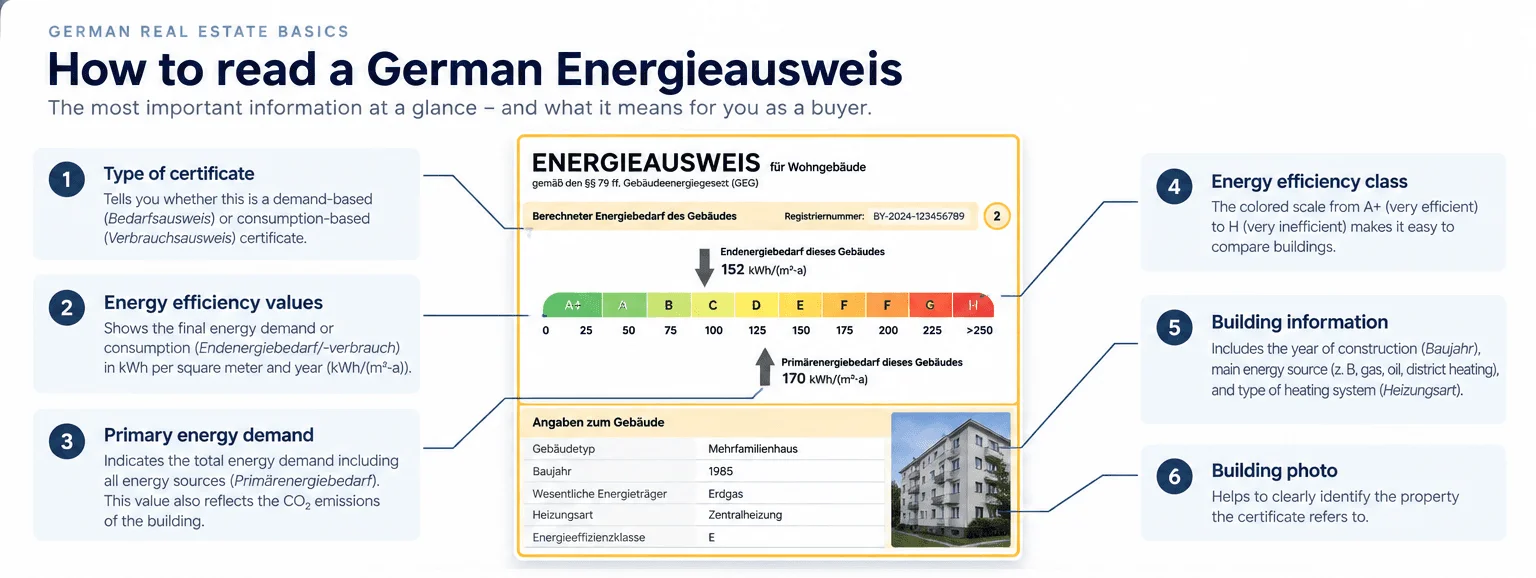
How to Read a German Energieausweis
You do not need to understand every technical line of the "Energieausweis" in order to get value from it. For a buyer, the most important task is to identify a few key figures and ask the right follow-up questions before making an offer.
Certificate Type: Bedarfsausweis or Verbrauchsausweis
One of the first things to check is which type of certificate you are looking at. A "Bedarfsausweis" is calculated on the basis of the building itself. A "Verbrauchsausweis" is calculated on the basis of the actual consumption of previous residents of a building.
We will return to this difference later when comparing both types in more detail. For the moment, it is simply useful to know which type of certificate you are dealing with.
Energy Efficiency Class
In Germany, building energy performance is expressed using energy efficiency classes from A+ to H. A+ is the most efficient category and H the least efficient. However, the energy efficiency class is only a first indicator. It does not automatically tell you everything about the roof, the heating system, the windows or the actual renovation condition of the building.
Final Energy Demand and Consumption
"Endenergiebedarf" means calculated final energy demand. "Endenergieverbrauch" means measured final energy consumption. Both are expressed in kWh/m²·a, which means kilowatt hours per square metre per year.
For example, 150 kWh/m²·a means approximately 150 kilowatt hours of final energy per square metre per year according to the certificate methodology. For a 100 m² flat, this would result in a certificate value of about 15,000 kWh per year.
That is not automatically the amount that you personally will pay for heating. Your actual consumption and cost can differ depending on your behaviour, the weather, energy prices, the heating system, building condition and whether the certificate is based on demand or past consumption.
Do not treat the number as your future heating bill
The final energy figure is a useful warning signal, but it is not a direct forecast of your future heating bill. Actual costs depend on usage behaviour, weather, energy prices, heating technology and the building's real condition.
Primary Energy Demand
"Primärenergiebedarf" looks at the wider energy chain behind the building's energy use. It considers not only the energy delivered to the building, but also the resources and emissions involved in producing and distributing that energy.
For example, a house with "Fernwärme", meaning district heating, or a "Wärmepumpe", meaning heat pump, may look different in the primary energy figures than a building heated with oil or gas. For buyers, the main point is not to become an engineer, but to understand that final energy and primary energy are not the same number.
Heating System, Energy Source and Construction Year
Next to that you will find the "Energieträger", the energy source. This can include:
- Natural gas, or "Erdgas"
- Oil, or "Öl"
- District heating, or "Fernwärme"
- Heat pump, or "Wärmepumpe"
This greatly affects the expected costs of heating as well as the future potential of a building. Oil and gas are classical heating fuels and may become more expensive or more strictly regulated over time. Heat pumps and district heating can be more future oriented options, but the local context matters a lot.
As far as age is concerned, there is more to a building than just its "Baujahr". While new buildings are often easier to understand from an energy perspective, older buildings can perform well if the roof, insulation, windows and heating system have been modernized. A building from the 1960s with strong renovation history can be more attractive than a newer building that has never been properly updated.
Buyers should therefore check:
- The age of the heating system, or "Heizungsanlage"
- Insulation
- Windows
- The roof
- Any past renovation work
Energy Efficiency Classes A+ to H: What They Mean for Buyers
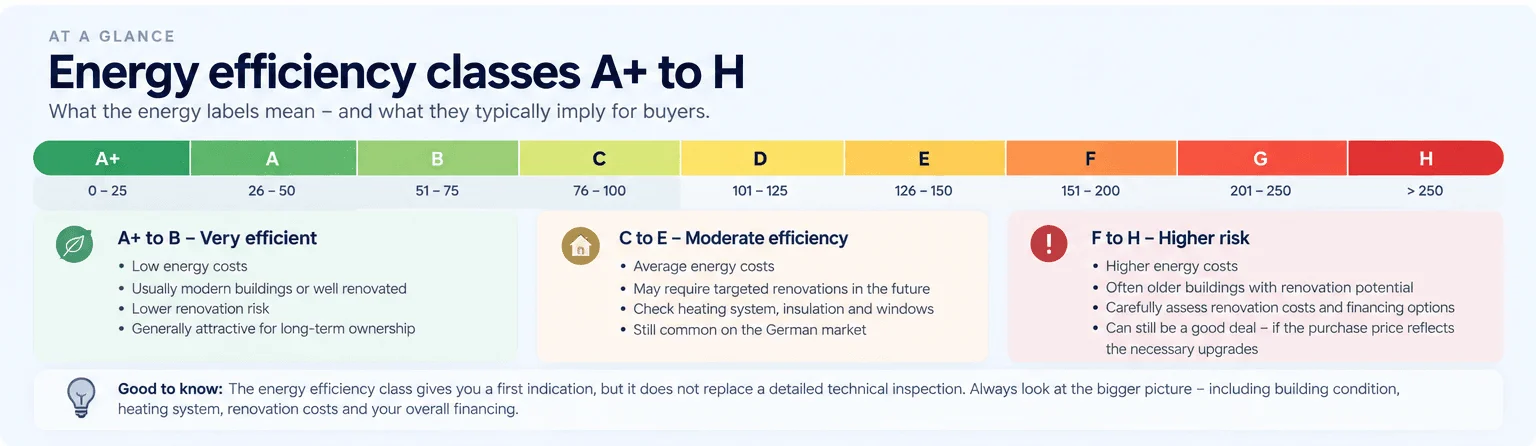
Even when knowing the energy efficiency classes, it is not always useful to overanalyse one letter in isolation. Sorting properties into higher and lower attention categories is often more helpful for a buyer.
A+ to B: Lower Energy Related Concern
This category covers buildings with energy labels ranging from A+ to B. In many cases, little energy is required in such buildings. For buildings that have already been renovated, however, it is still necessary to take a closer look at the heating system and the general condition of the building.
C to E: Check the Details
C to E usually means mid range energy performance. A property in this range is not automatically problematic, but buyers should check the details. Home inspections can reveal whether there is a need for new insulation, an update of the heating system or more efficient windows. In some years major repairs might be due, so you should include longer-term modernization costs in your budget.
F to H: Higher Buyer Attention
With weaker ratings comes higher attention. These classes can indicate higher energy consumption and potentially higher costs for energy-related measures. However, that does not necessarily mean that a poorly rated property can no longer be a good purchase or investment.
The real question is whether all aspects still work together: purchase price, renovation costs, financing options and future value. If the discount offered on a home is sufficient to cover the costs for the necessary energy-related refurbishments, then a home with a poor rating can still be interesting.
Energieausweis Quick Check
Use the key figures from the "Energieausweis" to get a first buyer-focused assessment of the property's energy profile. This quick check is designed as a first orientation for property buyers and can help you prepare early questions for sellers, contractors or advisors.
It does not replace a technical due diligence report, professional energy assessment, property valuation or individual financing advice.
If you are still comparing properties, use the Finance for Expats Real Estate Search Engine to find and compare opportunities across Germany. Energy efficiency is just one of many criteria you can use to narrow the search results for a location of interest.
Bedarfsausweis vs Verbrauchsausweis
The certificates show an efficiency class as well as the home's energy consumption or energy demand in kilowatt hours per square metre per year. Both certificate types can be useful, but they are calculated differently.
Bedarfsausweis
The "Bedarfsausweis" is based on a calculated assessment of the building itself. That means it takes into account the structure of a property and the technical installations such as walls, roofs, windows and the heating system.
This can make it useful for understanding the underlying energy characteristics of the building, regardless of how previous residents behaved. Still, buyers should review the assumptions and the wider property condition rather than treating the certificate as a complete technical inspection.
Verbrauchsausweis
A "Verbrauchsausweis" is generated on the basis of past energy consumption. It therefore depends on the previous inhabitants of the property. If they heated very little, were often away or used only part of the home, the certificate can make the building appear more efficient than it may feel for the next owner.
One important thing to consider when comparing different properties is whether the energy certificates are of the same type. A "Bedarfsausweis" is calculated based on the building itself, whereas a "Verbrauchsausweis" is based on previous energy consumption. Neither should be used without context.
What Does a Poor Energy Certificate Mean for Your Budget?
This is where the energy certificate becomes especially relevant for Finance for Expats readers. The purchase price is only part of the cost of a property. You also need to consider how much you might spend to heat it, maintain it and modernize it in the years to come.
A weaker "Energieausweis" may point to possible additional costs such as:
- Higher heating costs
- Replacing the heating system
- Roof insulation
- Façade insulation
- Window replacement
- Other modernization work in the coming years
- Possible work within the owners association, or "Wohnungseigentümergemeinschaft", if you buy an apartment
Remember that the "Energieausweis" is a simple tool to evaluate energy efficiency. It does not provide a fixed price for necessary refurbishment work. After evaluating it, you should ask for suitable contractor offers, get advice from a surveyor or perform a technical inspection before making a final purchase decision.
Finance for Expats Tool
Check the full ownership cost, not only the purchase price
Use the Total Cost of Ownership Calculator to estimate purchase costs, recurring expenses and the wider financial picture before making an offer.
The calculator provides orientation only. It does not replace a technical inspection, renovation quote or individual mortgage advice.
Energy Efficiency and Property Value
The same is true for the purchase price: energy efficiency is an important purchase criterion. Running costs are a permanent demand on the owner's funds, and potential renovations are a cost item that will often be reflected in negotiations.
Showing the seller that you have identified possible expenditures for a new heating system, roof insulation, façade insulation or window replacement can support a more realistic discussion about the purchase price. This does not mean every weak energy certificate automatically justifies a discount, but it does give you questions to investigate.
You can also read more about how German banks and buyers assess property value if you want to understand how condition, bank valuation and purchase price can differ.
Energy Efficiency and Mortgage Planning
When requesting credit for the purchase of a property in Germany, banks evaluate both the borrower and the property to be purchased. The energy efficiency rating as well as repair work that is immediately apparent can be included in the bank's wider assessment.
However, the lender does not simply apply a fixed rule such as class G equals no credit. The assessment is based on a variety of criteria, taking into account the bank, the property and the borrower.
Ultimately it is up to you to do your own planning and factor in the higher costs of necessary home improvements. It is better to discuss these issues with your broker or bank before you bind yourself to a purchase offer. If you want the wider financing context first, our guide to mortgage in Germany explains how lenders usually look at borrower and property risk.
Renovation Costs and the Real Investment Case
This is also relevant when buying properties to rent them out. A property with poor energy efficiency does not necessarily have to exclude it from the investment opportunity. Everything has to be weighed up against each other.
The calculation should include:
- Purchase price
- Financing costs
- Renovation costs
- Expected rental income
- Running costs
- Long-term value
It is completely possible that a very cheap class F apartment with an old heating system is more attractive than an expensive class B property, at least for a while. Once all the costs have been added up, the large discount for the needed modernization can be enough to make the weaker energy rating acceptable.
If you are buying as an investor, use the Property Investment Calculator to calculate and model the investment case, including expected rent, financing assumptions and renovation costs.
Energieausweis Red Flags Expats Should Check Before Making an Offer
Walking through this checklist of red flags will help signal key issues that you can verify with the seller before you sign off on an offer to purchase. Yes answers to these questions do not automatically mean you should walk away, but they should trigger further investigation.
- Is the property in energy class F, G or H?
- Is the heating system old?
- Is the main energy source expensive or outdated?
- Are modernization recommendations, or "Modernisierungsempfehlungen", listed?
- Has the seller documented previous renovations?
- Is the certificate a "Bedarfsausweis" or a "Verbrauchsausweis"?
- Does the construction year match the modernization history?
- Are major renovations planned by the "Wohnungseigentümergemeinschaft"?
- Does the purchase still work financially if substantial renovation becomes necessary?
Remember, having these points raised does not necessarily mean you have to pull out of purchasing the property. Try to bring up these points as early as possible, so that you can ask better questions, negotiate properly and avoid surprises after signing.
What Should Expats Ask the Seller Before Buying?
The above list serves as a certificate decoder. The additional questions below should be directed towards the seller of the property. They are standard questions that careful buyers would ask in Germany.
- Can I have a copy of the full "Energieausweis" instead of only a short summary or listing extract?
- When was the heating system installed?
- Which energy-related renovations have already been completed?
- Were the roof, façade or windows modernized?
- Are there invoices or documents for major renovations?
- When buying an apartment, what major work is planned by the "Wohnungseigentümergemeinschaft" and what decisions have already been taken by the owners association?
- Have heating and energy costs changed significantly in recent years?
You can learn a lot from a seller's attitude when you ask these questions. Clear answers and neatly organized documentation for recent major refurbishments are good indicators. Ambiguity means you should investigate further.
For a wider property document review before buying, our guide to due diligence in Germany explains which checks expats should not skip before committing to a property.
FAQs About the Energieausweis in Germany
What is an Energieausweis in Germany?
An "Energieausweis" is the German energy performance certificate for buildings. It provides standardized information about the building's energy performance and expresses this through values such as energy efficiency class, final energy demand or consumption, primary energy demand and energy source.
How long is an Energieausweis valid?
An "Energieausweis" is generally valid for ten years. Buyers should still check whether major renovation, heating replacement or extension work has taken place since it was issued, because the certificate may no longer reflect the current condition of the building.
What is the difference between Bedarfsausweis and Verbrauchsausweis?
A "Bedarfsausweis" is a demand-based certificate calculated from the building's structure and technical systems. A "Verbrauchsausweis" is a consumption-based certificate based on previous residents' actual energy consumption. The consumption-based certificate can therefore be influenced by how the previous occupants heated and used the property.
What energy efficiency class is good in Germany?
In the "Energieausweis", efficiency classes range from A+ at the most efficient end down to H at the least efficient end. There is no single universal cutoff between good and bad. A class A or B property usually raises fewer energy-related concerns, while F to H deserves closer attention, especially regarding heating, insulation and renovation costs.
Should I avoid a property with energy class F, G or H?
Not automatically. A poor energy class can mean higher running costs and possible renovation needs, but the full decision depends on purchase price, renovation budget, financing, location and long-term plans. A cheaper inefficient property can still make sense if the discount is large enough and the renovation plan is realistic.
Can the Energieausweis predict my future heating bill?
No. The "Energieausweis" gives an energy-related indicator, not a guaranteed future heating bill. Actual costs depend on usage behaviour, weather, energy prices, heating technology, building condition and the type of certificate. It is a useful starting point, but not a personal cost forecast.
Does an apartment have its own Energieausweis?
Usually not. For apartments, the "Energieausweis" normally refers to the building rather than one individual unit. This means your apartment may share the same certificate with other units in the building, even though your own heating behaviour and position in the building can still affect your actual costs.
Can energy efficiency affect a German mortgage?
There is no universal rule that a specific energy class automatically leads to rejection or a lower loan. However, property condition, renovation needs and visible repair work can form part of the lender's overall assessment. That is why buyers should discuss energy-related renovation costs with their bank or advisor before making a binding offer.
The Energieausweis Is a Starting Point, Not the Final Decision
An "Energieausweis" is a useful tool, but it is only a starting point. After reading an energy certificate, three key questions need to be answered:
- How efficient is the building?
- What future costs might be hiding behind the energy rating?
- Do those costs still fit your purchase and financing plan?
An inefficient property can be very attractive if the price is low enough compared with the required renovation measures and if you have sufficient funds to finance them. At the same time, a strong energy class does not replace normal property due diligence. You should still check the condition of the property, investigate the available documents and get familiar with the local surroundings.
If you are unsure about the property's condition, required renovation work or valuation, speak with Finance for Expats before making a binding offer. An early review can help you understand how these factors may affect your financing before you commit.