

Short answer
Property price negotiation in Germany is possible, but there is no standard discount such as 10 percent below asking price. Expats should base their offer on comparable properties, local demand, property condition, renovation costs, bank valuation and their own maximum purchase price before negotiating with the seller or "Makler".
Table of Contents
- Can You Negotiate Property Prices in Germany?
- How to Know Whether the Asking Price Is Too High
- Compare Similar Properties
- Check the Local Real Estate Market
- Use Property Condition to Support Your Offer
- Use the Energieausweis as Part of the Assessment
- Set Your Maximum Purchase Price Before Negotiating
- Understand the Bank Valuation Before Overbidding
- How to Make a Strong Property Offer in Germany
- How to Make a Lower Offer Without Looking Unserious
- How Much Below Asking Price Should You Offer?
- Negotiating Through the Makler
- Special Case: Negotiating an Investment Property
- Common Property Negotiation Mistakes Expats Should Avoid
- When Should You Walk Away?
- FAQs About Property Price Negotiation in Germany
- A Good Negotiation Starts With the Right Maximum Price
You found your ideal home. The viewing was successful. It has plenty of light and you like the location very much. The seller's agent, the "Makler", seems to suggest that there are many other interested buyers. This is now the main factor for you to consider when deciding on a purchase price.
This price is often far too high for expats purchasing a home for the first time, and they end up overpaying for the property. The reason for this is that they are unaware of the common practice of property price negotiation in Germany and how the seller's offer price, or "Angebotspreis", forms the starting point for negotiation. It is not necessarily the "Marktwert" of the property or the price that your bank will agree to lend you.
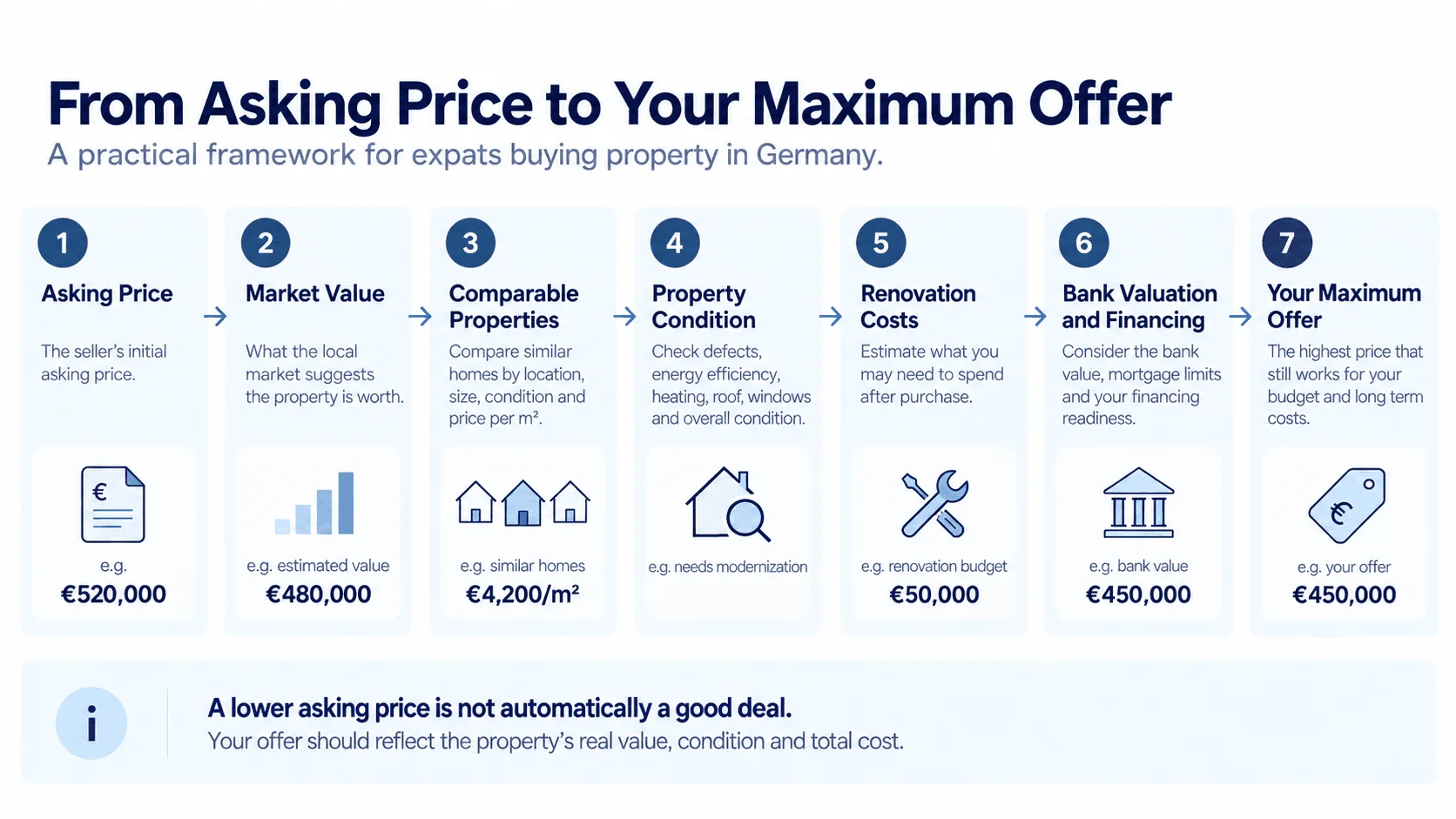
At Finance for Expats, we consider the process for buying a house in Germany in a simple step by step form.
- Understand the local market.
- Estimate the property's realistic value.
- Inspect the condition.
- Calculate renovation costs.
- Clarify your financing.
- Decide your maximum purchase price before you negotiate.
Before making an offer, take a little time to compare similar properties across Germany. This helps you avoid becoming too focused on one listing before you know whether the asking price is realistic.
Can You Negotiate Property Prices in Germany?
Yes, prices can be negotiated. However, the universal discount of 10 percent below the listing price does not exist. The scope of negotiation depends on several factors.
Depending on various points, the room for negotiation can vary greatly:
- Local demand and the number of competing buyers
- The condition of the property
- How long it has been on the market
- Whether the price has already been reduced
- How motivated the seller is
- How realistic the "Angebotspreis" was in the first place
A price for a very coveted home would leave little to no room for negotiation. An overpriced home with a large renovation backlog that has been on the market for months will have a lot more room for negotiation.
How to Know Whether the Asking Price Is Too High
A correct assessment of a price first requires clarity regarding four terms which are often used wrongly in conversations with banks and brokers:
- "Angebotspreis": the asking price, or what the seller wants.
- "Marktwert": the market value, or what comparable properties and current conditions actually support.
- "Verkehrswert": the formal value as determined by an expert in a formal report, or "Gutachten".
- "Kaufpreis": the final purchase price which the buyer and seller finally agree on.
The bank, however, will have its own valuation of the property for the purposes of lending. The differences between the various valuations for property are where a buyer's greatest negotiating power lies.
Simple pricing logic
Asking price is not market value
The "Angebotspreis" is what the seller wants. The "Marktwert" is what comparable properties and market conditions support. The bank valuation is what your lender accepts for financing. Your job is to make an offer based on evidence, not pressure.
Compare Similar Properties
Start with comparable real estate in the surrounding area. This may include properties of the same type, in the same location or even on the same street, and of similar size. Later on you can then also look at the price per square meter, or "Quadratmeterpreis", of these "Vergleichsobjekte".
Compared listings are of no value on their own. It is only when viewed against a bigger backdrop that you can see if the property of your choice is a good buy or priced too high in comparison. Use the Finance for Expats Real Estate Search Engine to find and compare similar properties in Germany.
When comparing properties, look at:
- Property type
- Living area
- Plot size where relevant
- Year of construction
- Condition
- Floor for apartments
- Energy efficiency
- Modernization history
- Price per square metre
Check the Local Real Estate Market
There is no single German real estate market. The markets in Munich and Leipzig, for example, are totally different, and the prices for similar properties in two houses next to each other can be different too. In negotiations, local conditions are much more important than national percentage figures.
Leverage is greatest when there are many comparable properties on the market, the listing has been online for a long time, the price of the property has already decreased or the demand for houses is low. On the other hand, a newly listed house, a popular location, many serious buyers and homes similar to yours selling fast are all bad news for your negotiating position.
Use Property Condition to Support Your Offer
The strongest points to bring to a negotiation are the obvious and acknowledged ones. As opposed to saying, "I think it is a bit too expensive", you can say: "The heating is from 1994. The roof has not been touched since 1997."
Older systems like the heating and roof will cost real money, as will old windows that need new seals and insulation. Moisture damage, structural damage, outdated electrical systems, old plumbing and "Sanierungsbedarf" all need to be shown as documents. And if there is any doubt, bring a specialist.
Please distinguish between needed repairs and things that you as a buyer would like to have changed. Your dislike for the kitchen is your personal preference and should not be part of the negotiation. The roof, however, needs replacing and therefore has a price tag. It is a defect, or "Mangel", that can be used in the negotiations.
As mentioned above, do not be mistaken that you can simply subtract the required renovations from the asking price. Although you may be right in many cases, the seller will not always agree to this, and it would be unrealistic to expect such a low price without a balanced argument.
Use the Energieausweis as Part of the Assessment
The "Energieausweis", or German energy certificate, is a document that briefly indicates how energy efficient a building is. However, a low energy class does not necessarily mean high running costs. It may indicate that work is currently required, for example to modernize heating systems, or that future work will be needed to increase the energy efficiency of the building, such as additional insulation.
A poor "Energieausweis" can support a negotiation if it points to future running costs, heating modernization, insulation requirements or other energy-related work. It should not be used in isolation, but together with the purchase price, property condition and renovation budget.
To read a full description, see our guide on how to read a German Energieausweis before buying a property.
Set Your Maximum Purchase Price Before Negotiating
This is possibly the most important part of your buying process that the vast majority of homebuyers neglect to outline in sufficient detail. Your maximum purchase price should not be equal to your bank's maximum mortgage approval. It is the amount you would wish to spend at purchase, plus the cost of subsequent repairs, while still being able to service the resulting debt and maintain your new home once completed.
Buyer rule
Your maximum price is not your maximum mortgage
Your maximum purchase price should include purchase costs, renovation costs, monthly mortgage affordability, an emergency buffer and future ownership costs. It should be set before negotiations start, not during an emotional counteroffer.
To get there, put these items on paper:
- Your available own funds
- The mortgage amount you can realistically carry
- Purchase costs, including notary, land registry, transfer tax and, where applicable, commission by the seller's agent
- Renovation costs
- The expected monthly mortgage payment
- An emergency buffer
- Future ownership costs, such as repairs and maintenance, as well as charges levied by the residents' community of an apartment and paid by the individual owner, such as a "Sonderumlage"
It is very important to set the maximum price before you view a property and before you submit an offer. Every time you view a property, you become more attached to it. Viewing house after house can also make you overlook how much more expensive the new property is to you than the last one. Every new property requires an increase in your own funds or an upper limit on the mortgage that you can get.
Set a walk away price. That is the amount above which you will not go, even for a wonderful kitchen. Write the amount down. Discuss it with your partner or your financial adviser. Treat it as if it were a contract condition. Do not be tempted to vary it.
The Total Cost of Ownership Calculator can help you estimate the wider cost picture before you decide your maximum purchase price.
Understand the Bank Valuation Before Overbidding
The seller's price for a property does not determine how a bank later assesses it in connection with a mortgage application. Every bank assesses a property differently.
Your agreed offer price, or "Kaufpreis", and the bank's valuation will likely differ. Even a difference of several thousand euros can easily become a massive headache for expatriates who have little in the way of reserve equity. Ensure that you fully grasp how properties are valued by a bank early on, in order to alert you to potential problems.
The bank valuation itself may also be of use for negotiations. It is, however, not proof of value which has to be accepted by the seller. It is simply further evidence of the value of a property.
Our article on property valuation in Germany explains how German banks value a property and why bank value can differ from the price agreed with the seller.
How to Make a Strong Property Offer in Germany
People looking for a property are often expected to make an offer within a short space of time. In addition to the purchase price, sellers are also often interested to learn whether the buyer is reliable and can be expected to complete the purchase on time.
To this end, potential buyers should present their financing, proof of their solvency and themselves in the best possible light. This can include a "Finanzierungsbestätigung" where required, a prompt response to any queries, a clear timeline, few conditions and a neatly drawn-up written offer.
A reliable buyer can sometimes be more attractive than a slightly higher but uncertain offer. Especially when the seller wants a smooth process, financing readiness can strengthen your position.
How to Make a Lower Offer Without Looking Unserious
A lower offer is fine, as long as it is explained convincingly in a few lines and you confirm your interest in buying the property.
- Confirm that you are genuinely interested.
- State your proposed price clearly.
- Give two or three objective reasons.
- Mention the evidence behind them.
- Confirm that your financing is ready.
- Stay polite and brief.
Among others, comparable properties, findings from a valuation report, necessary renovations, technical reports and the energy efficiency of the property make good reasons for your offer price. You do not have to state that the seller's house is bad. You simply explain why your offer price is reasonable.
How Much Below Asking Price Should You Offer?
Many buyers want to know which percentage discount is realistic when negotiating a property price in Germany. But there is no correct price reduction percentage. The only useful reduction is the difference between the asking price and the realistic value you can justify with evidence.
Here is a simple example:
- Asking price: EUR 550,000
- Estimated market value: EUR 515,000
- Near term renovation: around EUR 25,000
- Maximum price your financing supports: EUR 510,000
By laying out these facts, you are not left to make an educated guess. The market value of a property can be EUR 35,000 below its asking price, the sum needed for near term renovation is real, and your eventual financing can then be used to draft an offer of approximately EUR 510,000.
Now compare this with the most commonly used discounting of 10 percent or even 5 percent on already fairly priced properties which are in high demand. On overpriced properties in bad condition and on the lower end of the market, it can be possible to be more critical. In the end, it is the evidence that counts, not the percentage used.
Negotiating Through the Makler
Generally speaking, the "Makler" is the seller's agent. He or she works for the seller. This does not have to mean that the "Makler" is your enemy. You can still use the communication process to gather useful information.
Use the following questions to gather information for negotiating the purchase price of a property through the "Makler":
- How long has the property been listed?
- Has the asking price changed?
- Have concrete offers been made?
- What timeline does the seller prefer?
- Why is the property being sold?
- Are there any known renovation plans?
Do not reveal your maximum purchase price too early during the negotiation. The comment "many interested buyers" does not necessarily mean there are several offers on the property. Ask calmly and separately what that would actually look like.
Special Case: Negotiating an Investment Property
When buying to rent out, your maximum price for buying the flat is determined by your investment case. That means expected rent, returns, financing costs, maintenance, non recoverable costs, vacancy risk and any needed renovation.
It does not have to be pretty. It just has to be worthwhile. Run the numbers first and calculate whether the property still works as an investment at the offered price.
This is the right place to use the Property Investment Calculator. It can help you calculate whether the property still works as an investment after financing, renovation and running costs.
Common Property Negotiation Mistakes Expats Should Avoid
- Negotiating without knowing the market value
- Using an arbitrary discount percentage
- Becoming emotionally attached too early
- Ignoring renovation costs
- Revealing your maximum budget immediately
- Making an extremely low offer without evidence
- Assuming the "Angebotspreis" equals the "Marktwert"
- Looking only at the purchase price of a property instead of its total cost
- Negotiating before your financing is reasonably clear
- Automatically raising your offer after a counteroffer
- Continuing simply because time has already been invested in the property
When Should You Walk Away?
You need to be willing to walk away. That does not necessarily mean you have failed. It is simply part of buying property in a disciplined manner.
Consider stopping when:
- The seller's expectations stay above your calculated maximum.
- The asking price is not supported by market evidence.
- Renovation makes the overall project unaffordable.
- The bank valuation creates a financing gap you cannot accept.
- Important documents remain unclear.
- You are raising your offer mainly out of fear of losing the property.
The objective is not to win every property. It is to avoid winning the wrong property at the wrong price. Whether or not a property is the right one for you, Finance for Expats is here to help you in your home hunting. Speak with Finance for Expats before making a binding offer for any particular property.
FAQs About Property Price Negotiation in Germany
Can you negotiate house prices in Germany?
Yes, property prices in Germany can be negotiated. The available room depends on the local market, property condition, demand, seller motivation, time on market and whether the asking price was realistic in the first place. There is no universal discount that applies to every property.
How much can you negotiate on a property in Germany?
This depends greatly on the market, the property in question and the competition from other buyers. It is best to work from the estimated market value of the property and make your offer based on comparable properties, overall condition, local demand and your own financing limit.
How much below the asking price should I offer?
The reduction from the asking price should be reasonable and based on your estimated realistic purchase price, not on a fixed percentage. Start with comparable properties, renovation needs, market value and bank valuation risk. The right number is the one you can support with evidence.
How do I know if a German property is overpriced?
Compare other homes for sale in the same area, check the price per square metre, assess property condition and review the history of the listing, including whether the seller has already reduced the price. A property can also feel overpriced if the bank valuation is likely to be lower than the seller's expectation.
Can renovation costs justify a lower offer?
Yes, necessary renovation work can support a lower offer, especially if it relates to serious defects, outdated heating, roof issues, old windows, moisture, electrical systems or plumbing. However, not every euro spent by the buyer has to be deducted from the purchase price. Personal preferences are weaker arguments than documented defects.
Can a poor Energieausweis help in negotiations?
Yes, a poor "Energieausweis" can help in negotiations if the property needs modernization within the next few years or if low energy efficiency creates additional future costs. It is strongest when used together with contractor estimates, technical findings and realistic renovation planning.
Should I get mortgage approval before negotiating?
Financing readiness improves your credibility as a buyer. However, general affordability and final approval for the specific property are not the same thing. A "Finanzierungsbestätigung" can strengthen your position, but the bank may still review the property and valuation before final approval.
Can a bank valuation help negotiate the purchase price?
A bank valuation is useful information, but the seller is under no obligation to reduce the purchase price according to this report. It can still be part of your evidence, especially if the bank valuation suggests that the asking price is not fully supported by the property as collateral.
Should I negotiate through the Makler?
Usually yes. Follow the communication process established for the property. In many cases, the "Makler" communicates offers between buyer and seller. Remember, however, that the "Makler" usually represents the seller, so you should gather information carefully and not reveal your maximum budget too early.
What happens if the seller rejects my offer?
You can revise your offer, wait or walk away. Do not increase your price automatically. Reassess the market value, renovation costs, financing and your walk away price before making the next move. Sometimes the best negotiation decision is not to continue.
A Good Negotiation Starts With the Right Maximum Price
Paying too much for a house is bad enough. The real danger lies in being unaware of the exact costs involved.
Understand the market value, check similar offers for comparable properties, assess the property in detail, estimate the needed renovation, prepare your financing, define a maximum price and make an offer based on evidence. But be prepared to withdraw from a purchase offer as well.
The goal is not to obtain the biggest discount. The goal is to pay a price that makes sense for the property's value, condition and financing.
Even if the price and the bank valuation look alright, it is still wise to consult Finance for Expats before making a binding offer for a property. If you are unsure whether the asking price, bank valuation and financing still fit together, speak with Finance for Expats before making a binding offer.