

Short answer
A "Grundschuld" is the land charge registered against German real estate as security for a mortgage. It is not the same as the mortgage loan itself. The "Darlehen" is the money you borrow, while the "Grundschuld" is the registered security right the bank can rely on if serious repayment problems occur.
Table of Contents
- What Is a Grundschuld in Germany?
- Why Does Your Bank Register a Grundschuld?
- Grundschuld vs Mortgage vs Hypothek
- How Does the Grundschuldbestellung Work?
- Why Do the Grundschuld Amount and Grundschuldzinsen Look So High?
- What Is the Sicherungsabrede or Zweckerklärung?
- Before You Sign the Grundschuld Documents
- Personal Liability and Immediate Enforcement Explained
- How Much Does a Grundschuld Cost?
- What Happens to the Grundschuld After You Repay the Mortgage?
- Refinancing, Changing Banks and Selling the Property
- FAQs About Grundschuld in Germany
- Understand the Grundschuld Before You Sign
Your mortgage has been approved, and you are relieved. Then the bank or the notary sends a stack of documents full of words like "Grundschuld", "Grundschuldzinsen", "persönliche Haftung" and "Zwangsvollstreckungsunterwerfung". If you are an expat, this is usually the moment the financing starts to feel less like good news and more like a legal maze.
These documents are a completely normal part of property financing in Germany. They are also worth understanding before you sign. Here is the short version:
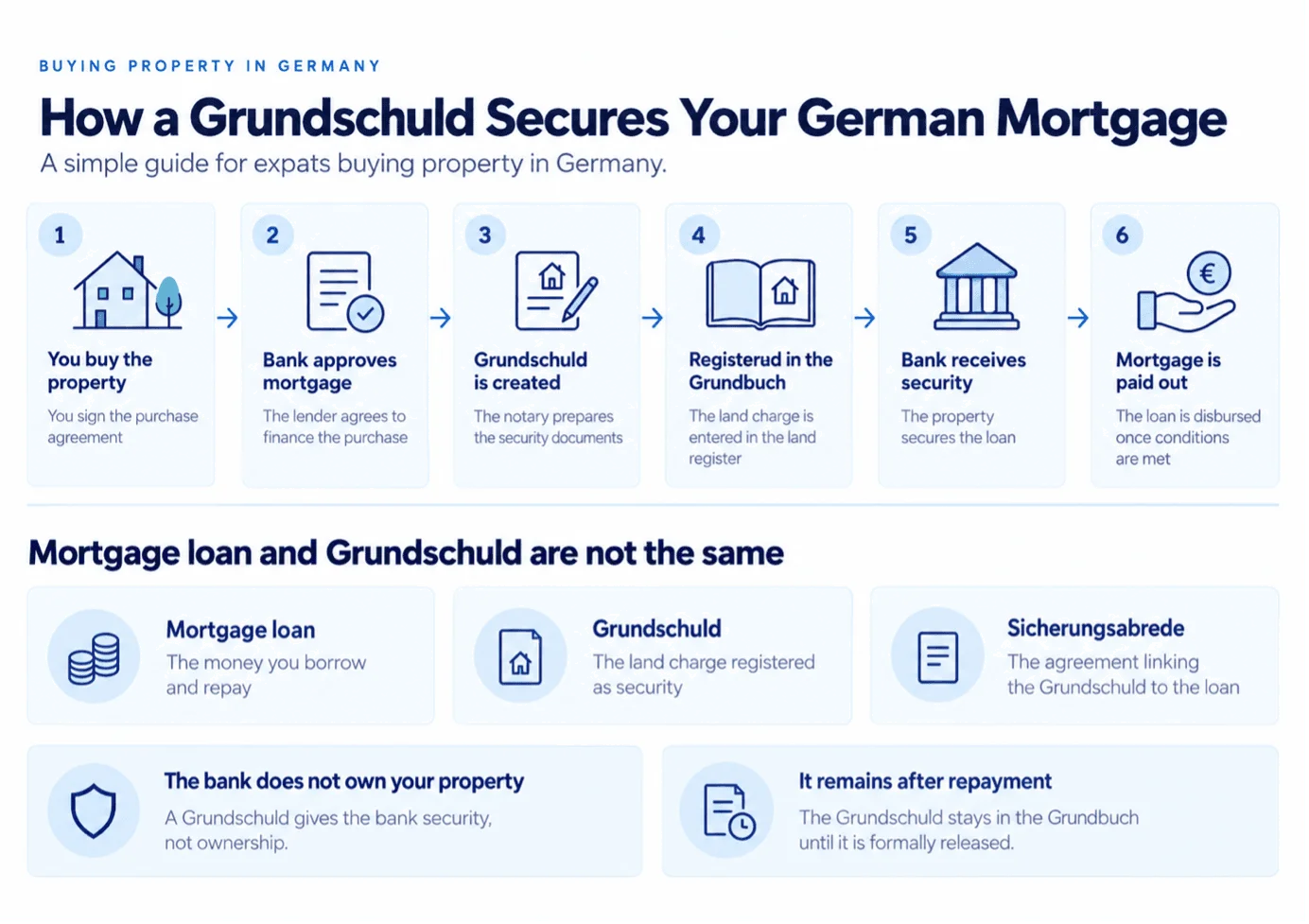
- Mortgage loan, or "Darlehen": the money you borrow and repay.
- "Grundschuld": the land charge registered against the property as security.
- "Sicherungsabrede": the agreement that defines which bank claims the "Grundschuld" secures.
The most important idea in this article is that your mortgage loan and the "Grundschuld" work together, but they are not the same thing. If you want the bigger picture first, our guide on how a mortgage in Germany works covers the basics of applying and borrowing.
What Is a Grundschuld in Germany?
A "Grundschuld" is a land charge registered against German real estate. Banks use it very commonly as security for property financing. When you take out a loan to buy a flat or a house, the bank will almost always ask for a "Grundschuld" on that property.
The English terminology adds to the confusion. English speakers use "mortgage" for the whole arrangement: the loan, the repayments and the security behind it. German law separates these. The "Darlehen" is the debt, and the "Grundschuld" is a separate security right registered against the property.
The "Grundschuld" is also legally independent of the exact outstanding loan balance. It does not automatically shrink as you repay, and it does not care whether your balance is EUR 400,000 or EUR 250,000. That flexibility is one reason it is so widely used. It is also the reason the numbers in your documents can look strange at first.
Why Does Your Bank Register a Grundschuld?
Look at it from the bank's side. A property loan is large and runs for many years, often decades. The bank wants a dependable form of security in case things go wrong. The property you are financing is the obvious candidate, and the "Grundschuld" is how that security becomes official and enforceable.
One misconception is worth clearing up straight away. The bank does not become the owner of your property. You are the owner. The bank holds a security right over it, nothing more.
The value of the property as collateral also shapes how much risk the bank will take on, and so how much it will lend. We explain this in our guide to how German banks assess property collateral. If you want to understand the difference between what you paid and what the bank thinks the property is worth, our article on property valuation in Germany is a useful next read.
Grundschuld vs Mortgage vs Hypothek
This is where most of the terminology trouble starts, so here is how the three terms relate.
Mortgage loan, or "Darlehen". This is the money the bank actually lends you. Interest and repayments follow your loan agreement, and the outstanding balance falls as you pay it back.
"Grundschuld". This is the security registered against the property. It does not automatically decrease with your balance, and it remains legally separate from the loan.
"Hypothek". This is another type of land-based security right, and it is where "Grundschuld vs Hypothek" comes in. A "Hypothek" is legally dependent on the claim it secures. If the debt shrinks or disappears, the "Hypothek" follows. A "Grundschuld" stands on its own.
So why do you hear "mortgage" in English when a "Grundschuld" is what is really being registered? Because English uses one word for what German law splits into two. In practice, German banks overwhelmingly prefer the "Grundschuld" because it is more flexible. When an English-speaking advisor says "mortgage", they usually mean the loan and the "Grundschuld" together.
How Does the Grundschuldbestellung Work?
The "Grundschuldbestellung" is the formal process of creating the "Grundschuld". In practice it runs in a fairly logical order.
The Bank Provides the Grundschuld Documents
The bank decides what security it needs and sends the details to the notary. The documents typically include:
- The creditor, meaning the bank
- The "Grundschuldsumme", meaning the registered amount
- The property details
- The "Grundschuldzinsen"
- The ranking the bank requires
The Notary Prepares the Grundschuldbestellung
The notary handles the documentation and, importantly, is required to explain the legal meaning of the deed to you. Do not treat that as a formality. It is your opportunity to ask what each clause means. The "Grundschuldbestellung" may take place together with the purchase contract signing or shortly afterwards.
How Can You Register a Grundschuld Before You Own the Property?
Expats often find this part contradictory. The bank wants its security in place before it releases the purchase price. But you do not legally own the property yet, because ownership only changes once you are registered in the "Grundbuch". So how can you give the bank security over something that is not yours?
The answer is a "Finanzierungsvollmacht", also called a "Belastungsvollmacht". The purchase contract authorises you, as the buyer, to use the property as collateral before final ownership registration. There are protections for the seller built in. The authorisation is restricted so that the security can only be used for financing the purchase, and the bank's funds are tied to payment of the purchase price. It sounds complicated, but it is a standard and well-tested part of German property purchases.
Registration in Abteilung III of the Grundbuch
Once everything is signed, the "Grundschuld" is entered in "Abteilung III" of the "Grundbuch", the German land register. Alongside it you will see the "Rang", meaning ranking, which determines the priority between registered security rights. If several rights are registered against one property, the ranking decides who is satisfied first. Banks care a lot about getting an acceptable position, usually first.
Why Do the Grundschuld Amount and Grundschuldzinsen Look So High?
This is the moment that most often alarms borrowers. You borrowed EUR 350,000, and the document says EUR 350,000 plus interest of what looks like a very high rate. Before panicking, separate three different numbers:
- The original mortgage loan: what the bank actually lent you.
- The registered "Grundschuldsumme": the amount of the security registered in the "Grundbuch".
- The actual outstanding mortgage balance: what you currently owe.
These are not automatically the same figure. The "Grundschuldsumme" can be higher than the loan, and your balance falls over time while the registered amount stays put.
Grundschuldzinsen Are Not Your Mortgage Interest Rate
Please read this part twice. The interest rate in your loan agreement determines the normal loan interest you pay. "Grundschuldzinsen" are part of the registered security. They give the bank additional cover for claims such as default interest and enforcement costs. You do not simply pay the stated "Grundschuldzinssatz" on top of your mortgage rate.
Mortgage interest vs Grundschuldzinsen
Mortgage interest: what you pay under the "Darlehensvertrag".
"Grundschuldzinsen": part of the registered security, not an extra monthly mortgage interest rate.
What Is the Sicherungsabrede or Zweckerklärung?
Many people skip over this document. It is one of the most important ones to understand.
The "Grundschuld" itself exists independently of your mortgage debt. Something has to connect the two, and that is the "Sicherungsabrede", the security agreement. You will often see it under another name too: the "Zweckerklärung", the declaration of purpose. In everyday use the terms overlap and often refer to the same thing.
The practical question for you as a borrower is simple: which debts and claims is my property actually securing? The wording can be narrower, covering just your mortgage, or broader, covering other claims the bank may have against you. We cannot interpret an individual document for you here, but if a provision is unclear, have it explained before you sign.
Before You Sign the Grundschuld Documents
Signing checklist
Questions to clarify before signing
Is the registered "Grundschuldsumme" clear?
Do you understand the difference between mortgage interest and "Grundschuldzinsen"?
Do you know which claims the "Sicherungsabrede" covers?
Is the bank's "Rangstelle" clear?
Have the "persönliche Haftung" clauses been explained?
Do you understand the "Zwangsvollstreckungsunterwerfung"?
Do you know what happens when the mortgage is repaid?
Have you asked about every clause you do not understand?
Personal Liability and Immediate Enforcement Explained
"Grundschuld" deeds commonly contain a few clauses that sound harsh at first reading. They are standard, so let us take them calmly.
- "Persönliche Haftung": your personal liability for the debt.
- "Persönliches Schuldanerkenntnis": a personal acknowledgment of the debt.
- "Zwangsvollstreckungsunterwerfung": submission to immediate enforcement.
The key is to distinguish the property security from any personal security. The "Grundschuld" secures the bank against the property. A personal liability clause goes further. Within the legal framework, it can allow enforcement against your other assets as well, not just the property.
The "Zwangsvollstreckungsunterwerfung" means the notarial deed itself can serve as an enforceable title. The bank would not need to obtain a separate court judgment first. That is a real legal consequence and the reason the notary has to explain it to you.
None of this means the bank can simply take your home. Enforcement only becomes relevant when secured obligations are seriously not fulfilled. For a borrower who keeps up with repayments, these clauses sit quietly in the background. You should still know they are there.
How Much Does a Grundschuld Cost?
People searching for "Grundschuld Kosten" or "Grundschuldbestellung Kosten" usually want one number. Unfortunately there is not one that fits every case. Costs arise in two places:
- Notarial work: drafting and certifying the "Grundschuld" deed.
- "Grundbuch" registration: the fees for entering the "Grundschuld" in the land register.
Both are set by statutory fee rules and depend on the relevant transaction value, in this case the registered "Grundschuld" amount. A higher "Grundschuldsumme" generally means higher costs, but I would avoid quoting a flat percentage because the schedule is not that simple.
These fees belong in your financing and acquisition planning. They are not interest, and they do not reduce your loan. To put them in context, read how to understand the full cost of buying property in Germany. If you would like to estimate everything together, you can calculate purchase costs alongside your financing with our Total Cost of Ownership Calculator.
What Happens to the Grundschuld After You Repay the Mortgage?
This is one of the most useful questions in the whole topic, and the answer surprises many people. When the last instalment is paid, the mortgage balance can reach zero, but the "Grundschuld" does not automatically disappear from the "Grundbuch". It stays registered until someone does something about it.
Deletion usually requires a "Löschungsbewilligung", a deletion consent issued by the bank, and then the actual deletion in the "Grundbuch". As the owner, you can consider how to handle the existing security. Typical outcomes include:
- Deletion: the "Grundschuld" is removed from the register.
- Leaving it registered for the time being: it stays in place without any debt behind it.
- Reuse or assignment: it is used again in a future financing structure.
There is no universal rule about which is best. If you expect to borrow again soon, for a renovation or a purchase, keeping it can make sense. If you plan to sell soon, deleting may be simpler. Remember that an old registered "Grundschuld" can complicate a later sale if the required deletion documents have not been arranged.
And one more point of confusion worth clearing up: the "Grundschuld" is not your remaining debt. To see how the real debt develops, look at how your remaining mortgage balance develops. That is your "Restschuld", and it is a different thing.
Refinancing, Changing Banks and Selling the Property
Refinancing or Changing Banks
When your fixed rate ends, you face an "Anschlussfinanzierung". If you move to a different lender, it is called an "Umschuldung". Many people assume the old "Grundschuld" must be deleted and a new one registered from scratch.
Not necessarily. Depending on the structure, the existing security can be assigned to the new lender through a "Grundschuldabtretung". That can save time and costs, though whether it works depends on the banks involved and how the original documents were drafted. To learn more about planning ahead, see how to understand your Anschlussfinanzierung options.
Selling the Property
If you sell, existing "Grundschulden" have to be dealt with as part of the transaction. The notary coordinates which security rights need to be removed and which are otherwise addressed. If you are the buyer, make sure you understand which entries will remain in the register after the purchase. We will not go into the detailed mechanics of clearing encumbrances here, as that deserves its own article.
FAQs About Grundschuld in Germany
What is a Grundschuld in Germany?
A "Grundschuld" is a land charge registered against German real estate. It is commonly used as security for German property financing. When a bank finances a property purchase, it usually wants this registered security right so that the property can serve as collateral if serious repayment problems occur.
What does Grundschuld mean in English?
"Grundschuld" is usually translated as land charge. It does not correspond perfectly to the everyday English use of "mortgage", because English often uses one word for the whole financing arrangement. In Germany, the loan and the registered security are separate concepts.
Is a Grundschuld the same as a mortgage?
No. In everyday English, "mortgage" often describes the whole financing arrangement. In Germany, the "Darlehen" is the loan you repay, while the "Grundschuld" is the registered security right over the property. They work together, but they are not the same legal thing.
What is the difference between Grundschuld and Hypothek?
A "Hypothek" is legally tied to the claim it secures. If the secured debt shrinks or disappears, the "Hypothek" follows. A "Grundschuld" exists independently from the exact loan balance, which makes it more flexible and is one reason banks commonly use it for German property financing.
Why does my bank need a Grundschuld?
The bank needs a "Grundschuld" to secure the mortgage against the financed property. A German property loan is usually large and runs for many years, so the lender wants a registered security right it can rely on if the borrower seriously fails to meet the secured obligations.
Where is a Grundschuld registered?
A "Grundschuld" is registered in "Abteilung III" of the "Grundbuch", the German land register. This section records land charges and other security rights. The ranking, or "Rang", is important because it determines priority if several rights are registered against the same property.
Why is the Grundschuld registered before I own the property?
This can happen because the purchase contract may contain a "Finanzierungsvollmacht" or "Belastungsvollmacht". This authorises the buyer to use the property as collateral before final ownership registration, within strict limits. It is a standard part of many financed property purchases in Germany.
Does the bank own my property?
No. The bank does not become the owner of your property. You own the property, while the bank holds a registered security right over it. This distinction matters because the "Grundschuld" gives the bank security, but it does not transfer ownership to the lender.
Why are Grundschuldzinsen so high?
"Grundschuldzinsen" often look high because they are part of the registered security, not your normal monthly mortgage interest rate. They provide additional security for claims such as default interest and enforcement costs. You do not simply pay the registered "Grundschuldzinsen" on top of your agreed loan interest.
What is a Zweckerklärung?
A "Zweckerklärung", often connected with the "Sicherungsabrede", defines which claims the "Grundschuld" is intended to secure. This document matters because the "Grundschuld" exists independently from the loan, so the security agreement explains which bank claims are actually connected to it.
What does Zwangsvollstreckungsunterwerfung mean?
"Zwangsvollstreckungsunterwerfung" means submission to immediate enforcement. In practical terms, the notarial deed can serve as an enforceable title, so the bank would not necessarily need a separate court judgment first. It is a serious clause and should be explained before signing.
Does the Grundschuld disappear when I repay the mortgage?
No. The mortgage balance can fall to zero, but the "Grundschuld" remains registered in the "Grundbuch" until it is formally deleted or otherwise dealt with. Deletion usually requires a "Löschungsbewilligung" from the bank and a further registration step.
Should I delete the Grundschuld after repayment?
There is no universal answer. If you might borrow again soon, keeping the registered "Grundschuld" can sometimes be practical. If you plan to sell, deletion may make the transaction simpler. Your future financing and sale plans should guide the decision.
Can I transfer a Grundschuld to another bank?
Depending on the refinancing structure, an assignment may be possible. This is often called a "Grundschuldabtretung". It can save time and costs compared with deleting the old security and registering a new one, but whether it works depends on the banks and documents involved.
Understand the Grundschuld Before You Sign
"Grundschuld" terminology is unfamiliar to most international buyers, and that is completely understandable. These are four concepts to take with you:
- "Darlehen": the money you borrow.
- "Grundschuld": the security registered over the property.
- "Sicherungsabrede": the agreement linking the security to the bank's claims.
- "Grundbuch": where the "Grundschuld" and its ranking are recorded.
Once you know how these fit together, the financing process becomes much less intimidating. And if any wording still feels unclear, ask for an explanation before you sign. A good notary and a good advisor will welcome the question.
If you are arranging a mortgage in Germany and want to understand how the loan, bank valuation and "Grundschuld" fit together, speak with Finance for Expats before completing your financing.