
Buying a Rented Apartment in Germany: Existing Tenants, Eigenbedarf & Resale Risks
You’re looking to buy an apartment in Germany. You’ve found a great property in a good location. It seems to cost less than other apartments of similar size on the same street. But when you read the small print in the property advert, it says "vermietet" (the property is rented to a tenant). You may wonder what this means for you as a future owner of the apartment.
When looking for an apartment to buy as a foreign buyer, terminology in property listings can also be confusing. Many Realtors advertise apartments that are currently rented out to tenants by using the term "vermietet". For expat buyers, the implications of this can be easy to underestimate, especially when viewed from an investor’s perspective.
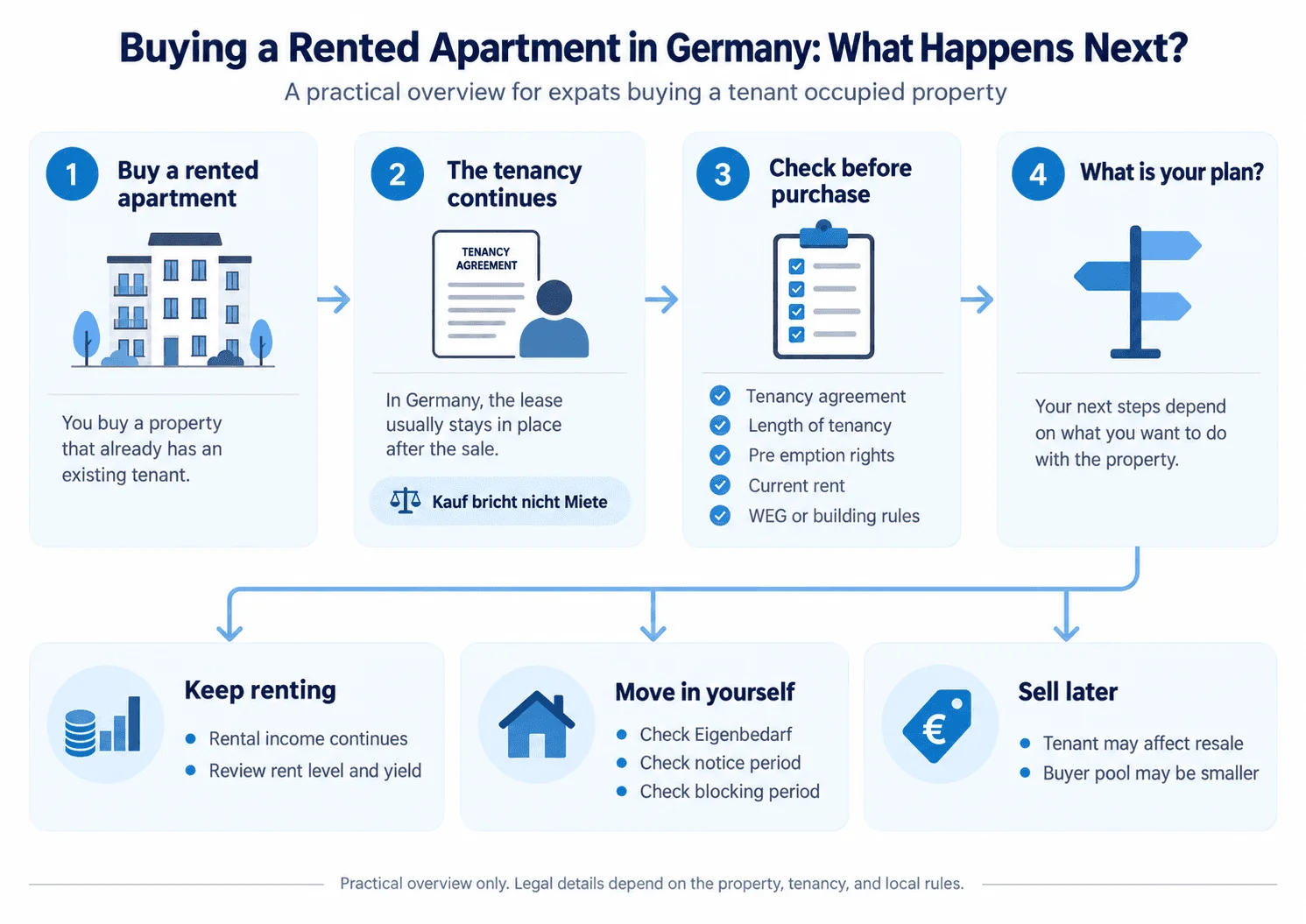
In order to be well-informed when you are purchasing a property that is currently rented by a tenant, you have to check whether or not there are any restrictions for your future plans. The sale of a property does not necessarily end a tenancy, since German law adheres to the principle of "Kauf bricht nicht Miete" (sale does not terminate the lease). Buying a rented apartment ("vermietete Wohnung kaufen") can make for a great investment, but it can also pose many restrictions on its future use.
In case you are new here, you might want to start with our two beginner’s guides. First, expats can find all the required information in Buying Property in Germany . Secondly, Property Investment in Germany explains why you would buy a property in the first place to earn rental income.
Short Answer
Buying a rented apartment in Germany does not end the existing tenancy. Under "Kauf bricht nicht Miete", the buyer generally takes over the landlord position once ownership transfers. Whether you can move in later depends on valid "Eigenbedarf", the statutory "Kündigungsfrist", possible "Sperrfrist" rules and tenant hardship rights. Investors should also check the rent, "Kaution", "WEG" costs, yield and resale implications before buying.
What Happens to the Tenant When You Buy a Rented Apartment?
When buying a rented apartment, the purchase of the property does not terminate the tenancy agreement. § 566 BGB states that the buyer becomes a party to the existing lease with all the rights and obligations of the landlord once ownership has transferred.
The "Mietvertrag" (residential lease agreement) is not broken by the purchase of the property by the new owner. Instead, it continues to exist with the new owner as landlord.
Thus, the buyer acquires two items: the property and the interests of the landlord under the tenancy agreement. A "Mietvertrag bei Eigentümerwechsel" continues on the basis of the same terms and conditions, with the new landlord.
Which Tenant Obligations Do You Take Over?
- the agreed rent and operating costs
- the "Kaution" (deposit)
- agreed rights of use, such as a cellar, parking space or garden
- special contractual clauses
- existing disputes or side agreements
For more information about renting as a tenant or landlord in Germany, read our article on German tenant and landlord rules .
Before we can speak of "Eigenbedarf" or possible returns on investment, the basic decisions for buying a rented apartment in Germany have to be laid out. Most importantly: what are you going to do with this property after purchase?
What Should You Check Before Buying a Rented Apartment?
The real information regarding rental income is hidden in the listing. Ask for the contract documents as early as possible.
Review the Existing "Mietvertrag"
Read the complete, signed contract and look at:
- the start date of the tenancy
- the current "Nettokaltmiete"
- how operating costs ("Nebenkosten") are agreed
- any "Indexmiete" or "Staffelmiete"
- special agreements on renovation or maintenance
- parking, cellar or garden rights
- subletting arrangements, where relevant
Important: the advertised rent and rental income is not the full scope of the situation.
Check How Long the Tenant Has Lived There
The length of time the sitting tenant has been in the property is far more important than people realize. It influences the length of the ordinary notice period for the new owner, and it is an important factor in deciding whether or not to purchase the property to occupy it yourself.
Under the ordinary statutory notice period, this can mean roughly three, six or nine months depending on the duration of the tenancy. Additional restrictions such as a "Sperrfrist" or a hardship objection can make the actual timeline considerably longer.
Check the Rent and Rental History
Consider the rent at the time of purchase as well as the rental increases in the years before. Are further increases legally possible and commercially realistic? Are there any restrictions on rent in your local area?
The article Mietpreisbremse in Germany: What Buyers Need to Know in 2026 looks at how rent controls can impact future rents for buyers.
Check the "Kaution"
You should also clarify the security deposit ("Kaution") that the buyer takes over from the seller.
Under § 566a BGB, the purchaser enters into the rights and obligations connected with the tenant’s security deposit. You should therefore verify the deposit amount, how it is held, the available documentation and how the handover is dealt with as part of the sale.
Check for Existing Disputes
You must also establish whether there are any existing disputes with the tenant(s), for example rent arrears and late payments, complaints regarding the apartment or the building, ongoing legal proceedings, rent reductions, claims in respect of defects, and disputes over additional costs such as "Nebenkosten".
Our guide Due Diligence in Germany: What Expats Must Check Before Buying Property outlines the required checks in full detail, including "WEG" documentation, "Hausgeld" and reserves.
Can You Buy a Rented Apartment and Move In Yourself?
Yes, you can buy a rental property to occupy it yourself, but note that buying a property does not automatically grant you the right to remove the tenant. The main legal route to end a tenancy for personal reasons is "Eigenbedarf" (owner occupation) under § 573 BGB.
This does not mean that "Eigenbedarf" can automatically be claimed by the new owner of a rented apartment. A legitimate personal need and the legal requirements for termination still have to be met.
However, it is certainly a possibility that has to be considered before buying a rented apartment with "Eigenbedarf" ("vermietete Wohnung kaufen Eigenbedarf") in mind.
When Can a New Owner Claim "Eigenbedarf"?
The mere purchase of a property does not by itself give the new owner the right to terminate the tenancy. The owner must also have a genuine need to occupy the apartment, and this must be stated in the formal notice of termination ("Eigenbedarf Kündigung").
Also remember that signing the purchase contract and legally becoming the owner are not the same moment. The ownership transfer is an important part of the legal timing.
Every case is different, therefore no one can guarantee a date for the termination of a tenancy.
Who Can "Eigenbedarf" Be Claimed For?
The need can be claimed by the owner of the flat, by certain family members and by certain members of their household. However, there are restrictions on this list, and it is wise to have a lawyer check this for you.
What Is the "Eigenbedarf Kündigungsfrist"?
The ordinary notice period starts at roughly three months (§ 573c BGB). It is then extended by a further three months after five years of tenancy, and by another three months after eight years.
Under the ordinary statutory rule, this means the landlord’s notice period can reach up to nine months.
By checking the start date of the tenancy before your purchase, you can establish how long the tenant has been living there. This gives you an indication of the potential time before you can take possession of the property as you intend.
Do not assume: “I buy in January and move in three months later.” Additional issues such as a "Sperrfrist" or a tenant hardship objection can make the actual timeline longer.
What Is the "Eigenbedarf Sperrfrist"?
The "Kündigungsfrist" tells you how long it takes for a valid notice of termination to become effective.
The "Sperrfrist" (blocking period) is something different: for a certain time the owner may be blocked from terminating the tenancy for personal use at all, for example under § 577a BGB.
When Can § 577a BGB Apply?
The classic situation looks like this:
- A tenant moves into a rented apartment.
- Later, the building is converted into condominium ownership.
- Then the apartment is sold.
In such a scenario, § 577a BGB can prevent the new owner, for a period of at least three years and potentially up to ten years under applicable state rules, from terminating the tenancy on the grounds of "Eigenbedarf" and certain other grounds.
Does Every Rented Apartment Have a Three-Year "Sperrfrist"?
The answer is a definite no. It depends heavily on the conversion history of the property and on the date of the tenant’s move-in compared with the date of the condominium conversion.
In the classic condominium-conversion case, a "Kündigungssperrfrist" can apply where the tenant was already living in the apartment before conversion and the apartment was sold afterwards. § 577a also contains additional rules for certain ownership structures.
So check the conversion history before buying if you may want to move in yourself.
Can the Tenant Object to an "Eigenbedarf" Termination?
Under § 574 BGB, the tenant can object to a notice of termination for "Eigenbedarf" on grounds of hardship ("Härtefall") and request that the tenancy continues.
Examples can include serious health or personal circumstances or situations where suitable replacement housing cannot reasonably be found.
The time frames described above are therefore legal scenarios, not a promise that you can move in by a certain date.
Does the Tenant Have a "Vorkaufsrecht"?
The tenant’s "Vorkaufsrecht" (right of first refusal) does not exist automatically whenever a landlord sells a rented apartment.
When Does the Tenant’s "Vorkaufsrecht" Apply?
§ 577 BGB grants a statutory "Vorkaufsrecht" in certain cases where residential property was converted into condominium ownership after the tenancy began, or is due to be converted, and is then sold to a third party.
Certain sales, for example to family or household members, are an exception.
If the statutory right applies and the tenant exercises it, the tenant can generally step into the agreed purchase on the relevant terms.
Why Buyers Should Check This Before Signing
Check with the seller and your notary whether a statutory tenant "Vorkaufsrecht" applies. It might influence the timing and certainty of your transaction. This is a question for the notary, so please don’t draft it yourself.
Is a Rented Apartment a Good Investment?
An existing tenant is not only a negative factor, but also a positive one. Renting out apartments with existing tenants can be a good investment, since there is no initial vacancy and the tenant already provides a known payment profile.
What May Work in Your Favour
- rental income starts from day one
- no initial vacancy
- a payment history may be available
- less effort to find a tenant
What May Work Against You
- rent may sit below market level
- limited room to change tenancy terms
- tenant and legal risk
- constrained future rent growth
- a different pool of buyers when you resell
Read our Property Investment in Germany guide to learn more about yields, financing, tax and locations of interest to property investors.
Check the Real Yield, Not Just the Rent
Start with the gross annual rent. Subtract the non-recoverable elements of the "Hausgeld", and also allow for ongoing maintenance, reserves, vacant periods and other risks unique to the property. Financing costs should also be included.
Our Property Investment Calculator provides a simple way to build up a gross and net return for the property in question.
"Hausgeld" and "WEG" Still Matter
Just because you have a tenant in your apartment, as an owner in the "WEG" ("Wohnungseigentümergemeinschaft") you still have obligations which need to be checked:
- the "Hausgeld"
- the "Instandhaltungsrücklage"
- planned renovations and any "Sonderumlagen"
- meeting minutes
- heating, façade or roof projects
- the "Teilungserklärung" (declaration of division)
Further reading: Hausgeld in Germany , Due Diligence in Germany and Apartment Renovation in Germany .
Can You Increase the Rent After Buying?
Not simply because ownership changed. As the owner of a rented apartment, you are bound by the same terms and conditions as your predecessor and by German rent law.
For possible restrictions, see Mietpreisbremse in Germany: What Buyers Need to Know in 2026 and our article on rental law in Germany .
Is a Rented Apartment Worth Less Than a Vacant Apartment?
This depends very much on the buyer:
- An investor may pay more for a reliable tenant and an attractive rent.
- An owner occupier sees reduced usability.
- The wider market may shrink because restrictions reduce the number of potential buyers.
Important factors for the price are the current rent, how long the tenant has been renting, your interest in the property as "Eigenbedarf", any "Sperrfrist", the condition and location of the property, the yield, and the situation within the "WEG".
A lower purchase price is not automatically a bargain if the tenancy prevents you from using or repositioning the property as planned.
See our Property Valuation tool and Property Price Negotiation in Germany for more.
What Happens if You Want to Sell the Apartment Later?
This even applies to selling a rented apartment ("vermietete Wohnung verkaufen"): the tenancy generally continues through another sale under the same principle.
Selling With the Tenant in Place
For investors buying in order to earn an immediate return in the form of rent, this might be a positive factor.
For owner occupiers, on the other hand, restrictions on use might be negative. Potential buyers may also price in legal and time restrictions, and a rent that is below market level.
Vacant vs Rented Resale
A lower purchase price is not automatically a bargain. Depending on your plans, an existing tenancy can limit your ability to use the apartment and may also reduce your options for selling it in the future.
If you buy because the apartment is discounted today, will the same tenancy also reduce your exit options later?
Keep Renting, Move In or Sell Later?
| Your plan | Main opportunity | Main risk | What to check first |
|---|---|---|---|
| Keep renting | Immediate rental income | Low rent, tenant restrictions | "Mietvertrag", yield, "Mietpreisbremse" |
| Move in | Potential owner occupation | "Eigenbedarf", notice period, "Sperrfrist" | Tenancy history, § 577a, legal advice |
| Sell later | Possible capital appreciation | Smaller buyer pool | Tenant status, rent, exit strategy |
Before You Buy: Rented Apartment Checklist for Expats
- Is there a complete, signed "Mietvertrag"?
- When did the tenancy begin?
- What is the current "Nettokaltmiete" and has the rent been increased lately?
- Is there an "Indexmiete" or "Staffelmiete"?
- Does the tenant pay on time? Any arrears or disputes?
- What "Kaution" is held?
- Could a "Vorkaufsrecht" apply?
- Was the property converted into "Wohnungseigentum" after the tenant moved in?
- Could § 577a create an "Eigenbedarf Sperrfrist"?
- What landlord "Kündigungsfrist" applies today?
- Could the tenant raise a hardship objection?
- What is the "Hausgeld", how large is the "Instandhaltungsrücklage" and are there any "Sonderumlagen" planned?
- Does the purchase still work financially if the tenant stays longer than expected?
- Would you still buy this flat if you could not move in on the date you had planned?
Common Mistakes When Buying a Rented Apartment
Assuming the Tenant Must Leave After the Sale
A sale does not break the lease of the tenant. "Kauf bricht nicht Miete".
Assuming "Eigenbedarf" Means Immediate Move-In
Your grounds must meet the required criteria and be notified at the right time, and a notice period and possible restrictions still apply.
Confusing "Kündigungsfrist" With "Sperrfrist"
The "Kündigungsfrist" (notice period) and the "Sperrfrist" (blocking period) are two different things.
Ignoring the Conversion History
The conversion history to apartment ownership is crucial for several reasons, in particular with regard to § 577a and § 577.
Looking Only at the Purchase Price
Do not only compare the purchase price of apartments for sale, but also the possible restrictions on the use of a rented apartment.
Assuming the Current Rent Can Immediately Be Increased
The currently valid tenancy agreement remains in full force after the purchase.
Ignoring the Exit
Think about resale as early as possible, not only when you are selling.
FAQs About Buying a Rented Apartment in Germany
What Does "Kauf bricht nicht Miete" Mean?
Section 566 BGB: "Kauf bricht nicht Miete". The purchase does not bring an end to the tenancy agreement of the existing tenant. The tenant remains a tenant under the same terms and with the same rights as before, only with the buyer as the new landlord once ownership transfers.
Can I Buy a Rented Apartment and Move In Myself?
You can purchase a rented apartment, but immediate move-in is not automatically granted. First, valid "Eigenbedarf" has to exist and the tenancy has to be terminated correctly. Then the applicable notice period has to run, and any applicable "Sperrfrist" or other restrictions also have to be considered.
Can a New Owner Terminate a Tenant for "Eigenbedarf"?
Potentially yes, if there is a genuine need to use the rented apartment for qualifying personal purposes and the reasons are formally specified in the notice. The regular notice period has to be observed, and any applicable "Sperrfrist" also matters.
How Long Is the "Eigenbedarf Kündigungsfrist"?
The ordinary landlord notice period is roughly three months. It is extended by three months after more than five years of tenancy and by a further three months after more than eight years.
Under the ordinary statutory rule, it can therefore reach up to nine months. Other legal issues can make the actual timeline longer.
Is There Always a Three-Year "Eigenbedarf Sperrfrist"?
No. It applies mainly in particular condominium-conversion situations and depends on the timing of the tenancy, conversion and sale. It should not be assumed from the fact that the apartment is rented alone.
Can the "Eigenbedarf Sperrfrist" Be Ten Years?
Yes, this is possible in certain areas where applicable state rules extend the period. It is not a nationwide ten-year rule.
Does the Tenant Have a "Vorkaufsrecht"?
Only in special cases, such as certain conversions of rental property into condominium ownership followed by a sale to a third party. Certain sales to family or household members are excluded. It is best to clarify this with the notary in your specific situation.
Is a Rented Apartment Cheaper Than a Vacant One?
Sometimes, but it can also be the same or more expensive. It depends on the rent, the terms of the tenancy, how usable the apartment is, and the potential buyer’s intended use.
Can I Increase the Rent After Buying?
Not simply because you bought the flat. The terms of the existing tenancy agreement, German rent law and local rent regulations still apply.
Can I Sell the Apartment With the Tenant Still Living There?
Yes, in principle. The tenancy agreement generally continues with the subsequent buyer. A sitting tenant can be a disadvantage for an owner-occupier buyer and may influence the resale price or buyer pool.
Final Thoughts: Buy the Tenancy as Carefully as You Buy the Apartment
The main points to take away:
- Buying does not terminate the existing "Mietvertrag".
- "Kauf bricht nicht Miete" is your starting point.
- "Eigenbedarf" is possible, but not necessarily immediately.
- The "Kündigungsfrist" and the "Sperrfrist" are two completely different things and must be checked separately.
- A "Vorkaufsrecht" can matter in particular conversion cases.
- The tenancy affects the investment value and the flexibility when selling the property.
- In addition to property documents, tenant due diligence has to be conducted.
When you buy a rented apartment in Germany, you are not only buying square metres and a share of the building, you are also taking over an existing legal and financial relationship that can shape what you can do with the property for years.
Considering a tenant-occupied property?
Finance for Expats can help you evaluate the property, valuation, financing and purchase process before you commit.