


How the Mietpreisbremse and Housing Policy Affect Expats, Tenants and Buyers
As an expat it can be quite challenging to deal with the German bureaucracy, besides looking for a suitable house or apartment to rent. If you have managed to find a house or apartment and dealt with the lease agreement, you can finally turn your attention to the specifics of your rental property. Here we explain the German rent control system, commonly known as "Mietpreisbremse", how it works, where it applies, what are the exceptions and why it is of importance for anyone interested in the Germany housing market, be it tenants or buyers.
This Guide to Germany's rental law controls is meant for the many new expats who are trying to find a place to rent whilst navigating the many tentacles of bureaucracy that come the way of any new expatriate to Germany. For many, the German rental controls will form part of that sea of red tape to fight against in the search for the perfect house to rent. Many expats consider the German rent controls as a huge barrier to entry for new expats to Germany but we hope to make sense of Germany's rental controls, known as "Mietpreisbremse", and the application of this, as well as where it applies, who it affects and more importantly, the key exceptions to this and how these could apply to you as an expat in Germany, whether you're buying property in Germany or comparing renting vs buying in Germany.
In simple terms, the "Mietpreisbremse" is Germany’s rent control system. It matters not only for tenants, but also for expats, buyers and investors who want to understand the Germany housing market without getting lost in legal jargon.
What Is the "Mietpreisbremse" in Germany
The German law on putting a brake on rent, the "Mietpreisbremse", is a federal law intended to limit rent increases on new leases in tight housing markets. The Federal Government has put this law into effect in order to protect tenants from extreme increases in rent. The main point of the law is to set a rent cap on the starting rent for new leases. The starting rent must not exceed the local reference rent, the "Mietspiegel", by more than 10 percent.
For international readers asking "was ist die Mietpreisbremse", the short answer is simple: it is Germany’s rent control rule for many new rental contracts in selected housing markets.
The main purpose of the "Mietpreisbremse" is to put a break on rent prices in cities that have seen rent prices increase strongly in the past and are now too expensive for most tenants. However, the rules of the "Mietpreisbremse in Deutschland" are not countrywide and thus not uniformly applied. Instead, every federal state decides on its own in which of its municipalities the pressure on the housing market is too high and which rules to apply in which way. For example, rules applied in "Mietpreisbremse Berlin" do not have to be applied in the same way in a small village in "Mietpreisbremse Bayern" or in a town in "Mietpreisbremse Niedersachsen". Therefore, always first check the local tenancy law and rental control laws to see what rules apply in your place of interest.
Rent Control Explained Flowchart: How the "Mietpreisbremse" Works
First a simple flowchart to explain the rules.
This quick overview shows step by step how the "Mietpreisbremse" may apply in practice, from a new rental contract to designated areas, new builds, previous rent levels and the legal rent cap.
- Is there a new rental contract being signed? If no, the Germany rent brake does not apply to this situation.
- Is the property in a designated area? If no, the "Mietpreisbremse" does not apply.
- Is the property a "Mietpreisbremse Neubau", meaning it was completed after 01.10.14? If yes, it may be exempt.
- Is the previous legal rent already above the cap? If yes, it is possible that the landlord can continue to charge the previous higher rent.
Is the local reference rent plus ten percent, the rent cap, still below the asking rent the landlord is asking? If yes, then as a tenant you have grounds to dispute the too high asking rent.
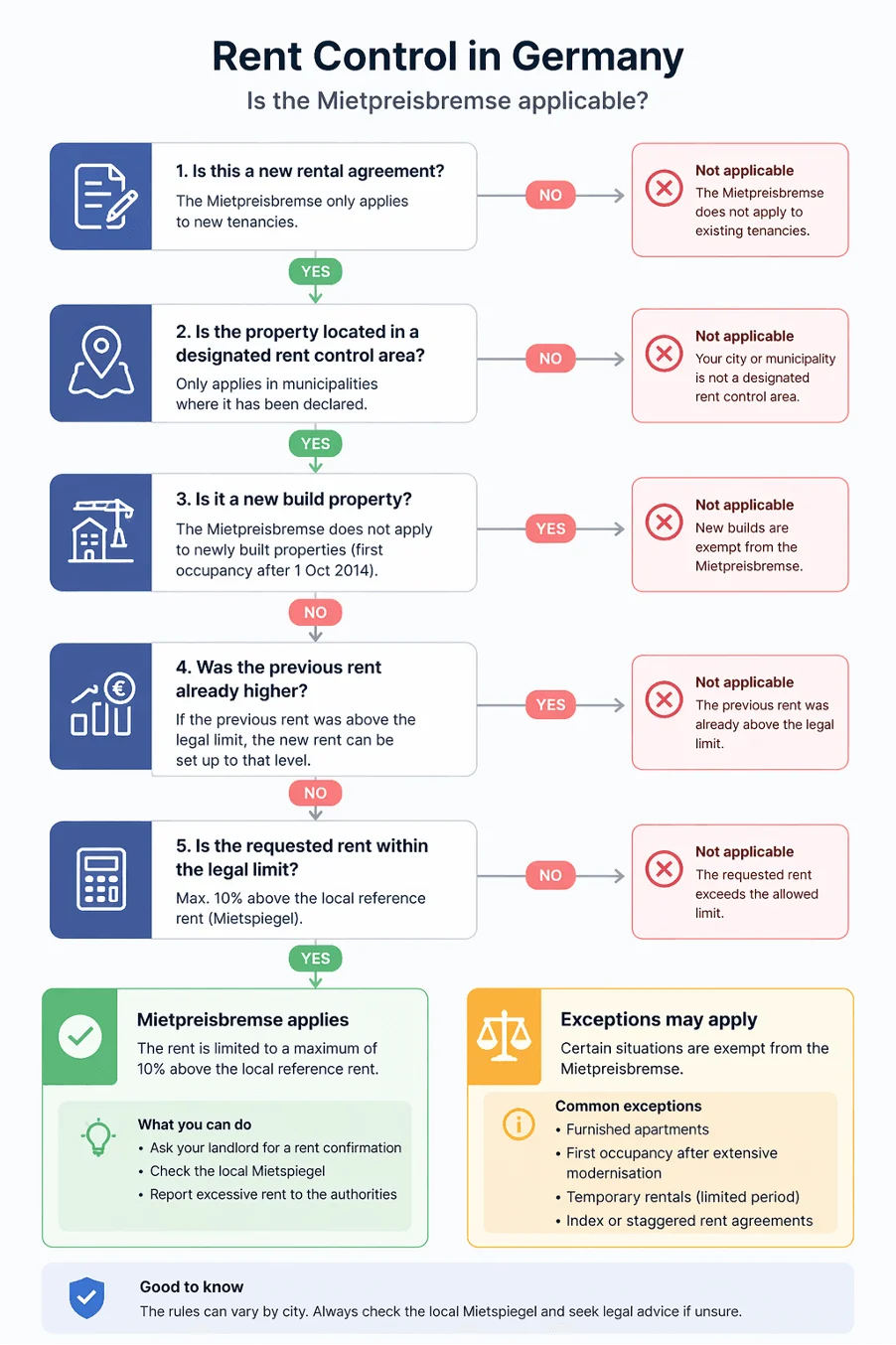
This is a simplified flowchart for "Mietpreisbremse" rules. Simplified flowcharts are useful for getting a rough idea of when a rule might or might not be applied. In order to get a more accurate assessment of the rules that will apply to a specific rental contract, you should first check the local "Mietspiegel" and then consult with the relevant sources.
Why Expats and Buyers Should Care About Rent Controls in Germany
While the rent control system is very interesting for tenants, for expats and property buyers, it is of much greater interest. For the latter, the "Mietpreisbremse" firstly sets a limit on possible rental returns for investors. In addition, rent control influences the composition of demand on the housing market. Last but not least, the rules on rent control also have an influence on the Germany property market for owner occupied housing, especially in price brackets where renters would otherwise buy an apartment in Germany to live in if they could afford it.
However, for a property that was previously rented out at a low rent, the landlord of that tenant will not be able to charge a higher rent when reletting the property. This leads to a significantly lower return on investment for such a property compared to a similar property in an unregulated rental market. In turn, this can have a strong impact on the Germany property market as a whole, as regulated rental properties can have a strong impact on the nature of demand in the market for owner occupied housing.
However, as already indicated above, the restrictions on the rental of controlled properties can have a positive effect on the Germany housing market as a whole. Since the rental of such properties is often affordable for certain households, these very households will prefer to rent instead of buying. This in turn will have a negative effect on the Germany housing market as a whole. In many areas of Germany, there is already less demand for buying a property than there is for renting out. This is especially true for the lower to mid range of the market. As a result, it may be more beneficial in terms of returns on investment to invest in Germany real estate and then rent out a property in a particular area instead of buying and then selling a property in the same area. It is, therefore, important to investigate this issue thoroughly before investing in German property. Running the numbers through a Property Investment Calculator will also help highlight which type of investment may generate the strongest long term return.
Where Does the "Mietpreisbremse" Apply in Germany
However, the "Mietpreisbremse" does not cover the whole of Germany. The laws are established on a state by state basis and within each of these states, there are individual municipalities where the rules of the "Mietpreisbremse in Deutschland" are applicable. This list is constantly updated by the federal states, but at the moment, the majority of the biggest German cities are covered by the rent brakes, for example "Mietpreisbremse Berlin", "Mietpreisbremse München", "Mietpreisbremse Hamburg", "Mietpreisbremse Köln", "Mietpreisbremse Frankfurt", "Mietpreisbremse Düsseldorf" and "Mietpreisbremse Stuttgart". As a rule, the big cities of "Mietpreisbremse NRW" are covered by the laws, as are the vast majority of towns in "Mietpreisbremse Hessen", "Mietpreisbremse Brandenburg", "Mietpreisbremse Niedersachsen" and "Baden-Württemberg". "Mietpreisbremse Bremen" and "Mietpreisbremse Hannover" also fall within the regulated areas.
So when readers ask "wo gilt die Mietpreisbremse", the answer is that it does not apply everywhere in Germany, but only in designated cities and municipalities defined at state level.
The law ("Mietpreisbremse Gesetz") was introduced on federal state level. The individual municipalities within the federal states are then designated by the federal states which are subject to the "Mietpreisbremse". Most of the major cities in Germany, such as "Mietpreisbremse Berlin", "Mietpreisbremse München", "Mietpreisbremse Hamburg", "Mietpreisbremse Köln", "Mietpreisbremse Frankfurt", "Mietpreisbremse Düsseldorf" and "Mietpreisbremse Stuttgart" are covered by the "Mietpreisbremse". In addition to the major cities, large parts of the states of "Mietpreisbremse NRW", "Mietpreisbremse Hessen", "Mietpreisbremse Brandenburg", "Mietpreisbremse Niedersachsen" and "Baden-Württemberg" are covered by the "Mietpreisbremse" in individual towns and cities. In "Mietpreisbremse Bremen" and "Mietpreisbremse Hannover", for example, the "Mietpreisbremse" is in place.
Of course we cannot say it once again: When in doubt please contact a local tenants association or the relevant authorities at the state level. Just because the next town or city is regulated does not automatically mean that your street is too.
Why Location Matters for Buyers
These are the most in demand and thus best performing areas in terms of capital gain in the long term. The rental returns are low in these controlled areas but the property prices in Germany can be very good in the long term. When comparing up and coming non controlled neighborhoods to areas subject to rent control within a region, buyers should not only look at regulation but also at overall demand and local market strength.

In searching online for a property to buy an apartment in Germany it is worth using an online real estate market search portal to filter search results for a city or region as well as by current market conditions. Cities with the strictest Mietpreisbremse like Mietpreisbremse München and Mietpreisbremse Hamburg are also the cities with the strongest Germany housing market. Long term capital gain is also strong in such locations, even when rental income is below that which might be obtained in an uncontrolled housing market.
For buyers comparing regulated and non regulated cities, the Real Estate Search Engine can help you review opportunities by location, pricing and market context more clearly.
"Mietpreisbremse" at New Rental Contracts
These restrictions on rent affect only "Mietpreisbremse bei Neuvermietung" of apartments in a regulated area. This means only when a new tenant enters into a rental contract for an apartment. When the previous tenant has left the apartment, the landlord quotes the previous tenant's legal rent for the new tenant. This legal rent may be compared to the local reference rent for comparable apartments in the same area. The landlord is not permitted to charge new tenants more than 10% above the local Mietspiegel reference rent for similar apartments in the same location. The local "Mietspiegel" reference rent is calculated based on the prices of similar rental apartments in the local area.
For many expats, the "Mietpreisbremse bei Neuvermietung" is especially relevant because it often matters most when signing a new rental contract for a long term apartment.
This previous rent is taken into account when a "Neuvermietung Mietpreisbremse" new tenant moves in. If the previous rent was already above the cap for the landlord or building in question then the new tenant is not entitled to a reduction of the rent to the level of the "Mietspiegel" for comparable new contracts for comparable apartments. He will have to pay the same rent as before.
It is advisable for "Mietpreisbremse Neuvermietung" new tenancies to check the reference rent for similar apartments in the neighborhood before signing a contract.
Important Exceptions to the "Mietpreisbremse"
The exceptions ("Mietpreisbremse Ausnahmen") for new tenancies of apartments in rental controlled areas do not apply to all contracts and properties.
"Mietpreisbremse Neubau" recently constructed homes and apartments are not subject to the rent brake for the very first tenant. This especially applies for contracts concluded as of October 1, 2014. With a capping of the rent from the very start, newly constructed homes and apartments would not be let in the first place because of a reduced income from rent for the landlord. This would not be in the interest of the new construction of residential units.
Another category which is not covered by the "Mietpreisbremse" are "möblierte Wohnung" so called furnished apartments which are handed over to a new tenant. The base rent of such apartments is subject to the same rules as for other apartments, meaning it is capped at 10% above the local "Mietspiegel" for comparable apartments. However, the landlord is allowed to charge a furnishing supplement on top of the capped base rent. However, there is no clear regulation of the furnishing supplement, so that the rules for charging it are unclear.
Other types of leases are not affected by the "Mietpreisbremse". For example contracts with "Indexmiete Mietpreisbremse" or "Mietpreisbremse Staffelmiete" terms. "Indexmiete Mietpreisbremse" rental agreements for example allow for an annual increase in the rent by the consumer price index of private households, whereas the local reference rent "Mietspiegel" just serves as a basis for the market orientated gross rent for comparable new lets on the open market. Other examples of contracts that are not affected are leases with a number of predefined levels of rent over a set period of time and their subsequent increases.
The most important "Mietpreisbremse Ausnahmen" for expats usually involve new builds, furnished apartments, index linked rents and staggered rent agreements.
Why Exceptions Matter for Expats
Many expats first move into a "Mietpreisbremse möblierte Wohnung" furnished apartment. This could be arranged for them by the relocation department of their employer, or they could have found the apartment themselves via short let websites and apps such as those that are used to book temporary housing for business travelers, conferences and events, or for city breaks and holidays in tourist locations. These high priced furnished apartments in city centers can be seen by expats new to Germany as examples of what to expect for future long term rentals on similar apartments that are unfurnished. This is not the case.
This is one reason why Germany rent controls explained for expats often need to focus on furnished apartments first, because many newcomers start in temporary or relocation housing.
"Mietpreisbremse" and Rent Increases for Existing Tenants
In contrast to new tenancies for which the legal rent is to be determined in the first place, for already existing tenancies for which the legal rent has already been determined, the previous legal rent plays a significant role, particularly also with regard to subsequent "Mietpreisbremse Mieterhöhung" rent increases for already existing tenants. The rent increase in Germany for already existing tenants may only be increased by a maximum of 20% within a period of 3 years. The increase must also be justified with the help of the local Mietspiegel for comparable apartments. For very tight rental markets the legal limit for "Mietpreisbremse Mieterhöhung" increases of the rent for already existing tenant rights in Germany currently is 15%.
The situation for lease agreements already in place is somewhat different. Any rent increase in Germany is no longer subject to the rules of the Mietpreisbremse. For example, within three years a Mietpreisbremse Mieterhöhung is only permitted on average of twenty percent in comparison with the local Mietspiegel or, in very expensive rent markets, fifteen percent. In the case of Indexmiete Mietpreisbremse index linked rents any increase in the rent is, in line with the lease agreement, increased by the amount of the current consumer price index. Finally, the major modernisation of a rented apartment with a corresponding increase in the rent is also no longer subject to any restrictions on rent increase in Germany on the basis of the Mietspiegel. The amount of the increased rent is to be calculated on the basis of the increased value of the property.

However, your landlord is not allowed to increase the rent on you as much and as often as he might like. For instance, a "Mietpreisbremse Mieterhöhung" of more than twenty percent within a three year period is not allowed and must be justified by reference to the local "Mietspiegel". However, in strongly rising housing markets, the cap on rent increase in Germany may be reduced from twenty percent to fifteen percent. Exceptions to these rules apply to so called "Indexmiete Mietpreisbremse" index linked rental agreements.
Can the "Mietpreisbremse" Lower Property Prices
Some German tenancy law rules like the "Mietpreisbremse" are discussed a lot. Like for any other topic, only one aspect is discussed and that is the possible effect on property prices in Germany. The "Mietpreisbremse" is just one of the many factors affecting the real estate market in Germany.
Even a capping of rental returns could, in theory, lower the desirability of rental properties for would be buyers and thus even decrease demand and therefore property prices in Germany in the long term. However, even the rent cap on returns in strongly rented cities such as "Mietpreisbremse Berlin" does not prevent long term increases in real estate market Germany prices. A host of other factors can have a much greater impact on German housing market prices in the medium and long term than the Germany rent brake, such as very high demand, a chronic housing crisis in Germany, growing population and current interest rates.
What Buyers Should Watch in 2026
In addition to the "Mietpreisbremse" there are other factors that have a greater impact on the German housing market than rent control laws. Firstly the supply of housing is less than the demand for housing, especially in big cities. For many years now mortgage rates in Germany have fluctuated greatly from the very low levels of the past and currently have a large impact on the German housing market. The demand for housing in cities with high population growth and a lack of developable land is currently driving up property prices in these cities. Finally the amount of new housing being built and the urban development of cities will have a greater impact on prices in the Germany housing market than rent control laws.
Renting vs Buying in Germany Under Rent Controls
The German housing market long term rental market is characterized by low levels of home ownership compared to most other European countries. The reason for this is that long term leases of rental apartments are subject to strong rent control, allowing tenants to benefit from the predictable costs of their long term residence. In many countries, long term rental is considered to be merely a stepping stone to homeownership but in Germany it is a perfectly normal and legitimate long term housing option.
Although in Germany most tenancies are rented instead of being owned, for those who have a long enough time frame ahead of them, buying property in Germany can be a very good investment. For many years the returns on a property can be higher than the returns on renting vs buying in Germany a similar property. This is because instead of paying rent on a property the buyer can build up equity on the property. In addition to this the mortgage interest rate on the mortgage can be fixed for a long time. A further advantage of buying an apartment in Germany is the stability of a long term housing strategy.
Of course it's necessary to work out a fair comparison between renting and buying a house in terms of their investment value, by comparing their costs and returns over several years. To do this with regard to a property currently on the market you can use a property investment calculator. The investment calculator can calculate the costs and returns which a property will realize over a number of years, on the basis of the current market value, terms of mortgage financing and current rent for similar furnished and unfurnished apartments.
To compare renting and buying more realistically across different timelines, you can use the Property Investment Calculator for scenario planning.
Common Mistakes Expats Make With German Rent Rules
Many people assume that all cities in Germany are subject to the same laws, but in reality this is not the case. Germany is a federal state made up of 16 federal states. Each state can pass its own laws and decide on matters of policy at a local level for individual towns and cities. As a result, the laws governing rent control are very different from state to state and even within individual states from town to town. A frequent mistake that many expats make is to agree to a high price for a "Mietpreisbremse möblierte Wohnung" furnished apartment in the first year of tenancy, not realizing that they are paying above market price and that in the regulated market the appropriate market rent would be much lower. This error arises from the so called furnished apartment exception that allows the initial year's rent for new furnished apartments to be higher than the market price in the regulated market.
Not checking the "Mietspiegel" is a grave mistake. The "Mietspiegel" contains the so called reference rent, which is published for most cities online within a few minutes. Many expats pay too much for their furnished apartment in Germany, because they do not compare the rental terms with the "Mietspiegel" in time. They get under pressure by the tight rental market and thus sign a rental agreement within a few hours. Only later do they realize that they are paying too much and that there must be a misunderstanding regarding the rental agreement. Others do not realize that they are paying way above the rent cap. This is because they believe that the rent cap, also known as the "Mietpreisbremse", is a complete ban on rent increases. In reality, it only regulates part of the rent increase process.
When to Seek Personal Advice
German housing policy laws and rent control rules are very detailed and can change over time. These changes can affect federal states and also cities within them. By the time you have read this there could have been changes to the rules in designated areas, new court decisions on how to treat "Mietpreisbremse Ausnahmen" exceptions, and even new laws being proposed and making their way through federal, state and local governments.
As foreign investors, those planning to invest in Germany real estate can greatly benefit from an expert who knows the Germany property market and its laws. Such an expert can check the numbers for a potential buyer of a contract or property and inform that buyer whether it is worth purchasing or renting the property in question. Whether a property is subject to the "Mietpreisbremse BGB" rent brake or not is also something such an expert can help assess.
If you want personal support with your housing or property decision, you can reach out through our contact page.
FAQs About the "Mietpreisbremse"
What is the "Mietpreisbremse"
The "Mietpreisbremse" is Germany’s rent control rule for many new rental contracts in selected housing markets.
Does the "Mietpreisbremse" apply everywhere in Germany
No. It only applies in designated areas defined by each federal state.
Are new builds exempt from the "Mietpreisbremse"
Many newly built properties can be exempt from the "Mietpreisbremse" under the current rules.
Does the "Mietpreisbremse" matter for buyers
Yes. It can affect rental income, local demand and the comparison between buying and renting in the same market.
Can furnished apartments avoid rent controls
Furnished apartments may follow different pricing rules depending on the case, especially where furnishing supplements are charged.
Should expats rent or buy in Germany first
That depends on your timeline, finances and the city you choose. Short stays often suit renting, while longer plans can justify buying.
Final Thoughts on Rent Controls in Germany
The "Mietpreisbremse" is a restriction on rent for many new rental contracts in selected areas. It is a protection for tenant rights at the time of signing a new rental contract in competitive cities. For buyers and investors it is only one of many criteria when assessing opportunities for rental income and for buying property in Germany in comparison to renting in the same city over the long term. Relevant are supply and demand, current interest rates as well as the general and long term development of a city.
Whether to rent or to buy apartment properties in Germany in 2026 as an expat will depend on the length of time for which you intend to remain in Germany, your finances and the city or region that you have chosen to live in. With this in mind it is highly advisable to go into the real estate market in Germany with your eyes open to all the different aspects of both markets. Knowing your tenant rights and the various pitfalls to both renting and owning properties in Germany will also be highly advantageous. Researching local markets and the associated figures in as much detail as possible before signing any leases or purchasing contracts will also be advisable. You must also carry out a full, realistic analysis of the costs and returns that owning a property will bring you over the period for which you anticipate living in Germany.
Use all the tools at your disposal to get a comprehensive overview of the cities you are interested in. For example, include the "Mietpreisbremse Ausnahmen" relevant to you when calculating the costs and returns of buying property in Germany. Always take a broad and long term perspective and do not base your decisions only on preconceived ideas of the Mietpreisbremse.