


Here's a pattern I see over and over with expats buying property in Germany: they nail the big numbers. Purchase price, mortgage rate, down payment, all worked out to the euro. Then they get to closing and realize there's a monthly cost they barely looked at, buried in the exposé under one unfamiliar word: "Hausgeld".
It sounds minor. It isn't. "Hausgeld" is one of the most important recurring costs tied to buying an apartment in Germany, and it's also one of the most misread. A lot of people assume it's just the German version of rent utilities, basically "Nebenkosten" with a different name. It's not, and treating it that way is how buyers end up surprised.
Some of what you pay in "Hausgeld" is genuine operating cost for the building. Some of it pays for professional management. And a chunk of it goes into a reserve fund for repairs that haven't happened yet and might not happen for years. That mix is exactly why "Hausgeld" affects so much: what you can actually afford monthly, your apartment ownership costs Germany, what your rental income really nets out to, how solid your real estate investment Germany actually is, the due diligence you should complete before buying, and what future financial risks you're signing up for without realizing it.
For expats researching Hausgeld Germany or monthly apartment costs Germany, the important point is not simply knowing the monthly number. You need to understand what sits behind it, which parts remain with you as the owner and whether the building itself is financially healthy.
This article walks through what "Hausgeld" actually covers, what you can pass on to a tenant, what stays on your plate as the owner, and how to read the number before you fall for it or get scared off by it.
Finance for Expats - Quick Answer
Hausgeld is the monthly payment apartment owners in Germany usually pay to the "Wohnungseigentümergemeinschaft", or "WEG". It can include building operating costs, property management fees, maintenance reserves and shared expenses. For expats buying an apartment, "Hausgeld" matters because not every part can be passed to tenants, and high non-recoverable costs can reduce cash flow and investment return.
Table of contents
- What is "Hausgeld" in Germany?
- Why "Hausgeld" is not the same as "Nebenkosten"
- What does "Hausgeld" usually include?
- Which "Hausgeld" costs can be passed to tenants?
- How "Hausgeld" affects cash flow and rental yield
- Which "WEG" documents should expats check before buying?
- What is a good or bad "Hausgeld" level?
- "Hausgeld" and "WEG" risks expats often miss
- Owner occupied apartments vs rental investments
- How to compare apartments using "Hausgeld"
- "Hausgeld" checklist before buying
- FAQs about "Hausgeld" in Germany
What is "Hausgeld" in Germany?
Put simply, "Hausgeld" is what an apartment owner pays each month to keep the building they own a piece of running properly. Roof, stairwell, heating for shared spaces, garden, insurance, the person managing all of it - that's what your "Hausgeld" goes toward.
It's tied to the "WEG", or "Wohnungseigentümergemeinschaft", which is the legal community every owner in the building automatically belongs to the moment they buy. You don't opt in. You just become part of it, and the monthly "WEG Hausgeld" is how that shared responsibility gets funded month by month.
If you're asking "was ist Hausgeld" or looking for the practical "Hausgeld Bedeutung", it's usually calculated from the "Wirtschaftsplan", a budget the "WEG" approves in advance for the year. The "Wirtschaftsplan" acts as the building budget and helps determine the expected contributions from the individual owners.
So one building's "Hausgeld" can look nothing like another's, even at similar prices, because it depends on the building's age, condition, management, running costs and whatever the "WEG" has decided over the years.
You'll see "Hausgeld Wohnung" and "Hausgeld Eigentumswohnung" figures on nearly every relevant apartment listing or exposé. That number by itself won't tell you much until you know what's inside it.
Why "Hausgeld" is not the same as "Nebenkosten"
This is where I see the most confusion, especially from people who rented in Germany before buying. As a tenant, "Nebenkosten" feels familiar - it's the operating cost bill that shows up alongside rent. So it's natural to assume "Hausgeld" works the same way.
It doesn't, not fully. "Hausgeld" goes from the owner to the "WEG", and it covers more ground than tenant "Nebenkosten" ever would. Part of it can eventually reach a tenant through the standard operating cost billing process. Part of it can't, because it relates to ownership itself rather than simply living in the unit.
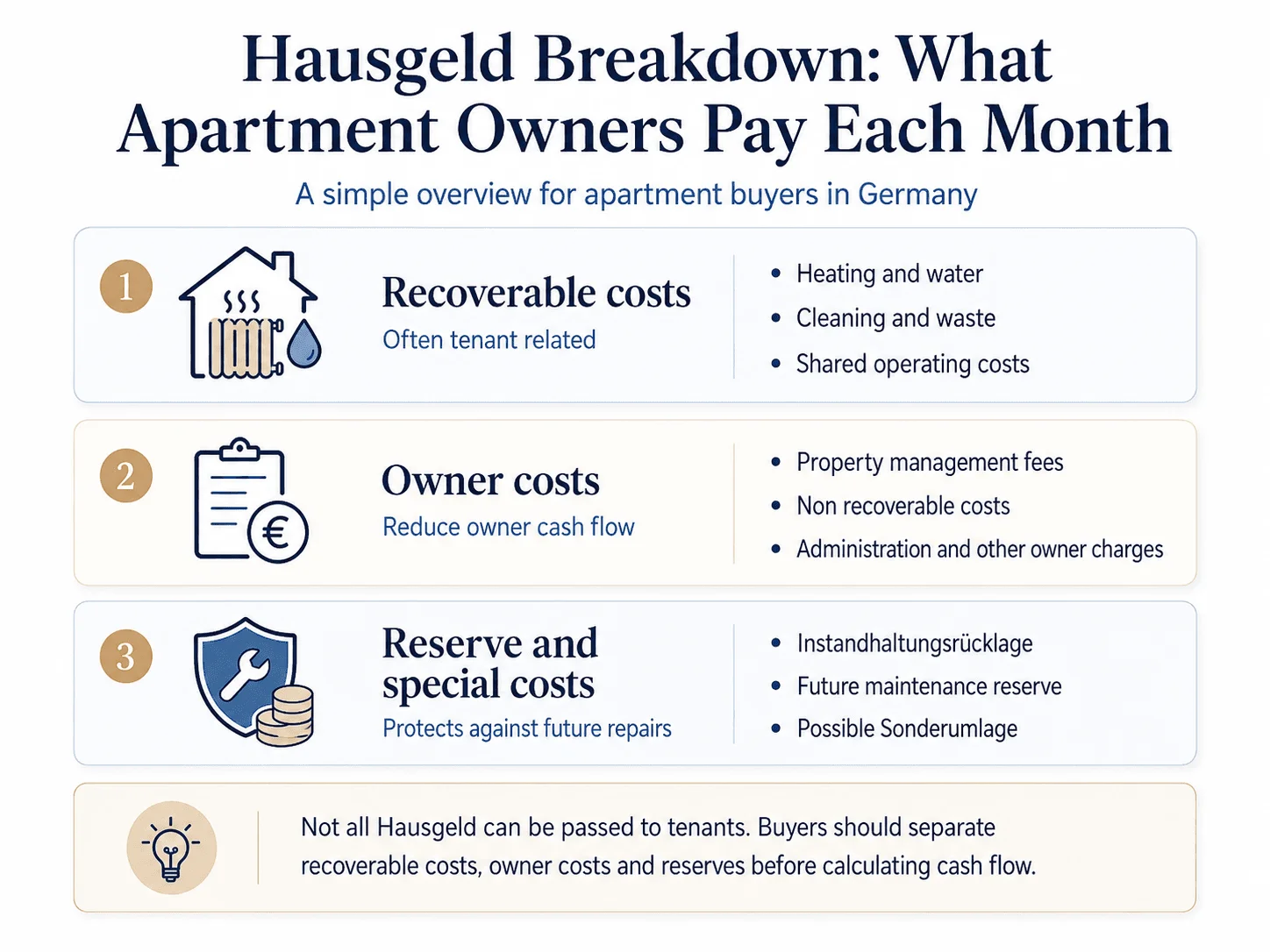
If you're buying as an investor, don't assume the whole "Hausgeld" figure will flow through to your tenant. Some costs count as "umlagefähige Kosten", meaning they're potentially recoverable, and others are "nicht umlagefähige Kosten", meaning they stay with you.
That distinction is one of the most important parts of understanding the real apartment costs Germany buyers face. Mixing recoverable and non-recoverable operating costs up is probably the single fastest way to overestimate what an apartment will actually earn you.
What does "Hausgeld" usually include?
"Hausgeld" isn't one expense, it's a bundle of several. Every building splits it a little differently, so what follows is a framework, not a formula you can apply blindly. The real breakdown always lives in the "Wirtschaftsplan" and the "Jahresabrechnung", the annual statement, for whichever building you're actually looking at.
Building operating costs
This part is closest to what a tenant would recognize as "Nebenkosten". Operating costs, or "Betriebskosten", can cover things like cleaning the stairwell, heating shared areas, waste collection, building insurance, garden maintenance and other general running costs.
Some of these may be passed to a tenant as "umlagefähige Kosten", but how much depends on the specific cost and how the rental is structured. Either way, this figure alone won't tell you your real monthly apartment costs Germany as the owner.
Property management and administration
Someone has to actually run the "WEG", and that's the "Hausverwaltung", the property management company. This slice of "Hausgeld" pays for administration, bookkeeping, communication between owners, building management and organizing the yearly "Eigentümerversammlung", the owners' meeting.
These are the "Verwalterkosten", and they matter because they're typically an owner cost rather than a normal tenant operating cost. If you're renting the apartment out, property management fees Germany can therefore reduce your investment cash flow.
That's exactly why it's worth knowing roughly how much of your "Hausgeld" goes toward "Hausverwaltung Kosten" before you buy, not after.
Maintenance reserve
This is the part I think expats underestimate the most. The "Instandhaltungsrücklage", sometimes called "Erhaltungsrücklage", is basically a savings account the building keeps for future repairs and maintenance of shared parts of the property.
A maintenance reserve Germany buyers find unusually thin can be a warning sign, particularly in an older building where a new roof, façade work or another major repair might be around the corner.
On the flip side, a healthy reserve is often a good sign. It usually means the "WEG" has been planning ahead instead of putting things off. When you're looking at a property, check both how much is being contributed monthly and how much has actually built up in the reserve fund property Germany owners collectively hold so far.
Special levies and unexpected costs
Even a well-funded reserve doesn't always cover everything. When it falls short, the "WEG" can call for a "Sonderumlage", a special levy or additional one-off payment from owners, usually for major repairs, modernization or sometimes legal issues.
These additional "WEG Kosten" can become particularly important when work is required on the "Gemeinschaftseigentum", the common property shared by all owners.
For a new buyer, a "Sonderumlage" can feel like getting blindsided. So ask directly, before you sign anything, whether one has already been discussed, voted on or is likely to come up soon because of future repairs everyone already knows are coming.
Which "Hausgeld" costs can be passed to tenants?
If you're investing, this is the section that actually moves your numbers. Not all of "Hausgeld" disappears into your costs, but not all of it can be handed to a tenant either, and the split matters more than people expect.
Broadly, "umlagefähige Kosten" can potentially go through to tenants via standard operating cost billing. "Nicht umlagefähige Kosten" stay with the owner. This is why searches around "Hausgeld umlagefähig" need a more nuanced answer than simply yes or no.
This isn't legal advice, and specific cases can get complicated, so don't treat general guidance as a substitute for checking the rules that apply to your specific apartment and rental situation.
Practically, what you need before making an offer is your net owner burden, not the headline "Hausgeld" figure everyone else is looking at. For investment property costs Germany, that difference is crucial.
It helps to break the total into four pieces in your head:
- total "Hausgeld"
- recoverable operating costs
- non-recoverable owner costs
- the maintenance reserve contribution
Once you separate those out, the real rental cash flow can look very different from the single number on the listing.
How "Hausgeld" affects cash flow and rental yield
Here's where "Hausgeld" stops being a line item and starts being the thing that decides whether a deal is actually good. A property can look great on rental income alone and still be a mediocre investment once you factor in the real, non-recoverable costs sitting underneath.
Getting an honest read on cash flow means going past rent minus mortgage. You need cold rent, recoverable operating costs, the non-recoverable part of "Hausgeld", the maintenance reserve contribution, your mortgage payment, some vacancy buffer, and taxes or insurance where they apply.
It sounds like a lot to track, but it's the difference between a spreadsheet that lies to you and one that doesn't. This is also why rental yield Germany calculations based only on the purchase price and annual rent can be misleading.
For a more realistic net rental yield Germany calculation, you need to consider the owner costs that actually remain after recoverable expenses have been separated out. Those investment property costs Germany directly affect whether a real estate investment Germany case produces the return you expected.
High "Hausgeld" isn't automatically a problem. If it reflects a well-run building with solid reserves and competent management, it can actually be protecting your property investment Germany case.
What actually hurts is high non-recoverable costs, because those come straight off your net rental yield with nothing to offset them.
Too many buyers stop at purchase price versus expected rent and call it done. That comparison will almost always make an apartment investment look better than it really is.
If you want to see how the picture shifts once "Hausgeld" is properly included, use the Property Investment Calculator to calculate the real cash flow of an apartment investment before you commit to anything.
Which "WEG" documents should expats check before buying?
You genuinely cannot judge "Hausgeld" from an exposé. What's printed there is, at best, a summary, and sometimes it's simply outdated. Before you make a final decision, go through the actual "WEG" documents.
This is the point where careful property due diligence Germany buyers complete before purchasing can prevent an unpleasant surprise six months after closing.
Ask for and read through:
- the "Wirtschaftsplan"
- the "Wirtschaftsplan WEG" information showing the building's expected annual budget
- the "Jahresabrechnung"
- the "Jahresabrechnung WEG" showing the actual annual costs
- the "WEG Protokoll", meaning past meeting minutes
- recent "Eigentümerversammlung" minutes
- the current reserve fund balance and how it has developed
- planned maintenance or renovation work
- ongoing disputes within the "WEG"
- any existing or planned "Sonderumlage"
- background on the current "Hausverwaltung"
- insurance and other important building-related documents
It's tedious compared to scrolling listings, I know. But the "Wirtschaftsplan", annual statement, meeting records and reserve information tell you far more about a building's real financial health than any exposé ever will.
If you want a fuller walkthrough of the buying process, this guide on property documents and due diligence before buying covers it in more depth.
What is a good or bad "Hausgeld" level?
There's no magic number here, and I'd be skeptical of anyone who gives you one. A low monthly figure can look attractive, but it might just mean the "WEG" isn't saving enough for what's coming.
A high figure can look alarming at first glance, and yet it might reflect exactly the kind of realistic reserves, maintenance and professional management that protect your investment down the line.
The real question isn't simply whether the "Hausgeld Höhe" looks high or low. It's what's inside it. A useful "Hausgeld berechnen" exercise therefore needs to go beyond dividing one monthly number by the apartment size.
When comparing "Hausgeld Kosten", ask:
- Is the "Instandhaltungsrücklage" healthy for the building's age?
- Are major repairs expected?
- Could a future "Sonderumlage" become necessary?
- Is the "Hausverwaltung" competent and responsive?
- Are the "WEG Kosten" stable or rising?
- Are there visible disputes within the "WEG"?
- How much of the total can realistically be passed to a tenant?
Answer those honestly, and you'll understand the real "Hausgeld Höhe" far better than you would by comparing it against some average figure someone quoted you at a dinner party.
"Hausgeld" and "WEG" risks expats often miss
Buying into a "Wohnungseigentümergemeinschaft" means buying into shared responsibility, and that's a concept a lot of expats don't fully register going in, especially coming from markets where ownership feels more self-contained.
A gorgeous, freshly renovated apartment can still carry real financial risk if the "WEG" behind it is disorganized or underfunded.
The mistakes I see most often include:
- an underfunded maintenance reserve relative to what the building actually needs
- roof or façade repairs that everyone can see coming but nobody has budgeted for
- missing or unclear "WEG Protokoll" records
- "Hausgeld" that's crept upward year after year without a clear reason
- ongoing conflict between owners that stalls decisions
- a weak or unresponsive "Hausverwaltung"
- an expensive or poorly disclosed "Sonderumlage"
- confusion about which costs can actually be passed to tenants
- confusion between "Gemeinschaftseigentum", common property, and "Sondereigentum", private ownership
None of these automatically kill a deal. But you want to know about them before you own the apartment, not after your first "Eigentümerversammlung".
"Hausgeld" for owner occupied apartments vs rental investments
How much "Hausgeld" matters, and in what way, really depends on why you're buying.
If you're planning to live in the apartment yourself, the priority is total monthly cost and long-term building quality. Your apartment ownership costs Germany calculation should include "Hausgeld" alongside the mortgage payment, rather than treating the mortgage as the full monthly cost.
Keep a personal buffer for furniture, moving costs and repairs you didn't see coming, and stay engaged with future "WEG" decisions since they'll shape your home and your monthly ownership costs for years.
If you're buying as an investor, the priorities shift. Rental property costs Germany investors need to calculate should separate recoverable from non-recoverable expenses rather than relying on the gross "Hausgeld" amount.
Calculate net cash flow instead of leaning on gross rental yield, dig into the reserve fund and any planned repairs, and confirm the rent actually covers your real ownership costs once "Hausgeld" is in the picture.
Running these through the Property Investment Calculator to test whether the apartment still works as an investment can save you from a costly miscalculation later on.
How to compare apartments using "Hausgeld"
Two apartments can share nearly the same price tag and still have very different real monthly cost profiles once "Hausgeld" enters the picture. That's why comparing listings on price and location alone tends to hide more than it reveals.
If you're buying apartment Germany property, line up:
- purchase price
- mortgage payment
- total "Hausgeld"
- the non-recoverable portion of "Hausgeld"
- the maintenance reserve contribution and current balance
- expected rent if you're investing
- any planned "WEG" repairs
- the property's overall condition
These apartment costs Germany buyers face can produce very different outcomes even when two properties have nearly identical purchase prices.
Do this early, not just after you've already fallen for a listing. "Hausgeld" belongs in your first screening of a property, because monthly property costs Germany buyers inherit can materially change both affordability and the property investment Germany case.
This is exactly where the Real Estate Search Engine can help you compare apartments before making an offer.
"Hausgeld" checklist before buying an apartment in Germany
Keep this list nearby the next time you're reviewing a listing or an exposé:
- What is the monthly "Hausgeld"?
- What exactly is included?
- How much is recoverable from tenants?
- How much is not recoverable?
- How much goes into the "Instandhaltungsrücklage" each month?
- What is the current reserve fund balance?
- Are major repairs planned?
- Has a "Sonderumlage" already been discussed or approved?
- Are the "WEG Protokoll" records available?
- Are there visible conflicts in the "Eigentümerversammlung"?
- Is the current "Hausverwaltung" professional and responsive?
- Has "Hausgeld" increased recently, and if so, why?
- Have you checked the latest "Wirtschaftsplan"?
- Have you reviewed the latest "Jahresabrechnung"?
- Does the apartment still fit your monthly budget once all "WEG Kosten" are included?
- Does the investment still work after subtracting non-recoverable costs from cash flow?
- Have you actually gone through the "WEG" documents before signing?
FAQs about "Hausgeld" in Germany
What is "Hausgeld" in Germany?
"Hausgeld" is the monthly payment apartment owners usually make to the "Wohnungseigentümergemeinschaft", or "WEG", to fund shared building expenses. It can include operating costs, property management, contributions to the "Instandhaltungsrücklage" and other common expenses. The exact breakdown differs from building to building and is normally based on the "Wirtschaftsplan". That's why buyers should look beyond the headline monthly amount and check what the payment actually covers before judging whether the apartment is affordable.
Is "Hausgeld" the same as "Nebenkosten"?
No. "Hausgeld" is paid by apartment owners to the "WEG", while "Nebenkosten" generally describes operating costs that tenants pay alongside rent. There is overlap because some parts of "Hausgeld" may qualify as "umlagefähige Kosten" and can potentially be billed to tenants. Other items, including certain owner-related costs, remain "nicht umlagefähige Kosten". For buyers and investors, the important point is that the full "Hausgeld" should never automatically be treated as a tenant expense.
Can "Hausgeld" be passed to tenants?
Only part of "Hausgeld" may generally be passed to tenants. Certain "umlagefähige Kosten", such as eligible operating costs, may be included in the tenant's operating cost billing. Other components remain with the owner and are therefore "nicht umlagefähige Kosten". Property management and reserve contributions are important examples buyers should examine carefully. The exact treatment can depend on the individual cost and rental situation, so investors should calculate their net owner burden rather than assuming the complete monthly "Hausgeld" is recoverable.
What is "Instandhaltungsrücklage"?
The "Instandhaltungsrücklage", also known as the "Erhaltungsrücklage", is the maintenance reserve held by the "WEG" for future work on the building's common property. It can help fund repairs to roofs, façades and other shared elements without requiring owners to cover the full cost at once. Buyers should check both the regular reserve contribution and the current reserve fund balance. A very low reserve can become a warning sign when an older building already has significant maintenance work approaching.
What is "Sonderumlage"?
A "Sonderumlage" is an additional payment apartment owners may need to make when the "WEG" requires more money than is available through normal contributions or existing reserves. This can happen because of major repairs, modernization projects or other unexpected expenses. For an investor, a large "Sonderumlage" can reduce cash flow and investment returns significantly. Buyers should therefore review recent "WEG" meeting minutes and ask whether any special levy has already been discussed, voted on or is likely in the near future.
What "WEG" documents should buyers check?
Buyers should review the "Wirtschaftsplan", "Jahresabrechnung", "WEG Protokoll" and recent "Eigentümerversammlung" minutes before making a final decision. These documents help show how the building is budgeted, what costs were actually incurred, how healthy the reserve fund is and whether major repairs or disputes are developing. It is also worth checking planned maintenance, existing or proposed "Sonderumlage" payments and information about the "Hausverwaltung". Together, these records provide a much clearer picture than the "Hausgeld" figure in an exposé alone.
Is high "Hausgeld" always bad?
No. High "Hausgeld" can reflect strong maintenance planning, realistic operating costs, a healthy reserve fund and professional building management. Those things may actually support the property's long-term condition. The problem is not simply a high monthly number, but what that number contains. High non-recoverable costs can reduce an investor's cash flow, while extremely low "Hausgeld" may mean the "WEG" is not saving enough for future repairs. Buyers should therefore compare the breakdown, not just the total amount.
Why does "Hausgeld" matter for property investors?
"Hausgeld" matters because it directly affects rental cash flow and net rental yield. Investors who compare only the purchase price, expected rent and mortgage payment can easily overestimate how profitable an apartment really is. The non-recoverable part of "Hausgeld", reserve contributions and other ownership expenses reduce the money that remains with the owner. Separating those costs from recoverable tenant expenses gives a far more realistic view of whether a real estate investment Germany property can actually produce the expected monthly return.
"Hausgeld" can make or break the real cost of an apartment
"Hausgeld" deserves a lot more attention than most buyers give it during the process. It is one of the most important monthly costs for apartment buyers in Germany and shapes your monthly affordability, rental cash flow and the long-term quality of your investment at the same time.
Don't rely purely on purchase price, rent and mortgage payment to judge whether an apartment makes sense. Go through the "WEG" documents, understand the "Instandhaltungsrücklage", check for "Sonderumlage" risk and separate recoverable costs from what you'll actually be carrying as the owner.
The right apartment usually isn't the one with the lowest "Hausgeld" on paper. It's the one where the costs are understandable, sustainable and reflected fairly in what you're paying for it.
Before making an offer, check whether the "Hausgeld", "WEG" documents and non-recoverable owner costs still fit your budget and investment plan.