


Krebsversicherung in Germany: Is Cancer Insurance Enough for Expats?
Nobody researches cancer insurance on a good day. Usually something has happened first. A colleague got a diagnosis at 41. A parent back home started treatment. Or you turned forty yourself and suddenly the paperwork you've been ignoring feels urgent.
And the worry is rarely only medical. You already have health insurance here, so the hospital bill isn't the thing keeping you awake. It's the rest of it. Rent doesn't pause. The mortgage doesn't pause. If your partner drops to part time to help, that income doesn't come back on its own.
That's the gap Krebsversicherung, the German word for cancer insurance, is meant to fill.
It's an easy product to understand, which is part of its appeal. But the better question isn't "can I insure against cancer?" It's "would cancer-only cover actually protect what I'm worried about?"
So let's go through how cancer insurance in Germany works, in plain English, and then compare it with Dread Disease Insurance for expats in Germany, which covers a wider set of illnesses.
No scare tactics. Just the things worth knowing before you sign a German contract.
What is Krebsversicherung in Germany?
Krebsversicherung means cancer insurance, or cancer cover. You'll also see it written as Versicherung gegen Krebs, Versicherung bei Krebs, or Krebsabsicherung depending on who's marketing it.
Same idea behind all of them: money after a covered cancer diagnosis.
That word "covered" is doing a lot of work, and we'll come back to it.
These policies are deliberately narrow. Cancer, and generally nothing else. No heart attack, no stroke, no multiple sclerosis.
The payout structure varies too. Some tariffs pay a single amount once a diagnosis is confirmed. Others pay in stages, or tie benefits to particular treatments or severity levels.
There's no single standard that applies to every policy. Two products with similar names and similar premiums can behave very differently when someone actually claims.
The contract wording is the product.
How cancer insurance works in practice
The sequence is usually similar wherever you apply.
- You choose an insurer and a tariff.
- You answer health questions if the product requires them.
- The insurer reviews what you've told them and decides whether and on what terms they can offer cover.
- The contract defines which diagnoses count as a Leistungsfall, meaning a valid claim.
- If a diagnosis occurs, your doctor provides the necessary documentation.
- The insurer compares that documentation against the Versicherungsbedingungen, the policy conditions.
- If the contractual conditions are met, the benefit is paid according to the policy.
The friction almost always sits in that comparison step.
Brochures can make these policies sound automatic, and in straightforward cases they may be. But whether a claim succeeds can come down to the specific type of cancer, the stage it was caught at, and how the contract defines its Leistungsauslöser, the trigger for payment.
Which is why covered cancer types and excluded cancer types aren't fine print. They're the whole thing.
A lump sum cancer insurance payout is worth exactly as much as the definition that unlocks it.
Does German health insurance already cover cancer treatment?
Medically, German statutory and private health insurance generally cover medically necessary cancer treatment within the rules of the respective system or policy.
What health insurance doesn't automatically do is keep your household running.
Think about what the twelve months after a diagnosis could look like.
- Income drops, sometimes sharply.
- A partner cuts hours or takes unpaid leave.
- You suddenly need childcare or help around the house.
- Family may travel from abroad to support you.
- Rent or mortgage payments continue.
- Recovery can create costs long after treatment ends.
Depending on the situation, people may also choose additional private support, rehabilitation services or second opinions that are not necessarily part of the financial protection provided by a normal health insurance policy.
This isn't medical advice and it isn't a treatment guide. The point is narrower than that.
Cancer insurance vs health insurance isn't really a choice, because they solve different problems.
Health insurance deals with medical care. Cancer insurance or broader critical illness cover is designed to provide money that can be used for the financial consequences surrounding the diagnosis.
If you're still figuring out how the system works here, this guide to German health insurance for expats covers GKV and PKV in more detail.
Cancer insurance vs Dread Disease cover
Here's the comparison that changes most people's minds, one way or the other.
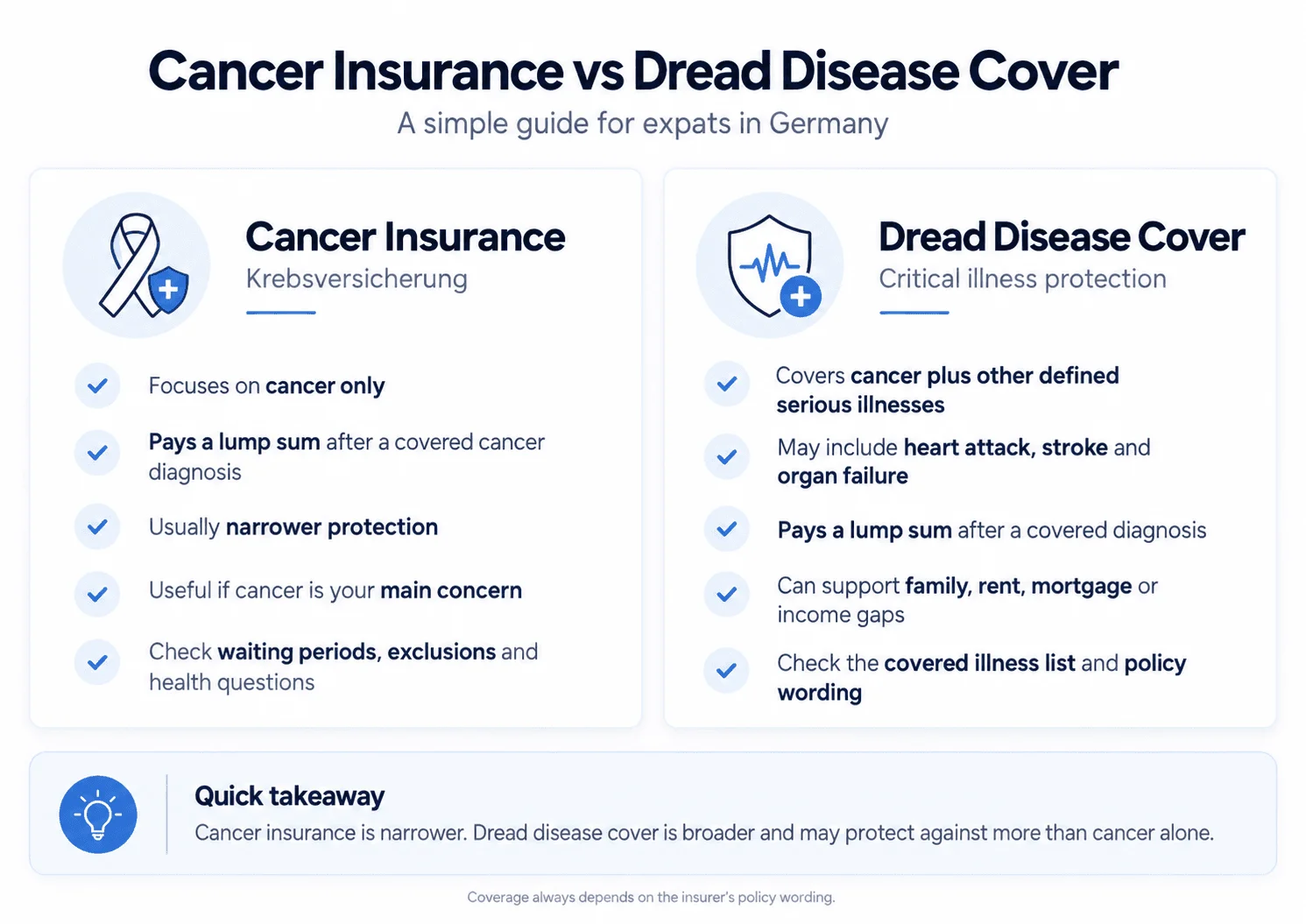
Cancer insurance does one job. Cancer, as defined in your contract. That's it.
Dread Disease Versicherung, also called Schwere-Krankheiten-Versicherung in German or critical illness cover in English, runs on a similar basic mechanism: defined diagnosis, benefit paid.
The difference is the list.
A Dread Disease policy might include cancer plus heart attack, stroke, multiple sclerosis, organ failure and a range of other defined conditions. The exact list depends on the policy.
So the trade-off comes down to this.
Cancer-only cover is simple. You know what it does and you can explain it to your partner in one sentence.
The weakness is equally simple: if the financial shock arrives as a stroke instead, the policy may do nothing.
Broader critical illness insurance covers more ground, but it asks more of you upfront. Condition lists, severity thresholds and exclusions all need reading.
And reading them in German makes it harder still.
Neither is automatically the right call.
It depends on whether you're insuring a specific fear or a broader financial risk.
If it's the second one, look at broader Dread Disease cover for expats in Germany before you commit to something narrower.
Is Krebsversicherung sinnvoll for expats?
Sometimes. For some people. Depending heavily on what else you've got in place.
Whether a Krebsversicherung makes sense for you usually comes down to how exposed you'd be if income dropped for several months.
It's worth a look if you:
- have children or others depending on your income
- are carrying a mortgage or high rent
- are self employed with limited employer sick pay protection
- run your household mainly on one income
- have limited emergency savings
- want a relatively simple cancer-focused payout
It may be too narrow if you'd also want financial protection after a heart attack, stroke or other serious illness.
It may also be the wrong tool if your main concern is long term inability to work rather than a one-off financial shock after diagnosis.
Because so much of this depends on your own numbers and existing protection, it's worth taking twenty minutes to speak with Finance for Expats rather than trusting a comparison table that knows nothing about your situation.
Protection needs look completely different for a single renter and a family with children, a mortgage and one main income.
Krebsversicherung Kosten: what affects the price?
Anyone quoting one universal figure for Krebsversicherung Kosten without knowing anything about you is guessing.
Price can depend on factors such as:
- your age when you apply
- the insured amount
- the contract duration
- smoking status
- current health
- previous illnesses
- family cancer history if the insurer asks about it
- waiting periods
- the depth of the Gesundheitsfragen
- the insurer and tariff
One thing worth saying plainly: cheap cover is not automatically good cover.
A lower premium can reflect a smaller insured amount, narrower definitions, more exclusions or other differences in the tariff.
If your health history raises questions during the Gesundheitsprüfung Krebsversicherung, the insurer may also apply different terms or a Risikozuschlag.
If cost is what's driving your decision, put the numbers next to broader options before you conclude anything.
You can compare Dread Disease cover options and see whether wider protection makes sense in your situation.
Gesundheitsfragen, Gesundheitsprüfung and pre-existing conditions
This is where expats most often get tripped up, and it's avoidable.
Gesundheitsfragen are the health questions on the application.
Gesundheitsprüfung is what the insurer does with your answers, called medical underwriting in English.
Pre-existing conditions can affect several things at once:
- whether you're accepted
- whether exclusions apply
- whether a Risikozuschlag applies
- whether the insured amount is limited
- whether the product is available to you at all
Previous cancer matters, obviously. So can findings that are still being monitored, previous investigations or family history, depending on exactly what the application asks.
And these questions are often phrased very carefully.
Answer them fully and honestly.
If you're unsure whether some investigation from years ago counts, ask before you tick the box, not after.
Incomplete or inaccurate answers can create major problems when a claim is reviewed later.
German application forms are dense even for Germans. If you want someone to walk you through the process in English, English-speaking insurance advice can make the application considerably easier to understand.
Can I get cancer insurance after a cancer diagnosis?
Usually difficult, and sometimes not possible.
Cancer insurance after diagnosis depends on the diagnosis itself, how long ago it was, what treatment you had, where things stand now and each insurer's underwriting rules.
Applicants may face restrictions, waiting periods, higher premiums or rejection depending on the insurer and medical history.
Insurance is designed to cover uncertain future events, which is why arranging protection before a serious diagnosis is generally easier than after one.
That's not a pleasant sentence to read if you're already past that point, but it's more useful than vague reassurance.
If you do have a cancer history, there may still be protection options available, just not necessarily the cancer insurance product you originally had in mind.
Krebsversicherung ohne Wartezeit or ohne Gesundheitsfragen: what should expats check?
Both phrases show up constantly in ads, and both deserve a second look.
Wartezeit is a waiting period, a period after the policy starts during which certain diagnoses may not trigger a benefit.
Krebsversicherung ohne Wartezeit suggests cover from the beginning of the contract.
Krebsversicherung ohne Gesundheitsfragen means an application without the usual health questions.
Both sound attractive.
But easy entry doesn't automatically mean broad cover.
Before taking either phrase at face value, check:
- whether cover really starts immediately
- whether certain cancer types are excluded
- how early-stage cancers are treated
- whether the payout is capped or tiered
- whether a survival period applies
- how pre-existing conditions are treated
- whether the benefit is a lump sum or another type of payment
None of this automatically makes these products bad.
It simply means the Versicherungsbedingungen are where the real story is.
Does Krebsversicherung cover all types and stages of cancer?
Not necessarily, and if you only take one thing from this article, make it this one.
Policies define cancer differently from one another, and sometimes differently from how you'd define it in conversation.
Carcinoma in situ, certain early-stage findings, pre-cancerous changes and some skin cancers may be excluded entirely or may trigger a reduced benefit depending on the policy.
What counts is the medical definition written in the contract.
Before signing, find out:
- which cancer types are covered
- which are excluded
- how early-stage diagnoses are treated
- what happens if cancer returns after a previous claim
- whether a waiting period applies
- what documentation is required at claim time
- how much gets paid
- when the benefit is paid
Getting clear on the Leistungsfall and the policy definitions is the difference between a policy that looks useful and one that actually matches what you expect it to do.
Krebsversicherung Vergleich: what expats should compare
A real Krebsversicherung Vergleich goes well past the monthly premium.
Look at:
- how cancer is defined
- how early-stage diagnoses are handled
- the payout amount and structure
- waiting periods
- how far the health questions reach
- the exclusion list
- whether children or a partner can be included
- whether the policy can continue if you leave Germany
- how claims are processed
- what language the documents are available in
- whether broader critical illness protection would suit you better
There's no shortage of pages promising the best cancer insurance Germany has available, and a Krebsversicherung Test ranking is easy to produce and difficult to apply to one specific person.
A ranking doesn't know your age, your health history, your family situation or whether you're moving to another country in three years.
And those are exactly the variables that can change the decision.
One expat-specific point: the binding contract wording is typically the German policy wording, even if an English summary is available.
If you don't understand the conditions, make sure they are properly explained before you sign.
Cancer insurance vs life insurance and disability insurance
It helps to see where this product sits next to the others.
Term life insurance pays a benefit if the insured person dies. It is primarily designed to protect the people who depend financially on that person.
Berufsunfähigkeitsversicherung, occupational disability insurance, is designed to replace part of your income if you can no longer work in your profession under the terms of the policy.
Cancer insurance can pay after a covered cancer diagnosis, whether or not you ultimately stop working.
Dread Disease cover works on a similar diagnosis-based principle across a broader list of defined serious illnesses.
These products solve different problems and can sometimes sit alongside each other rather than replacing one another.
If income protection is one of your biggest concerns, read more about occupational disability insurance for expats in Germany.
Quick self-check: is cancer-only cover enough for you?
Is cancer-only cover enough for you?
- Do you want protection against cancer specifically, or against serious illness in general?
- Would your family also be under financial pressure after a heart attack or stroke?
- Do you have children or others depending on your income?
- Do you have a mortgage or a high rent commitment?
- Would your household struggle if income dropped for several months?
- Do you understand the health questions and exclusions in the policy you're considering?
- Have you compared cancer-only cover with broader critical illness cover?
If cancer really is your main concern, Krebsversicherung may be worth reviewing.
If you want protection against several serious illnesses, broader Dread Disease cover may be the better comparison point.
If the second option sounds more like you, have a look at the available Dread Disease Insurance options before deciding.
Common mistakes expats make with cancer insurance in Germany
A few of these come up again and again.
- Assuming every cancer diagnosis pays out. Stage and contract definition matter.
- Treating cancer insurance and Dread Disease cover as the same product.
- Comparing only the monthly premium.
- Skipping past early-stage cancer rules.
- Rushing the Gesundheitsfragen.
- Not reading the exclusions.
- Assuming German health insurance replaces all lost income.
- Waiting until after a serious diagnosis before thinking about protection.
- Forgetting to check whether the policy still works if you leave Germany.
- Never comparing cancer-only cover with broader critical illness protection.
Most of these problems can be avoided by understanding the contract before signing rather than trying to understand it when a claim happens.
FAQs about Krebsversicherung in Germany
What is Krebsversicherung in Germany?
Krebsversicherung means cancer insurance. It can provide a financial benefit after a covered cancer diagnosis.
The money can generally be used according to your own needs, for example for rent, childcare or replacing income during treatment and recovery.
What's covered and how much gets paid depends on the individual policy.
Is Krebsversicherung sinnvoll for expats?
It depends on your finances and what protection you already have.
It may be worth considering if you have dependents, a mortgage, high rent or limited emergency savings.
The main limitation is that cancer-only cover may be too narrow if you want financial protection after other serious illnesses as well.
Does German health insurance already cover cancer treatment?
German statutory and private health insurance generally cover medically necessary cancer treatment within the rules of the respective system or policy.
What health insurance does not automatically provide is a lump sum to replace lost income, fund a partner's unpaid leave or cover the additional household costs that can arise around treatment and recovery.
Is cancer insurance the same as Dread Disease Insurance?
No.
Cancer insurance generally focuses on cancer.
Dread Disease Versicherung, also known as critical illness cover, can include cancer plus other defined illnesses such as heart attack or stroke depending on the policy.
Does cancer insurance cover all types of cancer?
Not necessarily.
Contracts may exclude certain diagnoses, treat early-stage cancers differently or pay a reduced benefit for some conditions.
The Versicherungsbedingungen are the reliable source for what is actually covered.
How much does Krebsversicherung cost?
There's no single figure.
Krebsversicherung Kosten can depend on your age, health, smoking status, insured amount, contract term and the insurer's underwriting rules.
The Gesundheitsprüfung can also influence whether standard premiums or different conditions apply.
Can I get cancer insurance after a cancer diagnosis?
It can be difficult and in some situations may not be possible.
The outcome depends on the specific diagnosis, medical history, treatment and the insurer's underwriting criteria.
Applicants may face restrictions, different terms or rejection depending on the circumstances.
Should expats choose cancer insurance or broader Dread Disease cover?
If cancer is genuinely the specific risk you want to protect against, cancer insurance may be enough.
If you'd also want financial protection following other serious diagnoses, compare broader Dread Disease cover for expats before deciding.
Cancer insurance can be useful, but it should not be viewed in isolation
Krebsversicherung appeals for good reasons.
It's simple, it speaks to something most of us quietly worry about, and it can address a financial gap that normal health insurance was never designed to solve.
It's also narrower than it first appears.
It protects against one category of diagnosis, while the financial risk you're actually worried about may be broader than that.
So before deciding, compare the things that determine whether a policy works when it matters:
- which diagnoses are covered
- how much gets paid
- what the health questions ask
- whether a waiting period applies
- what is excluded
- what your family would actually need
- how the policy fits with your health insurance and disability protection
Before choosing cancer-only insurance in Germany, make sure you understand whether it protects the financial risk you actually want to cover, or whether broader Dread Disease cover is the better fit for your situation.
If you'd rather talk it through in English with someone who works with German insurance contracts, you can book a consultation with Finance for Expats.