


Why Understanding Salary in Germany Is Crucial for Expats
Expats are often portrayed in the press as being extremely well-paid, and whilst this is true to an extent it is also worth considering how expensive life can be and how little of their salary is actually left at the end of the month. Many people move abroad with the intention of saving money, but due to expensive housing, a need to learn new systems, and higher deductions, the reality is often very different.
The salary in Germany is an important consideration for many foreign professionals. Germany is a very popular destination for expats from all over the world, and of course there are plenty of jobs available for them too. Germany is a beautiful country filled with amiable people and stunning landscapes. Making the move to this country is a huge decision, and salary is usually one of the key factors.
After researching and hearing from other expats, the average salary in Germany appears competitive in most industries. However, what they promised you versus what you actually get paid can be very different. Many people are surprised about the large gap between gross salary and net salary Germany. Due to the strong social security system, salary after tax Germany is significantly lower than expected, especially compared to countries like the US or UAE.
This guide helps you understand the average salary Germany after tax and what it really means in terms of living costs on the ground.
What Is the Average Salary in Germany?
The average salary for full-time employees in Germany amounts to approximately €54,000 gross per year across all industries and regions. However, averages can be misleading without understanding how salaries are distributed.
Average Salary Germany Per Year and Per Month
The average salary Germany per month typically ranges from €3,500 to €4,000 gross for mid-level professionals. Entry-level salaries, internships, and minimum wage roles are significantly lower, which brings the average down.
This is why focusing only on gross figures is risky. What matters is your gross to net salary Germany after all deductions have been applied.
Average Income Germany vs Average Wage Germany
"Average income Germany" and "average wage Germany" are two frequently missed terms that are often used interchangeably. The average consists of a whole variety of incomes, for example salaries from work and freelance work, capital income, income from social security contributions or pesions, or even rental income. When comparing salaries before your expat move on the other side of the world however, the wage (average salary) is the more suitable parameter.
Median Salary Germany vs Average Salary Germany
It might also be worth noting that the median salary in Germany is quite low. The median is the value which divides the sum of all values equally into two groups, with half of the values being higher and half being lower. In many cases, the median salary is actually lower than the average salary. For Germany this number is somewhere in the region of €40,000 to €43,000 gross per year. Average earnings are artificially inflated by the small numbers of very highly paid workers in senior management, top specialist doctors and leading engineers. The median income gives a better idea of typical earnings and is often more useful than the average salary Germany.
Why Median Salary Matters for Expats
As a mid-level professional you should rely on the "median" (the middle value of salaries in a given sector) for the given profession. The average salary (the mean value) can greatly exceed the median, especially if a few exceptionally high salaries greatly outweigh normal salaries. When a recruiter pitches you a job by saying you will be "paid above average", take this with a grain of salt if the average salary for that field is "above average" to begin with.
What Is a Good Salary in Germany?
How much does expat life cost? This is probably one of the most frequently asked questions I receive. And the answer to this question is: it depends. Not just on this answer, but also on where you live, and how you live. Here are a few rough estimates and ideas to give you an idea of where you are at. What is considered good salary in Germany? To consider your salary in Germany good, your net salary Germany must cover your fixed costs sufficiently, should still allow for the possibility of saving money and must generally not impose too many sacrifices. After tax and with all other dues and contributions paid, for single people this means a minimum of €2,200 to €2,500 per month, depending on salary after tax Germany.
Good Salary for a Single Expat
For one person, €2,200-€2,800 per month net is enough for a comfortable life in an affordable sized city in Germany. For reference, a one-bedroom apartment for rent should cost in the region of €900-€1,400 in a decent sized city and a further €500-€700 per month should be enough for food and transport with the remainder free for saving and socialising with family and friends. The re-usable bins are a great piece of kit, I think they will perform well in more urban environments like Munich or Frankfurt where the effective range may be greater.
Good Salary for Families
However, for families with more than one adult living in the apartment, two incomes are welcome but are outweighed by the cost of childcare, the need for a bigger space to live in and higher general expenses. A rough estimate for the net household income required for such an apartment would be €4,500 per month. This would translate to a gross salary of around €70,000 to €80,000 per year for a family with one working parent.
Salary Expectations for Expats
Salaries for expats can vary greatly. We base our estimates on various online sources and our own research. We therefore assume that a software engineer with 5 years of relevant experience would be paid around €65,000 to €85,000 gross per year. A marketing manager with the same amount of experience would get around €50,000 to €65,000 gross per year. Newly qualified professionals like nurses and teachers could start at around €35,000 gross per year. We would be happy to check for you whether your offered salary is suitable. Please contact us with your specific circumstances and we will have a word of mouth assessment of the salary levels on the German job market for you.
Net Salary Germany: What You Actually Take Home
Net salary in Germany – what's that? Most expats won't have heard of the term until pay time. Then they are in for a surprise when they see that their gross salary has already been decreased significantly before hitting their bank account. So what's going on? In this article we explain what net salary Germany is and how gross to net salary Germany works in practice.
Gross vs Net Salary Germany
Did you know how much the difference between gross and net salary is? For an annual gross salary of €50,000, your net salary is around €29,000 to €32,000 per year, depending on your tax class, children or church tax. So only 58-62% of your salary actually ends up in your pocket, ie 35% to 42% less.
Main Salary Deductions
Income tax in Germany is by far the largest deduction from salary. Income tax in Germany is progressive up to approximately 42%. In effect this means that you do not have to pay any income tax on your income up to a certain point. Then, as your income rises the tax rates increase step by step. On top of that in recent times a so-called "rich tax" has been introduced on incomes above €277,000. In addition to your Income Tax your salary will also have been decreased to pay for the following items. These are essentially taken from your pre tax salary.
Tax deductions in conjunction with contributions to superannuation and life insurance can result in capital deductions from income of 35% to 45%, which directly impacts your net salary Germany.
Net Salary Calculator
If you want to calculate your exact net salary Germany based on your personal situation, you can use the gross to net salary Germany calculator. This allows you to estimate your salary after tax Germany in just a few seconds.
Use our Property Investment Calculator to understand how your net salary can translate into real investment potential.
German Payslip Explained for Expats
Once you are earning money, at some point you will receive a payslip. If you are not yet fluent in German, this can seem a bit perplexing.
What Expats Should Understand
When first glancing at a German payslip, it can seem a bit confusing at first. However, the most important numbers are usually clearly visible. Starting from the top of the payslip, the first number is the gross salary paid for the month. Below this are all the payments that have been taken off your salary, such as income tax (Einkommensteuer), solidarity surcharge (Solidaritätszuschlag), health and accident insurance (Krankenversicherung), pension (Pfandversicherung), unemployment insurance (Urlaubsversicherung) and care insurance (Pflegeversicherung). At the bottom of the payslip is your net salary (Bruttolohn netto). In this article we shall look at the main numbers on a standard German payslip and have provided a glossary of important German words and phrases that you should look out for to make sure that you are receiving the correct amount of salary each month.
Salary and Tax Tools
At first sight, a salary calculator Germany only seems to offer the option for an instant generated payslip. But there is more hidden value in an online salary calculator. For example, you can test how your salary changes upon marriage and change of tax class. How much will your net salary be with two jobs? Useful online salary calculators for Germany should be saved as favourites early on to save time and headaches in the long run.
Minimum Wage Germany Explained
Although most expats come to Germany with an established career, there are some who look for entry-level positions or part-time work. Knowing what the minimum wage in Germany is can help these expats.
Minimum Wage Per Hour and Per Month
Germany's minimum wage will rise to €12.41 per hour for 2024. For a 40-hour week job, that would translate into a minimum gross wage for full-time work of €2,150 per month, netting around €1,600 per month. It should just be enough for a frugal lifestyle for one or two people in an average German city, but anything less than that would be stretching it rather severely.
Minimum Wage for Students
In how many areas applies the minimum wage for students? In most areas of student employment. For example for the part time work which is done in addition to studies. There are exceptions for internships, but then they have to be part of the study program. Conditions can be found in the job contract.
Average Salary in Germany by City
Average Salary in Berlin
Salaries in Berlin on average are somewhat below the national average. This reflects the average salary Berlin compared to other cities. This is because the economy of Berlin is mainly based on creative industries, startups and the public sector, which historically have been less well paid than finance and industry. On the plus side, the cost of living in Berlin is lower than that of other major capitals of similar size in Europe. This means that wages still have purchasing power.
Average Salary in Munich
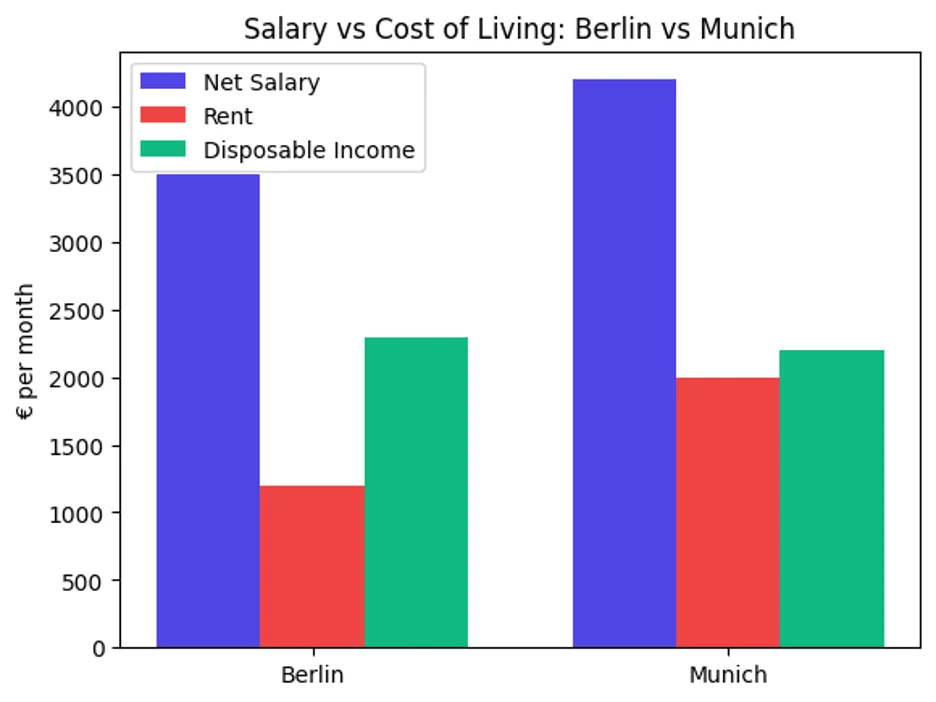
However, there is the other end of the spectrum. Munich has the highest average salary Munich in Germany at around €75,000. Many multinationals are based there as well as large financial companies, as well as the automotive and aerospace industries. But, as with many things in life, there are also downsides. The rent and living costs are the highest in Germany. Surprisingly, €70,000 gross in Munich can have as much cash left over as €55,000 in Leipzig will have after the fixed costs have been taken off.
Salary vs Cost of Living in Germany
Salary is not everything. A higher headline salary doesn't necessarily translate to a higher quality of life. You should also consider the net salary Germany and how it will support your lifestyle, in relation to local rent, cost of transport and food, before deciding if your new job in a new city is a good offer.
Salaries in Germany by Profession and Industry
Tech Salaries
Germany is heavily investing in recruiting the best tech talent, and the salaries are correspondingly high. Starting salaries for completely inexperienced programmers are already around €55,000 per year, while experienced software developers can look forward to upwards of €100,000 — especially when working for large, well-known companies.
However, salaries in startup hubs like Berlin, Munich and Hamburg differ. The highest salaries can typically be found in Munich, where the average salary Munich is significantly above the national average, especially in the tech sector.
Business Roles Salary Germany
All commercial and business sectors and industries are different. This is also reflected in salaries for employees in human resources, marketing, finance, sales and other departments.
The salary for a marketing manager in a medium-sized company in Germany is approximately €45,000 to €65,000 gross per year. Salaries for finance specialists are particularly high in Frankfurt, the financial capital of Germany.
Sales roles often include variable compensation, meaning total earnings can significantly exceed the base salary depending on performance.
Other Professions Salary Germany
Salary levels differ between sectors. A large share of wages and salaries is fixed by collective agreements, especially in industries such as healthcare, education and skilled trades.
In these sectors, salaries are typically between €35,000 and €50,000 gross per year, depending on experience and specialization. Even with lower base salaries, skilled tradespeople can earn very high incomes if they operate their own businesses.
Blue Card Salary Germany Requirements
The Blue Card salary Germany is the key criterion used to determine whether a non-EU skilled worker is granted a visa to live and work in Germany.
To apply for a Blue Card, candidates must have a university degree and a job offer in Germany. Most types of employment are eligible, provided that the annual gross salary meets the required threshold.
Currently, the minimum salary requirement is €43,800 per year. For shortage occupations such as IT, engineering and healthcare, the threshold is lower at €39,682.
The Blue Card also offers advantages such as faster access to permanent residence and long-term settlement opportunities in Germany.
How Salary Impacts Financial Planning in Germany
What's the average income in Germany? The average income in Germany is a figure that will likely influence every decision you make while living in Germany. From saving for a deposit on a house to whether or not you can take the next step in your career, knowing your average salary will be crucial.
From Salary to Investment in Germany
You have worked hard to earn as much possible net income as your salary allows. Now you are searching for options to make use of your remaining budget. In Germany there are many options for investments. For higher returns you invest your money in the long term. Even on a low income, you have the means to invest. You have to decide on real estate or on other securities. With our Property Investment Calculator you can calculate your possible yield on investment with your net salary Germany.
You can also explore investment opportunities via our Real Estate Search Engine.
Is Germany Attractive for Expats Based on Salary?
Salary vs Cost of Living
Salaries are generally enough for support of a reasonable lifestyle in Germany. While salaries do not go as far as they do in the US or UK for comparable work, the purchasing power of the euro far exceeds its value on the international market, especially outside of the larger cities. In addition, the social structure of Germany and the corresponding infrastructure (including very good healthcare, education, and public transport) increase the effective value of your salary far above the stated amount.
Salary vs Quality of Life
Germany rated highest in quality of life for expats. Many expats consider quality of life when calculating whether or not they are paid sufficiently. When Germany's strong labour protections, high levels of holiday pay and overall stable system are considered alongside the generally high standards of the country with regard to work-life balance, it is no surprise that many expats feel that the true value of their salary is higher than the actual figure.
FAQs About Average Salary in Germany
Salaries in Germany differ from job to job. In the following you will find the average monthly salary in Germany per profession. You may wonder what the average salary in Germany is for comparison before moving. The average gross salary for full-time employees in Germany is between €3,500 and €4,000 per month, depending on industry, experience and location.
What is a good net salary in Germany?
Single people are generally considering a net salary in Germany for the cost of living of around €2,200–€3,000 per month. In cities you will lead a comfortable life, and there will still be enough left to put aside.
How much tax do you pay in Germany?
Income tax in Germany starts at zero for low earners but increases to nearly 42 percent for higher income groups. Adding on social contributions, employees are effectively deducted from their gross salary by around 35–45 percent, which strongly impacts your salary after tax in Germany.
What is the minimum wage in Germany?
The minimum wage in Germany in 2024 is €12.41 per hour. For a full-time job, this results in roughly €2,150 gross per month and around €1,600 net. Online tools like a gross to net salary Germany calculator help estimate your actual take-home pay.
Which city has the highest salaries in Germany?
In Germany’s major cities, Munich offers the highest salaries, followed by Frankfurt and Stuttgart. However, due to the higher cost of living, especially rent, the real purchasing power of the average salary Munich can be similar to lower salaries in cheaper cities.
How to Evaluate a Salary in Germany
Salary evaluation is one of the more confusing processes for expats living in Germany. You also need to know the real salary. This is the net salary Germany. It is sensible to take regional costs and lifestyle expenses into account. And of course you should think about your saving and investment plans.
Considering accepting an offer? Even just having a conversation with us can give you a better understanding of whether that offer is suitable for you. Please contact us for guidance.