
Table of Contents
- Introduction: Why Property Tax Matters for Property Buyers and Expats
- What Property Tax in Germany Actually Is
- How Property Tax Germany Is Calculated
- Property Tax in Major German Cities
- Property Tax Reform and the Grundsteuergesetz
- When Property Tax Must Be Paid
- Property Taxes Compared With Other Real Estate Costs
- Property Tax Germany and the German Property Market
- Frequently Asked Questions About the Grundsteuer in Germany
- Conclusion Understanding the German Grundsteuer Before Buying Property
Property Tax Explained for Expats and Property Buyers
Let's be honest, buying property in Germany is already a lot to wrap your head around. Between the paperwork, the language barrier, and the sheer number of fees involved, it's easy to overlook something that will quietly follow you for as long as you own that property: the annual property tax in Germany or "Grundsteuer".
Whether you're eyeing a modern apartment in Berlin property or a cozy house somewhere in the suburbs, this is one cost you really can't afford to ignore.
Introduction: Why Property Tax Matters for Property Buyers and Expats
When expats first start exploring the german property market, they tend to fixate on the big ticket items, the purchase price, the notary fees, and the agent commission. That's understandable; those are the numbers that sting right away.
But here's the thing: property tax doesn't go away after you sign the papers. It's a recurring annual cost of owning real estate that stays with you for as long as your name is on the title deed. Year after year, without fail.
A lot of international buyers learn this the hard way. They run their numbers based on the purchase price alone, only to realize later that their projected returns didn't account for this ongoing obligation. If you're buying as an investment, that's a problem, because property tax in Germany directly eats into your net yield, and that changes the entire picture. Before you dive into a Real Estate Search Engine to find your dream home, it is vital to factor these ongoing payments into your budget. Understanding the "Grundsteuer in Deutschland" ensures that you have a clear, long term view of your financial commitments.
What Property Tax in Germany Actually Is
In practice, property tax in Germany is a tax levied on the ownership of land and the buildings situated upon it. It is a fundamental part of the German fiscal system, and every property owner is legally required to pay it. If you are wondering "Wer ist grundsteuerpflichtig", the answer is simple: the person who is registered as the owner of the property at the start of the calendar year.
"Warum Grundsteuer"? Why does this tax exist? Municipalities collect property taxes in Germany to fund essential local infrastructure and public services. This revenue goes toward maintaining roads, schools, parks, and fire departments, essentially supporting the very environment that makes the property valuable.
It is also important for potential landlords to know that while the owner is legally liable to the tax office, they may pass property taxes in Germany to tenants through operating costs in rental agreements. This makes it a neutral cost for many investors but a significant consideration for those planning to occupy the property themselves.
Property Tax vs Property Transfer Tax
One of the most frequent errors made by expats is the confusion between property tax in Germany and Real Estate transfer tax. While they sound similar, they serve entirely different purposes and occur at different stages of ownership:
Property Transfer Tax: This is a one time tax paid when purchasing property. It is a transaction cost that varies by federal state, usually ranging between 3.5% and 6.5% of the purchase price.
Germany property tax: This is an annual tax paid by property owners throughout the entire duration of ownership.
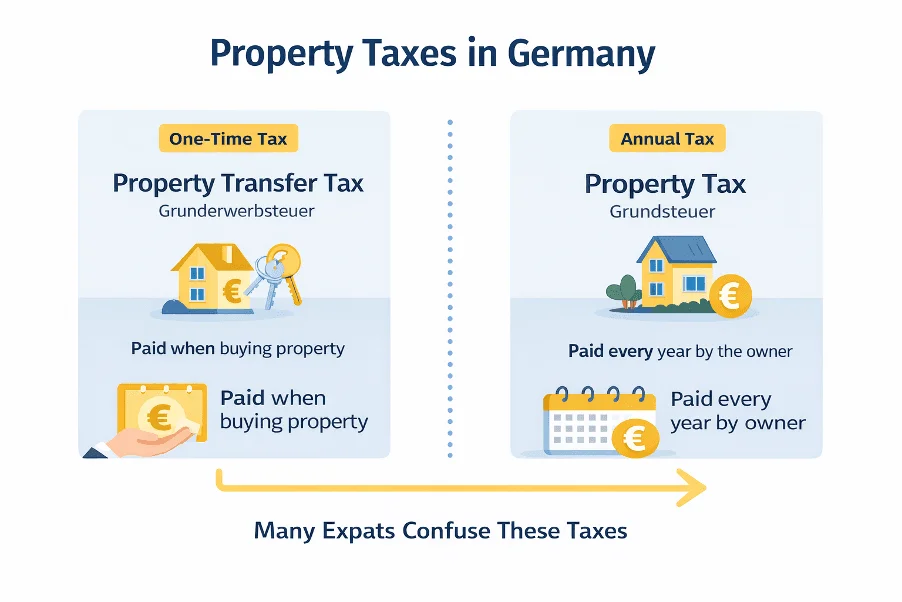
Many expats confuse these two taxes when buying property, leading to surprises in their first year of ownership. While the transfer tax is a significant upfront hurdle, the german property tax is a permanent fixture in your annual household or investment budget.
How Property Tax Germany Is Calculated
If you are trying to figure out "Wie Grundsteuer berechnen", you will find that the system is structured around three specific components. To answer the question of "Wie viel Grundsteuer muss ich bezahlen", one must look at the following formula:
- Assessed Property Value: This is the value of the property as determined by the tax office.
- Tax Rate: A basic tax rate defined by federal law, which depends on the type of property.
- Municipal Multiplier: This is a local multiplier set by local authorities.
The property taxes in Germany differ between municipalities primarily because of the local multiplier. For example, a property in a major city might have a much higher multiplier than a similar property in a rural village, leading to a higher total tax bill. For those looking for a quick estimate, using a german property tax calculator is the best way to get an approximation for planning purposes.
When evaluating a potential purchase, you should also consult a Property Investment Calculator to see how these taxes fit into the broader context of maintenance, interest, and potential rental income.
Property Tax Germany Calculator
Users enter estimated property value and location. The calculator estimates annual property tax in Germany. The result is only an approximation for planning purposes.
Property Tax in Major German Cities
Location is the most significant factor in determining your annual tax burden. Because each municipality has the power to set its own multiplier, property tax in Berlin can differ significantly from the rates in Munich, Hamburg, or Frankfurt.
The Berlin property market has seen rapid growth, and the local government uses the german property tax to manage its massive infrastructure needs. Generally, larger cities with high demand for services tend to have higher multipliers. However, because the tax is based on assessed values that have historically been kept quite low, the property tax often remains relatively affordable compared to international standards, even when german property prices are high.
Investors looking at property in Berlin, Munich, Hamburg, or Frankfurt must realize that while german Real Estate prices continue to fluctuate, the tax obligation remains a steady, predictable factor. This is one reason why the german property market should always be assessed through both purchase price and long term ownership costs.
Property Tax Reform and the Grundsteuergesetz
The landscape of property tax in Germany is currently undergoing a major transformation due to the "Grundsteuergesetz Reform". This recent reform of property taxation in Germany was introduced because the previous method of valuation was ruled unconstitutional. The old system relied on property values from decades ago, which no longer reflected the reality of the german property market.
Under the new "Grundsteuergesetz", the system changes property valuation to be more current and fair. As a result, property owners must provide updated property information to the tax authorities. While the goal of the reform is not necessarily to increase the total tax revenue for cities, the distribution will shift, meaning some owners of deutschland grundsteuer may see their bills go up while others see a decrease.
When Property Tax Must Be Paid
Knowing "wann Grundsteuer zahlen" is vital for staying in the good graces of the local tax office. Typically, municipalities issue property tax notices once a year. The typical annual payment schedule usually requires payments in four installments, specifically in February, May, August, and November. Alternatively, owners can often opt to pay the full amount in one lump sum in July.
A common question arises regarding how german property tax payments are handled when buying a property during the year. Legally, the person who owns the property on January 1st is responsible for the entire year's tax. However, in almost all sales contracts in the german property market, the costs are prorated so that the buyer reimburses the seller for the portion of the year they actually own the home.
Property Taxes Compared With Other Real Estate Costs
While property taxes in Germany are an important consideration, they are only one part of the total property ownership costs. When you compare the annual real estate tax to the one time real estate transfer tax, the latter is usually much more expensive in the short term.
Beyond these taxes, owners must also budget for:
- Regular maintenance and repairs.
- Building management fees, especially for apartments.
- Insurance costs.
All of these factors affect property investment profitability. A thorough analysis using a Property Investment Calculator is the only way to ensure that the property tax doesn't eat too far into your margins.
Property Tax in Germany and the German Property Market
The interaction between property tax in Germany and the broader german property market is subtle but significant. High germany real estate prices in cities like Munich often come with higher tax assessments, yet the annual tax remains a small percentage of the total asset value.
Long term investors should analyze property taxes carefully because, unlike mortgage interest which may decrease over time, property tax and other operating costs are subject to inflation and legislative changes. As german property prices have stabilized in recent years, the focus for many has shifted from pure capital appreciation to yield, making every Euro spent on property tax more relevant than ever.
Frequently Asked Questions About the Grundsteuer in Germany
Who must pay property tax in Germany
Every property owner is who is "grundsteuerpflichtig". This rule applies regardless of nationality, meaning expats and foreign investors have the same obligations as German citizens.
How much property tax do you pay in Germany
To determine how much "Grundsteuer" you owe, you must multiply the assessed value by the tax rate and the municipal multiplier. Because multipliers vary, the amount depends heavily on your specific location.
When must property tax be paid in Germany
Owners usually need to know when to pay "Grundsteuer" to avoid penalties. It is typically paid in quarterly installments, though an annual lump sum option exists.
What is the difference between property tax and property transfer tax
The property tax in german is an ongoing annual tax. The transfer tax is a one time fee paid only at the time of purchase.
Can tenants pay property tax in Germany
Yes, in most cases, a landlord can legally include the property tax in the operating costs that are passed on to the tenant.
Understanding the German Grundsteuer Before Buying Property
In summary, mastering the concept of "Grundsteuer" in Germany is a prerequisite for any successful Real Estate venture in this country. While it may seem like a small detail compared to the purchase price, it is a permanent part of your financial landscape.
By understanding the difference between annual property taxes in Germany and the one time purchase taxes, you can build a more robust financial plan. We encourage all readers to analyze these taxes as a core part of their investment planning. If you have further questions about the property tax in germany or need assistance with your search, please visit our contact us page for personalized guidance.